This manual is for ENG FPX 1000 Assessment 1, start to submission. The first graded piece in English Composition usually asks you to take somebody else's published argument apart and show how it works: what it claims, what it offers as support, where it leans on the reader, and where it goes quiet. Analysis rather than agreement is what the criteria buy, so a paper that spends its pages arguing with the author has answered a question nobody asked. The method our tutors follow is below, along with the section order the criteria produce and one annotated excerpt. Rather not write it yourself? A premium original sample built to your own prompt arrives inside 24 to 48 hours, and revisions continue at no charge until the guide is met. Capella's catalog lists the course as ENG-FPX1000, and some courserooms print ENG1000; both point to this same Assessment 1.
One honesty note before the manual: Capella revises courses and scoring guides over time, so always write to the exact scoring guide attached to your assessment in the courseroom. The course identity above is verified on capella.edu; the method and structure below are our tutors' approach to it, not Capella's official rubric text.
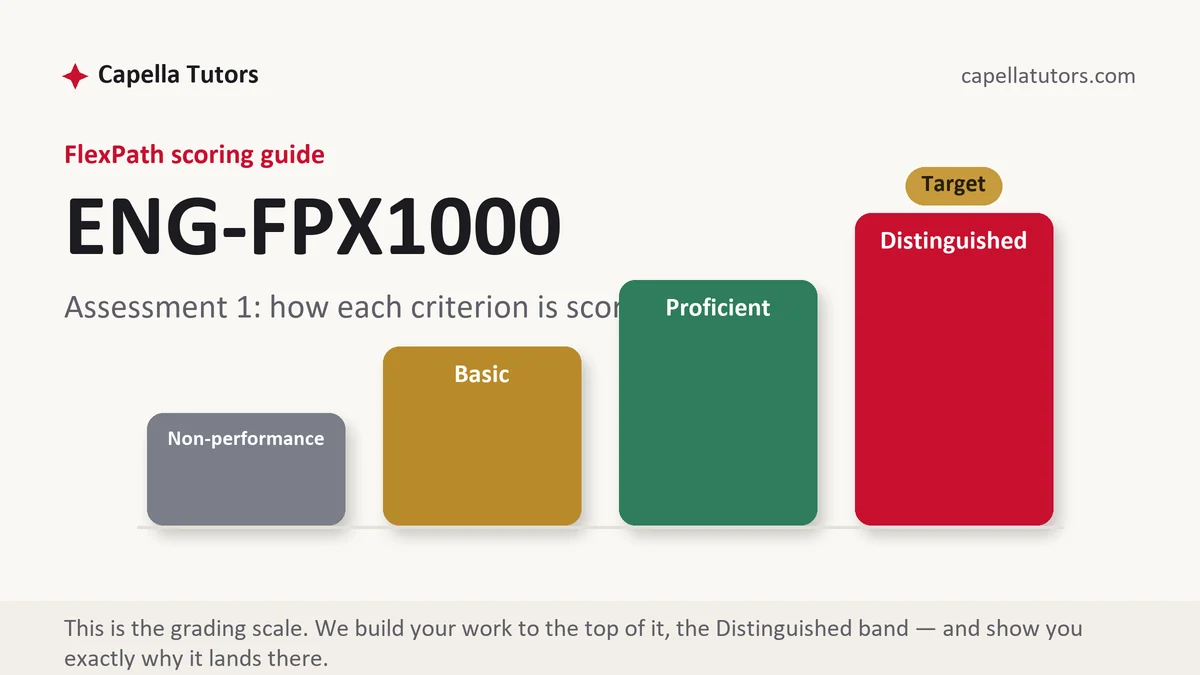
How ENG FPX 1000 Assessment 1 is scored
FlexPath awards no letter grades. Each row of your scoring guide is marked at one of four levels, and the wording inside those rows is the only brief that counts:
| Level | What it means on a rhetorical analysis |
|---|---|
| Distinguished | The claim under examination is stated in the author's terms, individual moves are named and quoted in miniature, the analysis explains the effect of each move rather than labeling it, and one place the argument depends on an unstated assumption is exposed. The extra act sits inside the criterion wording; find it and perform it. |
| Proficient | The argument is described accurately and its main moves are identified with support behind them. Correct work, one step below the column above it. |
| Basic | A summary of what the article says, with a line at the end about whether it was convincing. The most common landing place for a first attempt in this course. |
| Non-performance | A required element never appears, most often the analysis of a specific passage. Absent rather than thin is what puts a row on the floor. |
Composition carries 3 general education points, which makes it easy to treat as a formality. The habits this guide rewards, quoting small and explaining large, are the ones every research course after it assumes you arrived with.
The ENG FPX 1000 Assessment 1 method, step by step
-
Build the outline from the criteria, not from the article
The article supplies the material and the guide supplies the marks. Paste each criterion into an empty file as a heading, put its Distinguished wording underneath in a color you will strip out later, then underline the verb. Identify wants a list, analyze wants an explanation of effect, and evaluate wants stated grounds and a verdict. A paragraph attached to no row cannot raise a score however well it reads.
-
Read the piece three times, once for each question
The first pass answers what the author wants the reader to do. The second marks every place the author offers a reason, a number, a story or an authority, and nothing else. The third reads for the sentences carrying no evidence at all, since those are where the argument is trusting you.
-
Write the claim twice, once in the author's words and once in yours
Copy the sentence where the position is stated, then write your own version underneath with the loaded words removed. If the two disagree about what is being claimed, you have found either a misreading of your own or a vagueness in the original, and both are worth a sentence in the paper.
-
Name each move and quote it small
A move is what a sentence does, not what it says. Three words of quotation inside your own sentence is usually enough: an author who calls a fare increase a modest adjustment has chosen a word that makes the increase sound like maintenance, and saying so is analysis. A block quotation followed by the phrase this shows is the same observation with the work left out.
-
Find the sentence the argument needs you not to examine
Every argument rests on something it does not defend. A piece claiming that higher fares will fund better service assumes the money reaches service rather than debt. State the assumption plainly, say why the author could leave it unstated, and say what happens to the piece if a reader refuses it.
-
Score yourself against the guide, then read it aloud
Mark every criterion N, B, P or D yourself before submitting and give one more pass to anything under D. Then read the whole draft out loud, because the ear finds a comma splice the eye has forgiven three times, and the communication row is scored as tightly as the analysis rows. Submit early in the week, since an attempt can sit with faculty for two business days.
A structure that maps to the criteria
These word counts are planning numbers our tutors use for a short undergraduate analysis, not Capella rules; stretch any row your own scoring guide asks more of.
| Section | What it must do | Guide |
|---|---|---|
| Introduction | Name the piece, its author, where it appeared and the claim it makes, then say what your analysis will show about how it works. | ~150 words |
| The argument in brief | A short neutral account of the position and its main supports, written so a reader who has not seen the article can follow yours. | ~200 words |
| The moves analyzed | Two or three specific techniques, each quoted in a few words and explained for the effect it has on the reader it was written for. | ~400 words |
| The unstated assumption | The thing the argument needs and never defends, located in a particular sentence, with what follows if a reader declines it. | ~250 words |
| What the piece achieves | Your judgment of how well the argument works for its audience, tied to the analysis rather than to whether you agree with it. | ~180 words |
| References | The article itself and anything else you cite, in current APA, with citations and entries accounting for each other. | as needed |
Annotated sample excerpt
An original model opening from our team, pitched at the register the top of the guide describes. Treat it as study material: take the moves, then build the version your own article needs.
Rowan Delgado's opinion piece in the Rockford Register asks readers to accept a forty cent bus fare increase, and it never once uses the word increase in its opening two paragraphs.1 The argument runs on a single comparison, setting the fare against the price of a cup of coffee, which turns a recurring expense into a discretionary one and quietly moves the decision away from riders who make the trip twice a day.2 This analysis examines that comparison, the appeal to civic obligation built on top of it, and the assumption the piece depends on and never defends, which is that the additional revenue reaches service rather than existing debt.3
- 1The subject arrives with an author, a venue and a claim, and the observation in the second clause is already analysis rather than summary. Nothing in the sentence is throat-clearing.
- 2One move is named, quoted in miniature and explained for its effect on a particular reader. Explaining the effect is what separates the two middle columns.
- 3The paper announces the two moves it will handle and the assumption it will expose, so every later section arrives expected rather than discovered.
The full premium sample for your exact assessment, written fresh to your scoring guide and issue, is free to request. Study it, revise it into your own voice, and submit work you understand.
The five mistakes that cost Distinguished
- Summary wearing an analysis title. A faithful account of what the article says, with no account of how it works, answers the reading comprehension question this assessment did not ask.
- Arguing with the author instead of examining them. Your own position on bus fares is not the subject, and a paper that takes sides loses the rows that pay for analysis.
- Labels used as explanations. Naming a technique and stopping there leaves the effect undescribed, which is the part the criterion was written for.
- Block quotations doing the writing. A long quotation followed by this shows hands the analysis back to the author, and the paragraph has spent its space without earning anything.
- An assumption asserted rather than located. Saying the piece is biased is a verdict; pointing at the sentence that needs a reader's agreement and never asks for it is the evidence.
Pre-submission checklist
- Every criterion has its own labeled section, and the verb inside it is answered
- The author's claim appears in their words and in yours, and the two agree
- At least two moves named, quoted in a few words, and explained for effect
- One unstated assumption located in a specific sentence and tested
- No paragraph argues for or against the article's position on its own account
- Citations and entries account for each other, current APA, self-scored D throughout
Want the first composition paper handled with backup?
Send the prompt, the scoring guide and the article you were assigned. A team of eight, including a research analyst and two QA reviewers, returns a premium original sample written to the Distinguished column in 24 to 48 hours, with revisions until the guide is satisfied and faculty comments handled free in the same cycle.