Pass over the prompt with your scoring guide attached and an original premium sample lands within 24 to 48 hours, pitched at the Distinguished wording in your rubric, with every figure recalculated by a second reader before it goes out. The course is recorded as ECO FPX 1150, Personal Economics: Introduction to Financial Planning, worth 3 points, one of the Social Science choices in Capella's FlexPath general education menu. The menu requires at least 22.5 points with a floor of 2 points in each of its four categories, so this is one route into the social science requirement rather than a fixed part of any degree. In Capella's catalog the course code is written ECO-FPX1150.
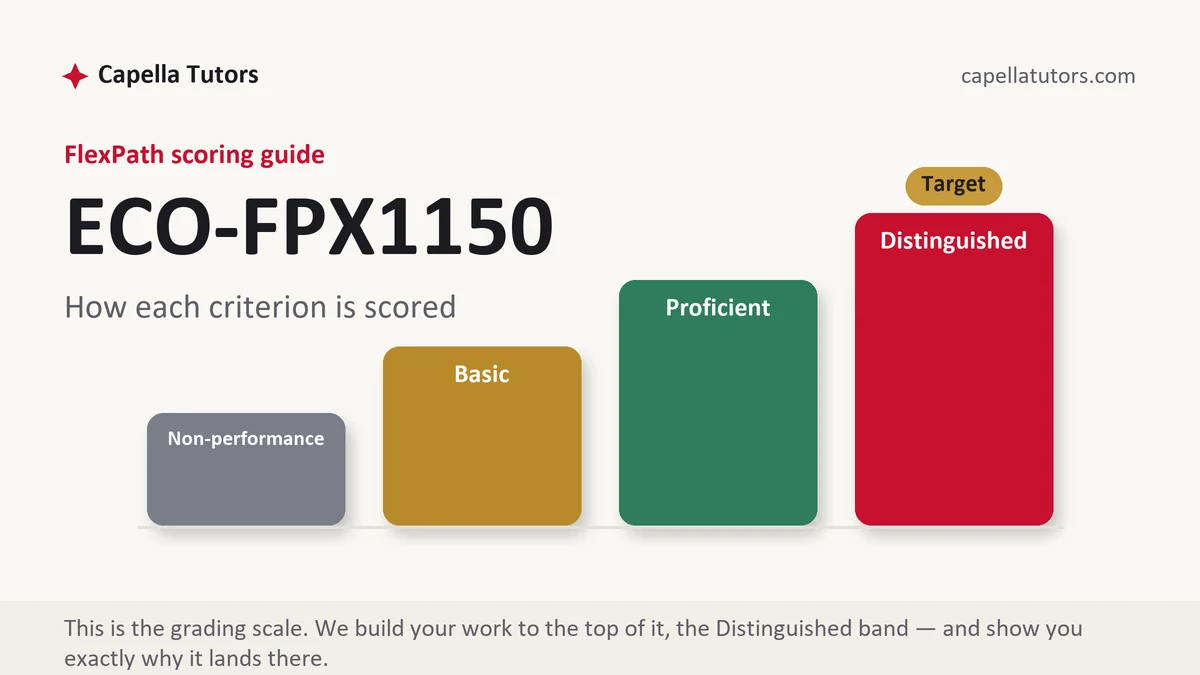
What ECO FPX 1150 actually grades
This is an arithmetic course dressed as a planning course, and the criteria are unusually literal about it. The assessments in this course usually ask you to build a personal budget, work out what a decision costs, and defend a plan with the numbers visible on the page. A response explaining why saving matters and recommending that you spend less than you earn has said something true and unscoreable. The column above it produces a budget that balances, classifies each line correctly, calculates a figure that was not handed to you, and states what the household would have to change for the plan to hold.
Start with the structure the criteria expect, which is income after tax set against expenses grouped by behavior. Take a monthly take-home figure of $3,480. Fixed obligations might run to rent at $1,150, a car payment at $310, insurance at $140, a phone plan at $65, and a student loan payment at $220, which is $1,885 arriving at the same size every month. Variable spending might be groceries at $460, fuel at $190, utilities at $180, and subscriptions at $48, another $878. Total outflow is $2,763 and the gap is $717. That gap is the whole paper: it is what a savings rate is calculated from, what an emergency fund is built out of, and what has to move if a goal is to arrive sooner. A budget leaving the gap uncalculated has not been used for anything.
The second graded strand is what money does over time, and it comes down to two calculations students routinely get wrong. The first is interest on debt. A balance of $4,200 on a card at 22.9 percent annual rate accrues at roughly 1.9083 percent a month, which is $80.15 in the first month alone, so a $150 payment removes only $69.85 of principal and the balance takes something over three years and roughly $1,860 in interest to clear. Raise the payment to $350 and the same balance is gone in fourteen payments for about $616. The second calculation runs the other way. Two hundred dollars a month into an account assumed to return 6 percent a year, compounded monthly, is $72,000 of contributions over thirty years and a balance near $200,900, and the distance between those two figures is the argument the course is making. Label the assumed return as an assumption every time, because an unlabeled projection is the error that costs a criterion.
How we help in this course
Our 1150 samples arrive with the arithmetic done and shown. Give us the income figure, the expense lines, the debts with their rates, and whatever goal your prompt names, and the draft returns with a budget that balances to the cent, a savings rate expressed against a stated base, interest calculated month by month where the prompt asks for it, and every assumption written where it is used rather than buried at the end. If you would rather the numbers were invented, we will build a household that behaves like a real one, internally consistent and labeled as constructed.
Our terms do not change because the subject is money. The draft returns in 24 to 48 hours, aimed at Distinguished, after eight people have worked it, and in this course one of those passes is spent entirely on arithmetic, recalculating every figure and confirming that the totals in the narrative agree with the totals in the table. Revisions stay free until the guide is cleared, and faculty comments are reworked at no cost.
The assessments, one by one
Assessment 1
An opening assessment in a personal finance course usually asks you to build a budget and use it for something. Read the full Assessment 1 manual.
Assessment 2
A middle assessment in a personal finance course usually turns to debt, where the arithmetic is unforgiving and the recommendation has to follow from it. Read the full Assessment 2 manual.
Assessment 3
A closing assessment in a personal finance course usually asks you to turn a plan into dated goals and defend the trade-offs that fund them. Read the full Assessment 3 manual.
How to actually write ECO FPX 1150: where to begin
Turn the scoring guide into headings first, then settle the numbers before you write any prose, because prose written around unsettled figures has to be rewritten when they move. Build the budget in a spreadsheet, get it to balance, and only then start the document. Financial planning rows almost always pair a calculation with an interpretation, something like calculate and evaluate, or develop and justify, and the interpretation is where a paper full of correct arithmetic still loses marks by stopping at the total.
Then get the classification right, because two different distinctions get confused and both are graded. Fixed against variable is about whether the amount changes with your behavior: rent is fixed, groceries are variable, and a car payment is fixed even though you chose to take it on. Needs against wants is a judgment about priority, defensible only if you state the standard you used. Transport to work is a need; a specific vehicle at $310 a month may not be, and the honest version of that line says the need is transport, the current solution costs $310, and a cheaper solution exists at some cost in time. Writing the distinction that way turns a classification exercise into the analysis the criterion wants.
Then give every goal a number and a date and show the division. An emergency fund covering three months of essential spending, where essential means the $2,715 left once subscriptions come out, is $8,145, and at $400 a month that is twenty-one months, which may be too slow for the household in your case. Say so, then show the alternative: raising the contribution to $600 gets there in fourteen months and takes the money from somewhere you have to name. Opportunity cost is the concept the course wants used here, and it is only visible when both sides carry a figure. That $48 of subscriptions is $576 a year, and redirected under the same 6 percent assumption for thirty years it is roughly $48,200, which does more persuasive work than any paragraph about discipline.
| Section | What goes in it | What Distinguished looks like |
|---|---|---|
| Income | Take-home pay after tax and deductions, with the period stated and any variability described. | Net rather than gross, with irregular income averaged over a named number of months. |
| Expenses | Every outflow, grouped fixed and variable, each line sourced from a statement or labeled an estimate. | Lines that sum to the stated total, estimates flagged, and a category for irregular annual costs. |
| The gap | Income minus outflow, expressed in dollars and as a percentage of take-home pay. | A savings rate with its base named, reconciled against what actually accumulated. |
| Debt | Each balance with its rate, its minimum payment, and the interest it generates in a month. | A repayment order defended by rate or by balance, with the total interest of each route compared. |
| Goals | Each goal with a dollar amount, a date, and the monthly contribution the two of them imply. | The division shown, the shortfall named, and the trade-off that closes it identified by line. |
| Assumptions and sources | Rates, returns, inflation, and benchmark figures, each with a source and a date. | Assumed returns labeled as assumptions and benchmarks cited to federal data rather than to a blog. |
Developing the analysis
Personal finance advice does not agree with itself, and a criterion asking you to justify a plan is asking which side you are on and why. Debt repayment is the clean example. Ordering debts by interest rate, highest first, minimizes total interest and is what the arithmetic recommends without qualification. Ordering them by balance, smallest first, costs more in interest and has behavioral research behind it suggesting that people who watch an account close are likelier to keep going. On the $4,200 card plus a $900 store card at 26 percent and a $6,800 loan at 7 percent, the two methods produce different sequences and a difference in total interest you can calculate for the household in your case. That calculation, followed by a recommendation naming which failure the household is more at risk of, running out of patience or running out of money, is what a justification row describes. The same structure works on renting against buying: compute both, state the assumption that decides it, and say what would have to be true for the other answer to win.
Citations that survive faculty review
Personal finance is the discipline where the internet is least trustworthy and the free official sources are best, so the reference list is easy to get right and revealing when it is wrong. The Consumer Financial Protection Bureau publishes plain explanations of credit, mortgages, and student loans that are neither selling anything nor out of date, and it is the right citation for how a product works. Federal statistical sources carry the benchmarks: the Bureau of Labor Statistics Consumer Expenditure Survey for what households spend by category, the Federal Reserve's Survey of Consumer Finances for balances and net worth, and the Bureau of Economic Analysis for the personal saving rate. Program and tax facts come from the agency that administers them, so the Internal Revenue Service for contribution limits and the Social Security Administration for benefit rules. Peer-reviewed work in financial planning and consumer economics carries any claim about behavior. A bank page is acceptable for one thing only, a current rate cited with the date you retrieved it.
The mistakes that land Basic instead of Distinguished
- A budget that does not add up. A total disagreeing with its lines invalidates every conclusion drawn from it.
- An annual percentage rate used as a monthly one. Dividing by twelve is the step, and skipping it overstates the interest twelvefold.
- A percentage with no base. Saving twenty percent means one thing against take-home pay and another against gross.
- Goals with no date. A plan to save for a house is an intention until the amount, the date, and the monthly figure appear together.
- Gross income used for planning. Money that never arrives cannot be budgeted, and using the salary instead of the deposit is the commonest structural error here.
ECO FPX 1150 questions students actually ask
Do I have to use my own real income and expenses?
Check the prompt, because some assessments require your own figures and others let you build a household. Either works, and what matters is internal consistency rather than authenticity. If you use real figures and would rather not share them, scale every line by the same factor and say in one sentence that the amounts have been adjusted proportionally, which preserves every ratio the analysis depends on. If you construct a household, anchor it to something real: pick an occupation, take a median wage figure from the Bureau of Labor Statistics for that occupation and area, estimate the deductions to reach a take-home figure, and use the Consumer Expenditure Survey for category ranges. A budget built that way is more defensible than a real one presented with no account of where the numbers came from.
How do I show interest calculations without a finance background?
Do one month by hand and let the pattern carry the rest. Divide the annual rate by twelve to get the monthly rate, multiply it by the current balance for that month's interest, subtract the interest from your payment to see what actually came off the principal, and subtract that from the balance. Write those four steps out for the first month, then use a spreadsheet for the remaining months and report the total interest and the number of payments. Showing the first month long-hand demonstrates that you understand what the tool did, and a criterion measuring calculation accepts a spreadsheet result far more readily when the method sits beside it.
How precise do the numbers need to be?
Precise enough to add up and consistent everywhere they appear, which is a stricter test than accuracy. Round to the dollar for budget lines and to the cent for interest, then verify that every total in the narrative matches the corresponding total in the table, because a figure appearing as $717 in one place and $720 in another tells the reader to check everything else. Where a number is estimated, say so in the sentence that uses it and keep the same estimate throughout. Where it is projected, name the assumption that produced it and reuse that assumption everywhere. Evaluators here are not looking for financial expertise, they are looking for arithmetic that survives being checked.
Budget assessment due?
Send the prompt, the criteria, and whatever figures you are working from. The sample comes back with a budget that balances and every calculation shown. Nothing is charged for the first premium sample.