This manual is for ECO FPX 1150 Assessment 1, start to submission. An opening assessment in a personal finance course usually asks you to build a budget and use it for something. The assessment usually wants income after tax set against expenses grouped by behavior, a gap calculated rather than described, and a conclusion the arithmetic actually supports. Your scoring guide decides whether the figures are your own or constructed. Or hand it to us: a premium original sample with a budget that balances to the cent arrives inside 24 to 48 hours, revised free until every criterion clears. Capella's catalog lists the course as ECO-FPX1150, and some courserooms print ECO1150; both point to this same Assessment 1.
One honesty note before the manual: Capella revises courses and scoring guides over time, so always write to the exact scoring guide attached to your assessment in the courseroom. The course identity above is verified on capella.edu; the method and structure below are our tutors' approach to it, not Capella's official rubric text.
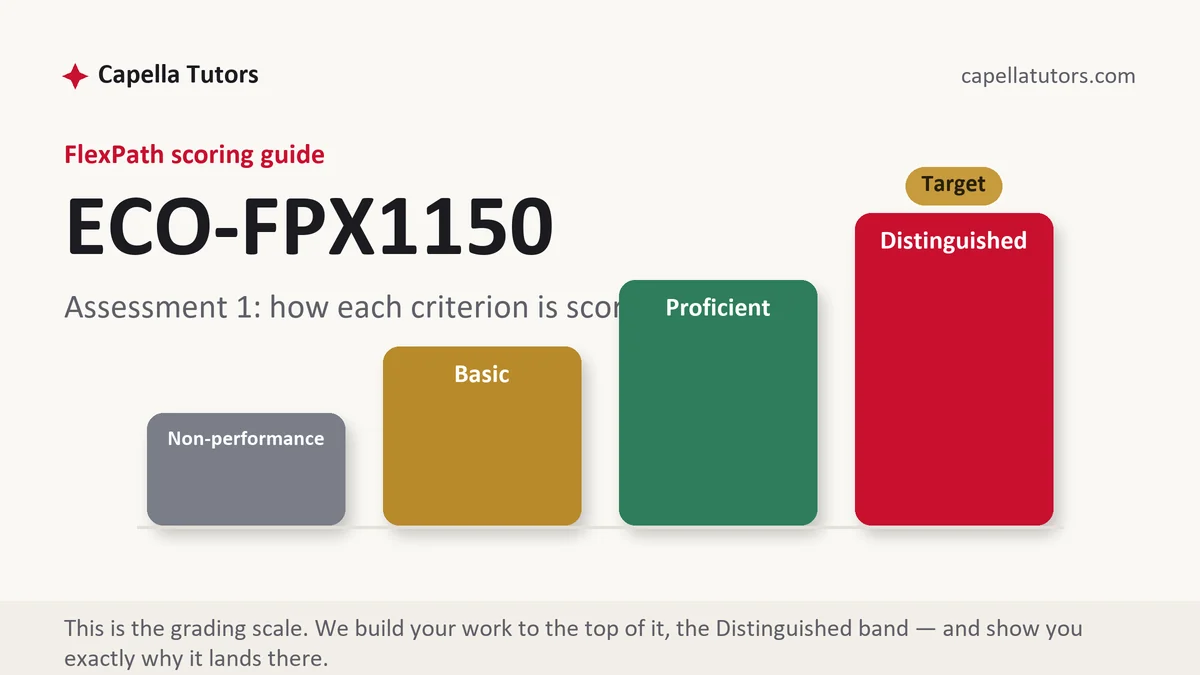
How ECO FPX 1150 Assessment 1 is scored
Grading runs row by row in FlexPath and no letter is attached to the result. Each row comes to rest on one of four levels, and that wording is what you are writing toward:
| Level | What it means on a budget and gap deliverable |
|---|---|
| Distinguished | A budget that balances to the cent, a gap expressed in dollars and as a percentage of a stated base, and the change the household would have to make for the plan to hold. |
| Proficient | A complete and accurate budget with a sensible interpretation attached. |
| Basic | A correct list of income and expenses with the totals left to speak for themselves. The commonest outcome on a first budget attempt. |
| Non-performance | A required element absent, most often the calculation the row asked for. |
This is an arithmetic course wearing a planning name. Saving matters and spend less than you earn are both true and neither is scoreable. The columns pay for a figure that was not handed to you, a classification you can defend, and a total that agrees with itself everywhere it appears.
The ECO FPX 1150 Assessment 1 method, step by step
-
Settle the numbers before you write any prose
Prose written around unsettled figures has to be rewritten when they move. Build the budget in a spreadsheet, get it to balance, and only then open the document. Financial planning rows usually pair a calculation with an interpretation, and the interpretation is where a paper full of correct arithmetic still stops short.
-
Use net income, and average it if it is irregular
Money that never arrives cannot be budgeted, so the figure is the deposit rather than the salary. Where income is seasonal or variable, average it over a named number of months and say which months you used, because an unnamed averaging period is an assumption the reader cannot check.
-
Group expenses by behavior, not by feeling
Fixed against variable is about whether the amount moves when you do: rent is fixed, groceries are variable, and a car payment is fixed even though you chose to take it on. Needs against wants is a separate judgment, defensible only where you state the standard you used, and the two distinctions get confused in most drafts.
-
Calculate the gap and give it a base
Income minus outflow, in dollars, then as a percentage of take-home pay with the base named in the sentence. A savings rate of twenty percent means one thing against net pay and another against gross, and a percentage with no base is the single most common way a criterion is lost here.
-
Make the gap do work
The gap is what an emergency fund is built out of, what a goal is funded from and what has to move if the plan changes. A budget that stops at the total has not been used for anything, and the row asking you to evaluate a plan is asking what the number implies.
-
Reconcile every total, then self-score
Round budget lines to the dollar and interest to the cent, then confirm each total in the narrative matches the corresponding total in the table, because a figure appearing as one number in one place and another elsewhere tells a reader to check everything. Then grade each criterion yourself and submit early, since faculty have up to two business days.
A structure that maps to the criteria
Word counts are our tutors' planning targets for a budget deliverable, not Capella rules; wherever your scoring guide asks for more, give it more.
| Section | What it must do | Guide |
|---|---|---|
| Income | Take-home pay after tax and deductions, with the period stated and any variability described and averaged. | ~180 words |
| Expenses | Each payment out, sorted into fixed and variable, with a statement behind it or the word estimate beside it. | ~250 words |
| The gap | Income minus outflow in dollars and as a percentage of a named base, reconciled against what accumulated. | ~230 words |
| What the gap has to cover | Reserves, irregular annual costs and any month where income does not arrive, each with a figure. | ~280 words |
| The plan and its condition | What the household does with the gap, and the single change that would break the plan. | ~200 words |
| Assumptions and sources | Rates, benchmarks and estimates, each with a source and a date, in current APA. | as needed |
Annotated sample excerpt
A model excerpt from our team, showing four figures that reconcile with one another. Read it for the arithmetic, then rebuild it with the figures your own prompt gives you.
Pay arrives in ten months rather than twelve, at $2,940 net a month, which is $29,400 a year and $2,450 a month averaged across the whole year, and the averaged figure is the one the plan has to be built on.1 Level monthly spending comes to $2,308, made up of $1,503 in fixed obligations and $805 in variable lines, so each paid month leaves $632 and the twelve-month surplus is $1,704, or $142 a month against a base of $2,450 net, which is a savings rate of 5.8 percent.2 The plan is not the surplus, it is the reservation: two unpaid months cost $4,616 at level spending, so $461.60 has to be held back from each of the ten paychecks, which leaves $170.40 a month of genuinely free cash and makes the summer a scheduling problem rather than a crisis.3
- 1States the pay pattern, the net figure, the annual total and the averaged monthly figure, then says which one the plan uses. Naming the averaging basis is what makes every later number checkable.
- 2Shows both expense groups, the per-paid-month remainder, the annual surplus and the rate with its base attached. Four figures that reconcile with each other are worth more than any paragraph about discipline.
- 3Converts the surplus into a reservation with a monthly amount, then states what is actually left. Turning a total into an instruction is the move the top column describes.
The full premium sample for your exact assessment, written fresh to your scoring guide and issue, is free to request. Study it, revise it into your own voice, and submit work you understand.
The five mistakes that cost Distinguished
- A budget whose lines do not sum to its totals. A total disagreeing with its lines invalidates every conclusion drawn from it, and it is the first thing checked.
- Gross pay used as the planning figure. The salary is not the deposit, and building a plan on money that never arrives is the commonest structural error here.
- A percentage with no base named. Twenty percent of take-home pay and twenty percent of gross are different plans, and the sentence has to say which.
- Irregular income averaged over an unnamed period. The number of months is the assumption doing the work, and leaving it out makes the average unverifiable.
- A gap calculated and never used. The row asking you to evaluate a plan is asking what the surplus is for, and a total with no destination answers it with silence.
Pre-submission checklist
- Every criterion has its own labeled section and its own calculation
- Income is net, and any averaging period is named in the sentence
- Expense lines are grouped by behavior and sum to the stated totals
- The gap appears in dollars and as a percentage of a named base
- The gap is assigned to reserves, irregular costs or a dated goal
- Every total in the prose matches the table, APA matched both ways
Budget assessment due and the totals will not agree?
Send the prompt, the criteria and whatever figures you are working from, or ask us to construct a household that behaves like a real one. One pass on this course is spent entirely on arithmetic, recalculating every figure and confirming the narrative matches the table. Returned inside 24 to 48 hours, and reworked at no charge until every row is where it needs to be.