This manual is for ECO FPX 1150 Assessment 3, start to submission. A closing assessment in a personal finance course usually asks you to turn a plan into dated goals and defend the trade-offs that fund them. The assessment usually wants each goal carrying an amount, a date and the monthly figure the two of them imply, plus the line the money comes out of. If you would rather not do the arithmetic, a premium original sample dividing every goal and closing the shortfall comes back inside 24 to 48 hours, revised free. Capella's catalog lists the course as ECO-FPX1150, and some courserooms print ECO1150; both point to this same Assessment 3.
One honesty note before the manual: Capella revises courses and scoring guides over time, so always write to the exact scoring guide attached to your assessment in the courseroom. The course identity above is verified on capella.edu; the method and structure below are our tutors' approach to it, not Capella's official rubric text.
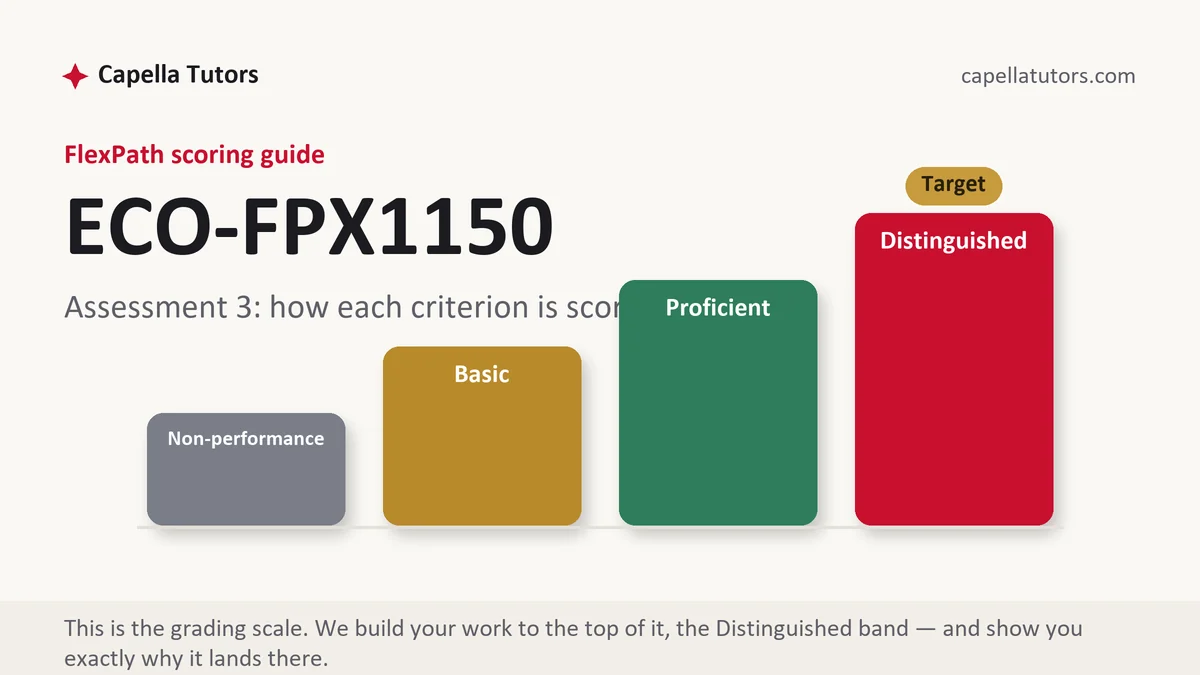
How ECO FPX 1150 Assessment 3 is scored
Criteria are graded one at a time on a four-level scale, and the level language is the specification:
| Level | What it means on a goal and trade-off analysis |
|---|---|
| Distinguished | Each goal divided into a monthly figure, the shortfall named, and the trade-off that closes it identified by line with its own long-run cost shown. |
| Proficient | Goals costed and funded from a plan that balances. |
| Basic | Goals listed with intentions attached and no division shown. The classic middle-column goals paper. |
| Non-performance | A required element absent, most often the amount or the date. |
A goal with no date is an intention, and an intention cannot be graded. The amount, the date and the monthly figure have to appear in the same place, because the division is what turns a wish into something a reader can check against the budget above it.
The ECO FPX 1150 Assessment 3 method, step by step
-
Turn the criteria into headings and list the goals the prompt requires
Some guides specify short, medium and long horizons, others leave the choice open. Read the row rather than assuming, because a paper with three goals where one was wanted usually gives all three the same thin treatment.
-
Give every goal an amount, a date and a division
Write the target, the deadline and the amount divided by the months between now and then. Then check the monthly figure against the gap in your budget, because a goal that needs more than the budget produces is the finding rather than the failure.
-
Name the shortfall instead of adjusting the goal quietly
Where the monthly figure exceeds the available surplus, say so with the difference in dollars. Then close it deliberately, either by moving the date, reducing the target or naming the budget lines the money will come from. Quietly shrinking the goal until it fits is what the top column is built to detect.
-
Show both sides of every trade-off
Opportunity cost is only visible when both sides carry a figure. A line cut is a dollar amount per month and a dollar amount per year, and the thing given up has to be named. A paragraph about discipline does none of that work.
-
Put a long-run figure on the smallest line
Convert a monthly line into an annual figure, then project it under an assumption you label. That projection is usually the most persuasive sentence in the paper, and it earns nothing at all if the assumed return is presented as a fact.
-
Check consistency, then self-score
Confirm every goal figure reconciles with the budget it came from, that each estimate is used at the same value throughout, and that each assumption appears where it is applied. Then score each row yourself and leave the evaluator's two days room to fit.
A structure that maps to the criteria
Planning targets our tutors use on a goals deliverable, not Capella rules; the guide attached to your assessment governs.
| Section | What it must do | Guide |
|---|---|---|
| The starting position | The surplus available each month, carried forward from the budget, with its base stated. | ~160 words |
| The goals | Each one with an amount, a date and the monthly contribution the division produces. | ~250 words |
| The shortfall | The difference between what the goals need and what the budget produces, in dollars. | ~220 words |
| The trade-offs | The specific lines that close the shortfall, each with a monthly and an annual figure. | ~280 words |
| Long-run cost | One line projected forward under a labeled assumption, so the trade is visible over time. | ~220 words |
| Assumptions and sources | Returns and benchmarks with sources and dates, federal data preferred, current APA. | as needed |
Annotated sample excerpt
An original excerpt from our team showing a trade-off with figures on both sides. Study the pattern, then rebuild it around the goals your own criteria name.
The goal is a $6,000 down payment in 18 months, which divides to $333.33 a month, and the budget above produces $185, so the shortfall is $148.33 a month and it has to come from somewhere named.1 Two lines close it: $52 of streaming and app subscriptions, and $96 of lunches bought at work at roughly $6 on four days a week, which together supply $148 and leave the plan short by 33 cents a month, or $6 over the whole period.2 The subscriptions are the more expensive line than they look, because $52 a month is $624 a year, and $52 a month redirected for ten years at an assumed 6 percent annual return compounded monthly reaches roughly $8,520, an assumption labeled as an assumption because the return is not promised by anybody.3
- 1Divides the goal, sets it against the surplus, and states the shortfall as a figure. The division is the sentence the criterion is looking for and it is the one most drafts leave out.
- 2Closes the shortfall with two named lines and shows the arithmetic of the second, then reports the tiny remaining gap rather than rounding it away. Precision about a 33 cent difference is what tells a reader the rest was checked.
- 3Converts a monthly line to annual, projects it under a stated assumption, and labels the assumption in the same sentence. The projection persuades; the label is what keeps the criterion.
The full premium sample for your exact assessment, written fresh to your scoring guide and issue, is free to request. Study it, revise it into your own voice, and submit work you understand.
The five mistakes that cost Distinguished
- Goals carrying no date. Saving toward a home stays a wish until the target, the deadline and the monthly contribution sit in the same sentence.
- A goal quietly shrunk to fit the budget. Adjusting the target without saying so hides the finding the criterion was asking for.
- Trade-offs with one side costed. Opportunity cost needs a figure on the thing gained and the thing given up, or it is just a preference.
- An assumed return presented as a fact. Any projection carries an assumption, and the word has to appear beside it.
- Estimates that change value between sections. The same figure used at two different amounts tells the reader to verify everything else in the paper.
Pre-submission checklist
- Each goal carries an amount, a date and a monthly division
- The surplus is carried forward from the budget with its base stated
- The shortfall is stated in dollars rather than absorbed
- Each closing trade-off names a line and shows monthly and annual figures
- At least one line is projected forward under a labeled assumption
- Every estimate is used consistently, APA matched both ways, self-scored
Goals section due and the arithmetic will not close?
Send the criteria, the budget you have already built and the goals your prompt names. The draft divides every goal, states the shortfall, closes it line by line and projects the smallest line forward under a labeled assumption. Back in 24 to 48 hours, revised free until every row clears.