This manual is for ECO FPX 1150 Assessment 2, start to submission. A middle assessment in a personal finance course usually turns to debt, where the arithmetic is unforgiving and the recommendation has to follow from it. The assessment usually asks you to calculate what a balance actually costs, compare at least two ways of dealing with it, and justify a choice with the totals visible. Delegating is straightforward, and a premium original sample showing the interest month by month returns inside 24 to 48 hours, with revision included until the rows are satisfied. Capella's catalog lists the course as ECO-FPX1150, and some courserooms print ECO1150; both point to this same Assessment 2.
One honesty note before the manual: Capella revises courses and scoring guides over time, so always write to the exact scoring guide attached to your assessment in the courseroom. The course identity above is verified on capella.edu; the method and structure below are our tutors' approach to it, not Capella's official rubric text.
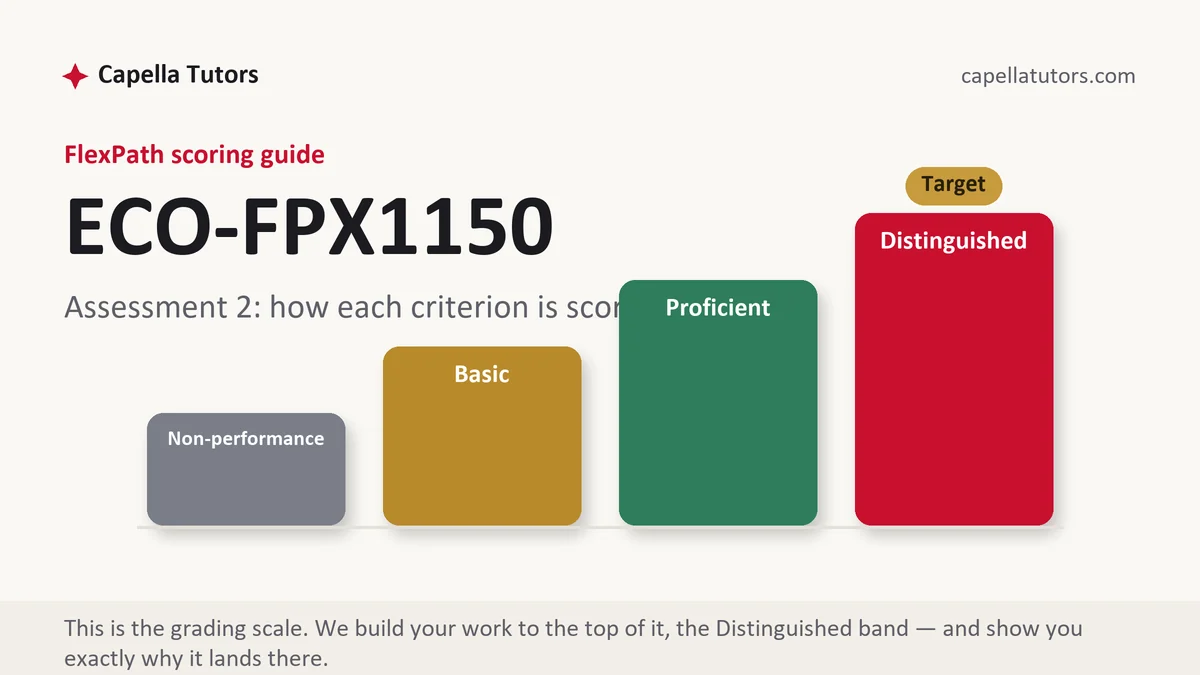
How ECO FPX 1150 Assessment 2 is scored
Each criterion is scored on its own at one of four levels, and the level wording tells you what to produce:
| Level | What it means on a debt analysis |
|---|---|
| Distinguished | The monthly arithmetic shown for at least one period, two routes compared on total interest and total months, and a recommendation naming which failure the household is more exposed to. |
| Proficient | Interest calculated correctly and a defensible repayment route chosen. |
| Basic | Balances and rates listed with advice to pay more than the minimum. Where a first attempt at debt arithmetic usually lands. |
| Non-performance | A required element absent, most often the calculation itself. |
Two errors account for most of the lost marks in this material. An annual rate used as a monthly one overstates the interest twelvefold, and a projection presented without its assumption looks like a fact. Both are avoidable in a single line of writing, and both are checked.
The ECO FPX 1150 Assessment 2 method, step by step
-
Build headings from the criteria and list what has to be computed
Write down each figure the guide requires before you calculate anything: monthly interest, months to clear, total interest, the comparison. A row asking you to calculate and evaluate owes both, and papers here more often lose the second than the first.
-
Convert the rate before you use it
Divide the annual rate by twelve to get the monthly rate and write the converted figure into the paper. This is the single step that separates a correct answer from one that is wrong by an order of magnitude, and showing it costs one clause.
-
Work the first month long-hand
Multiply the monthly rate by the current balance for that month's interest, subtract the interest from the payment to see what came off the principal, and subtract that from the balance. Write those four steps out once, then use a spreadsheet for the rest. A criterion measuring calculation accepts a spreadsheet result far more readily when the method sits beside it.
-
Compare routes on both totals
Report total interest and total months for each option, not one or the other, because a route that saves interest and extends the term is a different trade from one that does both. Where a fee or a credit check is involved, put it in the comparison as a figure rather than as a caution.
-
Recommend by naming the risk, not the arithmetic
Ordering debts by rate minimizes interest, and ordering by balance has behavioral research behind it. Both are defensible, so the recommendation should say which failure this household is more exposed to, running out of money or running out of patience. That sentence is what a justification row is describing.
-
Label every assumption, then self-score
An assumed rate, an assumed fee and an assumed constant payment are all assumptions, and each is labeled where it is used rather than collected at the end. Then read the guide row by row, mark your own levels, and submit early enough to absorb a two-business-day review.
A structure that maps to the criteria
These are our tutors' planning targets for a debt deliverable, not Capella requirements; your scoring guide decides where the length goes.
| Section | What it must do | Guide |
|---|---|---|
| The debt as it stands | Each balance with its annual rate, its current payment and the months remaining. | ~170 words |
| Rate conversion and one month | The monthly rate derived, and the first month worked interest, principal and closing balance. | ~230 words |
| Route one | The first option carried to completion, with total interest, total months and any fee. | ~250 words |
| Route two | The second option on the same basis, so the two can be set beside each other. | ~250 words |
| Comparison and recommendation | Both totals side by side, the choice made, and the risk that decided it. | ~230 words |
| Assumptions and sources | Rates and fees with the date retrieved, plus federal consumer sources, in current APA. | as needed |
Annotated sample excerpt
A model excerpt from our team showing what worked arithmetic looks like on the page. Learn the sequence, then run it on the balances your own prompt supplies.
The balance is $11,400 at 9.4 percent a year, which is 0.7833 percent a month, so the first month generates $89.30 of interest and the $365 payment removes $275.70 of principal, leaving $11,124.30.1 Run to completion on that schedule the loan takes 36 payments and costs $1,740 in interest, while a refinance at 6.9 percent over the same 36 months lowers the payment to about $351.50 and the total interest to about $1,254, a difference of $486 before the lender fee.2 At a $175 fee the refinance still wins by $311 and lowers the monthly obligation by $13.50, whereas adding $60 a month to the existing loan clears it in 31 payments for roughly $1,440 without a credit application, so the recommendation depends on which the household is short of, cash flow or paperwork tolerance, and this household has said it is short of the first.3
- 1Converts the annual rate, states the converted figure, and then runs all four steps of the first month with a closing balance. Every number here can be checked with a calculator, which is the point.
- 2Reports total interest and total months for both routes on the same basis, and holds the fee back so the comparison stays clean before it is applied.
- 3Applies the fee, gives a third route, and then decides by naming what the household is actually short of. Choosing on a stated constraint rather than on the lowest number is the top-column move.
The full premium sample for your exact assessment, written fresh to your scoring guide and issue, is free to request. Study it, revise it into your own voice, and submit work you understand.
The five mistakes that cost Distinguished
- An annual rate applied as a monthly one. Dividing by twelve is the step, and skipping it overstates the interest twelvefold in every line that follows.
- Only the answer presented. A total with no method beside it asks the evaluator to trust a spreadsheet they cannot see, and the calculation row is scored on the working.
- Interest compared and months ignored. A route that saves interest by extending the term is a different trade, and reporting one total hides it.
- A fee mentioned as a caution. Costs belong in the comparison as figures, because a caution changes no total and a number does.
- A projected return left unlabeled. An assumed rate presented without the word assumption reads as a fact, and it is the error that costs this criterion most often.
Pre-submission checklist
- Every figure the criteria require is computed and labeled
- The monthly rate is derived and written into the paper
- One month is worked long-hand with interest, principal and closing balance
- Both routes report total interest and total months
- The recommendation names the constraint that decided it
- Assumptions labeled where used, sources dated, APA matched both ways
Debt analysis due and the interest will not reconcile?
Send the criteria and the balances, rates and payments you are working with. The draft converts the rate, works the first month long-hand, carries both routes to completion and recommends on a stated constraint. A dedicated pass recalculates every figure. Delivered in 24 to 48 hours, revised free until it clears.