How to write DB-FPX8400 Assessment 2

The short answer

This manual is for DB-FPX8400 Assessment 2, start to submission. The middle deliverable of the opening core course usually moves from your candidate problem to the evidence around it: a search somebody else could repeat, empirical studies appraised by design rather than by conclusion, and a defensible statement of what that body of work can and cannot support at your site. Doctoral readers treat the appraisal as the graded object and the summary as the by-product. What follows is the method our doctoral desk uses, the shape the document takes, and an annotated excerpt. Rather delegate it? A premium original sample built to your own scoring guide returns inside 24 to 48 hours, with rewrites at no charge until every criterion is satisfied. Your courseroom may print this as DB FPX 8400 Assessment 2 or DB8400 Assessment 2; it is the same deliverable, and DB-FPX8400 Assessment 2 is what this manual walks through.

One honesty note before the manual: Capella revises courses and scoring guides over time, so always write to the exact scoring guide attached to your assessment in the courseroom. The course identity above is verified on capella.edu; the method and structure below are our tutors' approach to it, not Capella's official rubric text.
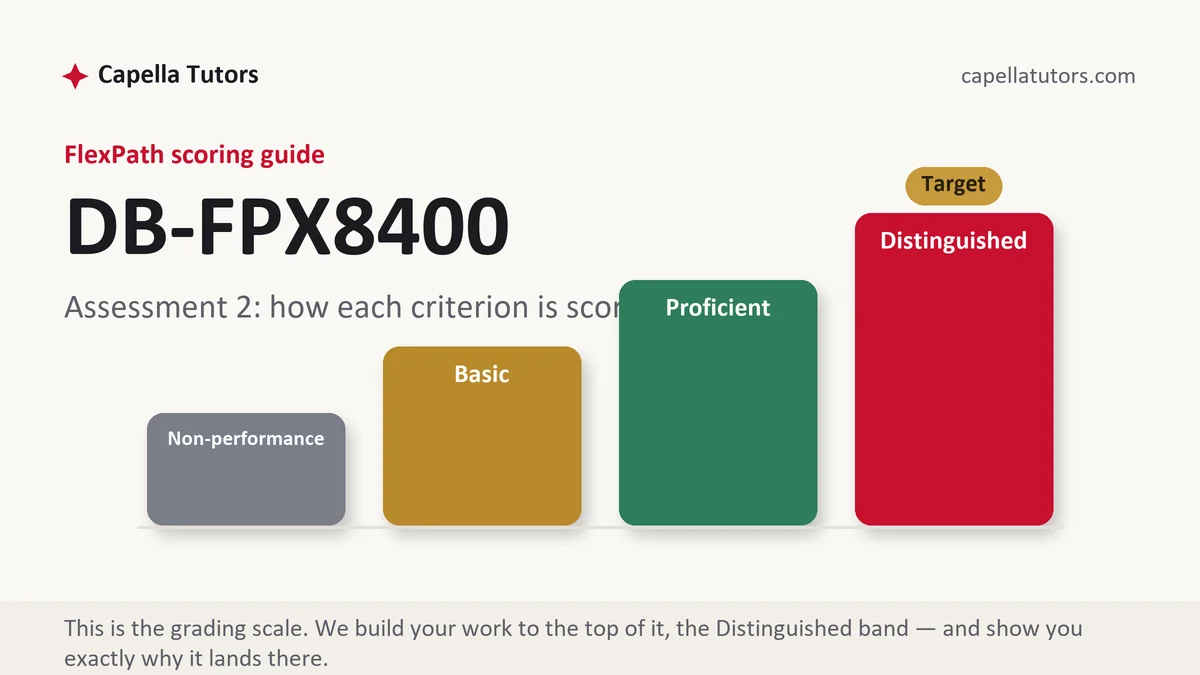
DB-FPX8400 Assessment 2 grading scale at Capella FlexPath, the criterion levels this assessment is scored on, from Capella Tutors
How Capella FlexPath grades DB-FPX8400 Assessment 2, visualized by Capella Tutors.

How DB-FPX8400 Assessment 2 is scored

There is no curve and no letter grade in FlexPath. Every criterion lands on one of four levels, and the words inside those levels are your brief:

LevelWhat it means on an evidence and literature deliverable
DistinguishedThe search is reproducible from the page, studies are weighed against each other by design and sample, the strongest and weakest links in the chain are labeled as such, and the writing says which mechanism is worth measuring at your site. One further move is buried in the criterion wording; locate it and make it.
ProficientRelevant literature is located, described accurately and connected to the problem. Competent doctoral work, and still a summary rather than an appraisal.
BasicSources reported one paragraph at a time in the order they were read, with no relationship stated between any two of them. The default shape of a first attempt.
Non-performanceA required element is missing, most often the search record or the appraisal of design quality. A criterion with nothing to mark cannot be marked upward.

This deliverable is graded literally because the seminar courses and the project sequence both assume it. A candidate who can sort a body of work by what was measured, in whom, and under what design has the one skill that makes a literature review finishable. A candidate who can only summarize will write the same review four times.

The DB-FPX8400 Assessment 2 method, step by step

  1. Convert your problem into search concepts

    Split the problem sentence into its concepts, then write the synonyms and the controlled vocabulary for each before touching a database. Acquisition cost, member attrition and pricing sensitivity are three concept blocks, and combining them with the wrong operator returns either eleven records or eleven thousand. Ten minutes spent on the concept table saves an evening of keyword roulette.

  2. Search in two databases and record as you go

    Business Source Complete and ABI/INFORM Global are the two faculty expect named, and the log needs the date, the exact string, the year and peer-review filters, and the record count surviving each screen. Add the reason a batch was excluded. A log written during the search is evidence of method; one written afterward is a narrative about a search.

  3. Screen against a rule you wrote first

    Write the inclusion rule before you read a single abstract, covering population, setting, outcome, design and years, then apply it without negotiating with yourself. When a study you wanted keeps failing, the honest options are to change the rule openly and rescreen, or to keep it out. Quietly admitting one favorite is what an evaluator scans for.

  4. Extract into a matrix, not into prose

    One row per study, columns for design, sample and setting, measures used, effect reported and the limitation the authors concede. Fill the matrix completely before drafting. The matrix is where a synthesis becomes possible, because patterns appear across columns and never appear across paragraphs written one source at a time.

  5. Group by mechanism, then weigh the groups

    Sort the studies by the explanation they assume rather than by the year they appeared, then say which group rests on stronger designs. Two longitudinal studies and a meta-analysis outweigh nine cross-sectional surveys of convenience samples, and writing that sentence, with the reason attached, is most of the distance between a summary and an appraisal.

  6. End on the gap, stated as a measurement

    Close by naming what this body of work does not settle for an organization like yours, in terms of something measurable rather than something interesting. Then self-score each criterion against the top descriptor, fix what falls short, and submit with the two business days an evaluator may take built into your plan.

A structure that maps to the criteria

These lengths are our doctoral desk's planning targets for an appraisal of this size rather than Capella requirements; write the sections your own guide asks for.

SectionWhat it must doGuide
The problem restatedThe gap at your site in two or three sentences, carrying its figure, so the reader knows what the literature is being asked about.~150 words
Search methodDatabases, strings, filters, inclusion rule and the record count at each screen, written so another reader could repeat it.~250 words
What the evidence base looks likeHow many studies, of what designs, in what settings, and where the body of work is thin, stated before any finding is reported.~200 words
Findings by mechanismThe studies grouped by the explanation they assume, each group weighed by design strength and effect size rather than by count.~450 words
What this cannot settle hereThe distance between the settings studied and your own, and the measurable question that distance leaves open.~200 words
ReferencesCurrent APA, every citation matched both ways, empirical and practitioner sources visibly distinguished.as needed

Annotated sample excerpt

A model paragraph written by our team to show what appraisal reads like when it is doing work rather than describing it. Absorb the moves, then produce your own.

Sample excerpt: weighing a mechanism Original model · Capella Tutors

Two explanations compete for why acquisition cost rises while core deposits fall at a 26-branch credit union, and the evidence behind them is not of equal weight.1 The pricing account is carried by four studies, of which one is a two-year panel across 118 institutions and three are cross-sectional surveys of member intention with samples between 210 and 480, meaning the panel is the only design here that can order cause and effect in time.2 The switching-cost account is carried by six studies with a larger combined sample, all of them cross-sectional and five drawn from retail banking rather than co-operative membership, which is the reason this review treats the pricing mechanism as the one worth measuring locally and the switching-cost mechanism as the one worth controlling for.3

  • 1Opens on a comparison rather than on a source, so the paragraph has an argument before it has a citation. The reader knows immediately what is being decided.
  • 2Counts studies, names designs, gives sample sizes, then states what the strongest design permits. Design language is the vocabulary the top column is written in.
  • 3Notes the setting mismatch and turns the appraisal into a decision about the project's own design. Weighing evidence and using it are one movement here, not two.

The full premium sample for your exact assessment, written fresh to your scoring guide and issue, is free to request. Study it, revise it into your own voice, and submit work you understand.

Get the full sample free

The five mistakes that cost Distinguished

  • The annotated bibliography in paragraph form. One study per paragraph, no relationship declared between any two, is the shape that reads as reading rather than as analysis.
  • Counting studies instead of weighing them. Nine convenience samples pointing one way do not outrank one well-designed panel study pointing the other, and the criterion knows it.
  • A search that cannot be repeated. Named the library but not the database, the string or the filters, and the method criterion has nothing to mark.
  • Findings imported across settings in silence. A result from publicly traded retail banks does not transfer to a member-owned co-operative without a sentence saying you noticed.
  • A gap defined as an absence of articles. Nobody has studied this is a comment on the literature; a gap worth a doctorate is a quantity nobody at your site can currently state.

Pre-submission checklist

  • The search log carries databases, exact strings, filters and counts at every screen
  • The inclusion rule was written before screening and any change to it is disclosed
  • Every study appears in the extraction matrix with design, sample and setting recorded
  • Studies are grouped by mechanism and each group is weighed by design strength
  • The setting distance between the literature and your organization is stated plainly
  • Current APA both ways, practitioner sources labeled, self-scored against the top level

Need the evidence base appraised rather than listed?

Send the guide and your candidate problem. A team of eight, a research analyst among them and two reviewers who see the draft cold, returns a premium original sample inside 24 to 48 hours with the extraction matrix attached and every study marked for design and sample. Revision stays free until each criterion clears.

Keep going

Online now