This manual is for DB-FPX8400 Assessment 3, start to submission. The closing deliverable of the opening core course usually asks you to make the pieces agree: the problem names what is wrong and by how much, the purpose names what the project will establish about it, the questions name what gets asked, and the design names how answers are produced. Alongside that sits your route through the rest of the sequence, including the access the work will need. Doctoral work that stalls in year two nearly always drifted here in year one. Below is the sequence our doctoral desk works through, the shape the document takes, and a marked-up excerpt. Prefer to hand it across? A premium original sample written to your own scoring guide comes back inside 24 to 48 hours, revised at no cost until the criteria clear. Your courseroom may print this as DB FPX 8400 Assessment 3 or DB8400 Assessment 3; it is the same deliverable, and DB-FPX8400 Assessment 3 is what this manual walks through.
One honesty note before the manual: Capella revises courses and scoring guides over time, so always write to the exact scoring guide attached to your assessment in the courseroom. The course identity above is verified on capella.edu; the method and structure below are our tutors' approach to it, not Capella's official rubric text.
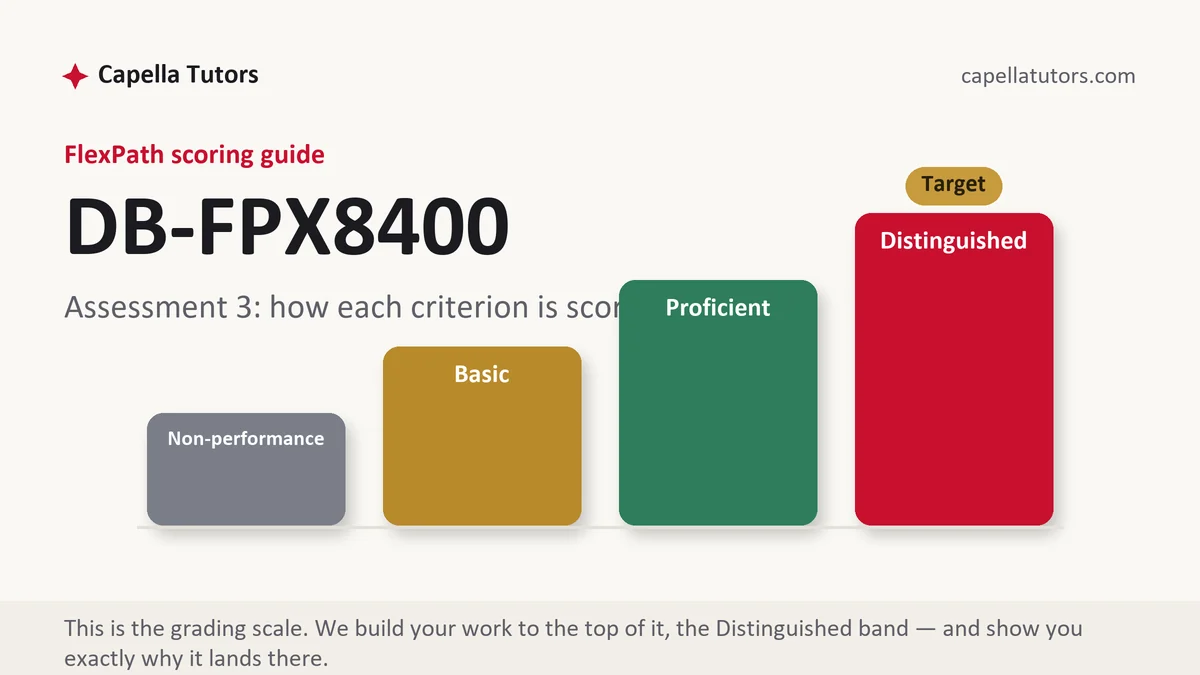
How DB-FPX8400 Assessment 3 is scored
Grading in FlexPath happens criterion by criterion, four levels per criterion, and the top level describes a document rather than paying a compliment:
| Level | What it means on an alignment and doctoral plan deliverable |
|---|---|
| Distinguished | Problem, purpose, questions and design agree so tightly that changing one would force a change in the others, the access and permission the design requires are identified rather than assumed, and the plan is set against the hours a working week actually contains. Each criterion conceals a further step; find it and take it. |
| Proficient | The four elements are present, defensible and broadly consistent, and the plan is realistic. Solid doctoral work with one seam still visible. |
| Basic | Four correct-looking elements written independently, most commonly a measurement problem carrying questions only a set of interviews could answer. The single most frequent fault in this deliverable. |
| Non-performance | A required element is absent, often the design or the access it depends on. An evaluator cannot infer a design you did not name. |
The project sequence inherits this deliverable. A candidate who arrives at proposal writing with a tested alignment chain spends that course refining a document; one who arrives with four independent paragraphs spends it rebuilding. The same is true of access: site permission and whether your work requires review are decided by your program's own process and by the organization you approach, and the answer changes which design is available to you.
The DB-FPX8400 Assessment 3 method, step by step
-
Lay the four elements side by side on one page
Write the problem, the purpose, the questions and the design as four short blocks on a single sheet, then read across rather than down. Most misalignment is invisible in a full draft and obvious in a table, because a purpose promising to explain and a design able only to describe sit two inches apart and contradict each other.
-
Make the purpose answer the problem, exactly
If the problem is that nobody can state a rate, the purpose is to establish it, not to improve it. Doctoral candidates routinely write a purpose one step ahead of what the problem justifies, promising to reduce something the project has not yet measured. Trim the purpose back until it matches the gap you actually evidenced.
-
Write questions the named design can answer
Take each question and say which data collection produces its answer. A question asking how much and compared with what needs records; a question asking why participants behave as they do needs interviews or observation. When a question needs both, split it, because one question serviced by two designs is the seam reviewers pull on first.
-
Choose the design, then price its access
Name the design in plain terms, then write what it will require from somebody who can grant it: which records, held by which function, released by whom, and whether people will be asked anything at all. That last question governs a great deal, since work built on records already collected sits differently from work collecting new data from people.
-
Test the chain by breaking one link
Change the design on purpose and see what else has to move. If swapping records for interviews leaves your questions untouched, the questions were too vague to be graded well. A chain that survives every substitution without adjustment is not tight, it is loose in a way a committee will find faster than you did.
-
Plan the sequence against real weeks, then self-score
Map the courses ahead against the hours your job leaves, decide how many you carry per session, and mark the points where permission has to be requested rather than assumed. Then read the draft one criterion at a time against the top descriptor, and build the two business days an evaluator may take into the date you commit to.
A structure that maps to the criteria
The lengths below are planning figures our doctoral desk uses for an alignment document, not Capella rules; your scoring guide decides the sections and their order.
| Section | What it must do | Guide |
|---|---|---|
| Problem | The sited, sized, dated gap carried forward unchanged from your earlier work, with its source visible. | ~150 words |
| Purpose | One sentence stating what the project will establish, scoped so that it answers the problem and nothing beyond it. | ~120 words |
| Questions | Two or three questions, each answerable by one named form of data collection, with the units and comparisons visible. | ~200 words |
| Design and data | The design, the records or measures it uses, the period it covers, and why this design suits these questions. | ~350 words |
| Access and permission | Who releases what, your own position relative to that decision, and the point in the sequence at which review questions are settled through your program. | ~250 words |
| Plan and references | The route through the remaining courses against real available hours, plus current APA matched in both directions. | ~250 words |
Annotated sample excerpt
An original model excerpt from our doctoral desk showing an alignment chain written so a reader can test it. Take the structure, then build your own.
The purpose of this project is to establish whether the difference in scrap rate between the first and second shifts at a specialty food co-packer is produced by changeover practice, by the product mix each shift is assigned, or by both, using production records already collected for the 24 months ending March 2026.1 The first question asks how much of the 2.9 point gap remains once runs are matched on product and batch size; the second asks whether scrap varies with the number of changeovers per shift within matched runs.2 Both questions are answered from the plant's existing batch records and changeover logs, which means the design requires the operations director to release archived production data rather than requiring anything from operators, and the project's access request is written to that scope.3
- 1The purpose establishes rather than improves, which is what the evidenced problem supports. It also names the data and the window, so the design is half declared before the design section arrives.
- 2Each question carries a comparison and a unit, and each is answerable from records. No question here quietly needs an interview to be answered.
- 3Names who must grant access and states that nothing is asked of people, which is the distinction that governs what any review process is being asked about.
The full premium sample for your exact assessment, written fresh to your scoring guide and issue, is free to request. Study it, revise it into your own voice, and submit work you understand.
The five mistakes that cost Distinguished
- A purpose one step ahead of the problem. Promising to reduce a rate the project has not yet established is the most common break in the chain and the easiest for a reader to see.
- Questions the design cannot reach. A why question attached to a records-based design is a promise the method section will have to withdraw.
- Access assumed rather than located. Naming a design that depends on data nobody has agreed to release moves the risk into the project courses, where it costs a term.
- A design named by label only. Calling the work a case study without saying what will be collected, from where and over what period leaves the criterion nothing to assess.
- A plan built on the weeks a calendar has rather than the hours a week has. Twelve weeks is a billing period, not an estimate of your available reading time.
Pre-submission checklist
- Problem, purpose, questions and design appear together and read consistently across
- The purpose promises exactly what the evidenced problem supports and no more
- Each question names the data collection that produces its answer
- The design states what data, from where, over what period, and why it suits the questions
- Access is identified by role, and any review question is routed through your program
- Current APA matched both ways, and every criterion self-scored against the top level
Want the alignment chain pressure-tested first?
Send the guide, the problem you have evidenced and the access you believe you can get. A team of eight, including a research analyst and two reviewers who read the draft cold, returns a premium original sample inside 24 to 48 hours with each link tested by substitution. Revision is free until the criteria clear.