Send the image set, the prompt, and the scoring guide, and a premium original sample returns inside 24 to 48 hours with every parameter reported, the results measured against labeled ground truth, and the failure cases shown rather than cropped away. Your program plan records this course as CSC FPX 4040, Computer Vision, worth 3 program points, a Computer Science specialization course delivered in FlexPath inside an undergraduate computing degree built on at least 90 program points, 27 or more of them earned at the 3000 level and above. In Capella's catalog the course code is written CSC-FPX4040.
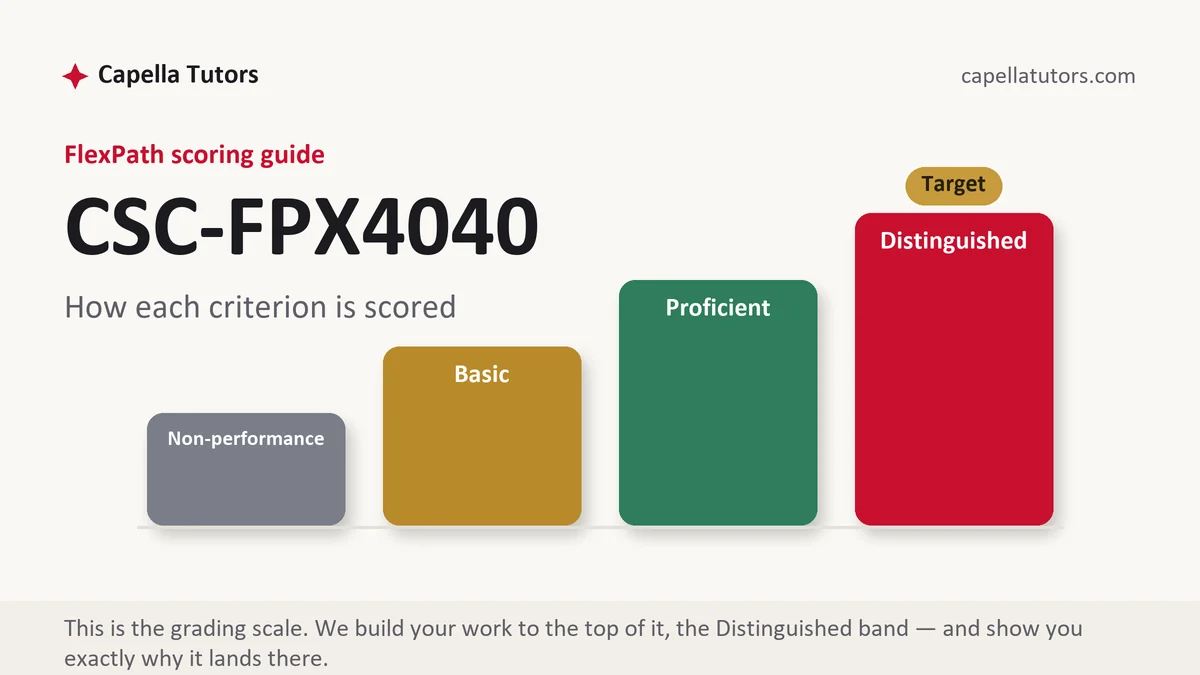
What CSC FPX 4040 actually grades
This course begins by taking the picture away. A grayscale frame is a rectangle of intensity values, a color frame is three of those rectangles stacked, and every operation taught here is arithmetic performed on that grid. The criteria follow from it: they ask what an operation does to the numbers, which parameters control it, and what evidence shows it worked. A submission that describes an outcome in visual language, saying the edges came out nicely or the mask looked clean, has skipped the entire graded layer of the work. The version that scores names the kernel, the threshold, and the color space, then measures the result against ground truth somebody labeled in advance.
The classical pipeline is examinable from end to end, and the order of it matters as much as the pieces do. Convert to a color space that suits the target first, since separating hue from brightness isolates a colored object far more reliably than three correlated channels will. Reduce noise before hunting for detail, because an edge operator run on a noisy frame finds noise faithfully. Apply a gradient operator, usually the pair of Sobel kernels measuring change across and down the image, or the multi-stage detector Canny published in 1986 with its two thresholds and the hysteresis step that keeps a weak edge only where it touches a strong one. Threshold the result, clean it with morphological opening and closing to drop speckle and close small gaps, then find contours and measure them. Cost belongs in the analysis: a 640 by 480 grayscale frame holds 307,200 values, a single 3 by 3 convolution reads nine of them for every output pixel, and that comes to roughly 2.8 million multiply and add operations per pass before anything interesting has happened.
The second half of the subject swaps hand-tuned rules for learned ones and the grading moves with it. Convolutional networks, transfer learning from a pretrained backbone, augmentation used to stretch a small labeled set, and the arithmetic of the layers themselves, where a 224 by 224 input under a 3 by 3 kernel at unit stride with no padding comes out 222 by 222, which is the reason padding and stride belong in your parameter table. Detection carries its own measure and it is less forgiving than it appears. Intersection over union scores a predicted box against the true one, so a true box of 100 by 80 pixels and a prediction of 90 by 90 overlapping across a 70 by 60 region share 4,200 pixels out of a combined 11,900, an overlap of 0.35, and at the customary half threshold that single sloppy box counts twice against you, once as a false alarm and once as a missed object.
How we help in this course
Deliverables from us report their settings. Every stage names its parameter, so a blur states its kernel size and its sigma, a threshold states its value and whether it was fixed, adaptive, or selected by the method that maximizes separation between the two classes of pixel, and a detector states the resolution it was fed. Results are measured against a labeled set rather than admired, failures are printed beside the successes, and timings are recorded on named hardware so a claim about speed has a machine attached to it. Tell us which images you have and what constrains you, whether that is lighting, hardware, or labeling effort, and the method proposed will live inside that constraint.
Commercial terms do not change between courses. Delivery runs 24 to 48 hours, the target is the Distinguished descriptor, and revisions stay free until your guide is satisfied. Eight people move a file from prompt to finished document, and the two worth knowing here are the subject writer who selects and tunes the method and the editor who keeps the write-up readable to a grader who has never opened a vision library. Anything your evaluator sends back is folded into the next revision for free. With two business days sitting between a submitted attempt and its result, one more day spent on the draft is the cheaper of the two ways to fix a criterion.
The assessments, one by one
Assessment 1
Assessment 1 in CSC FPX 4040, Computer Vision, is usually where the picture gets taken away and the arithmetic put in its place: a pipeline built stage by stage, every parameter reported, and each stage defended by its effect on the numbers in the array rather than by how the picture ends up looking. Read the full Assessment 1 manual.
Assessment 2
Assessment 2 in CSC FPX 4040, Computer Vision, is usually where the method has to be measured instead of demonstrated: ground truth labelled in advance, results reported as counts, the overlap threshold stated, and the numbers broken out by the conditions that actually change the answer. Read the full Assessment 2 manual.
Assessment 3
Assessment 3 in CSC FPX 4040, Computer Vision, is usually the synthesis deliverable: a hand-built pipeline weighed against a trained one for the same task, the choice argued from the constraints rather than from the reputation of either technique, and the whole thing explained in language a reader. Read the full Assessment 3 manual.
How to actually write CSC FPX 4040: where to begin
Take the criteria as headings, then adopt the rule this subject rewards above every other: nothing in the method section gets described without its numbers. Submissions that land in the Basic column share one property, which is that a reader cannot rebuild the pipeline from the text. Start a parameter table early and fill it as you work, one row per stage, holding the operation, the values it used, and a sentence saying why those values rather than others. That table answers the reproducibility criterion on its own, and it rescues you later when the results section has to explain why one stage behaved differently on the second batch of images.
Build the evaluation before you tune anything, because a pipeline tuned against the pictures used to judge it has simply been fitted to them. Assemble a set covering the conditions the system will meet, label it, and hold part of it back. Report results by condition instead of as one average, since a detector at ninety percent overall may be at ninety-eight in even light and at forty against a bright window, and the average buries the only finding worth writing down. Give counts rather than rates alone: how many objects were present, how many were found, how many were invented. For detection work, state the overlap threshold you scored at, because identical predictions produce very different numbers at a half overlap and at three quarters, and a figure quoted without its threshold cannot be compared with anything. Put the failures in the document. An evaluator who sees three cases where the method broke, each with a sentence naming the cause, is reading a student who tested the work.
Close by justifying the approach in language a non-specialist can follow, since the communication criterion is worth as much as the technical ones. Say what the system does, what it needs in order to work, and what makes it fail, in three sentences without jargon, then attach the measurement that supports each. If the pipeline is classical, say that it depends on controlled lighting and can be debugged stage by stage when it goes wrong. If it is learned, say how many labeled examples it consumed, what hardware trained it, and that a wrong answer will arrive without a reason attached. Then name what you would change given twice the data or twice the compute budget. That paragraph takes twenty minutes and it routinely lifts a criterion from Proficient to Distinguished, for the simple reason that most submissions never write it at all.
| Section | What goes in it | What Distinguished looks like |
|---|---|---|
| Problem and imagery | The task, the images, how they were captured, and the conditions the set covers. | An image set deliberately built to include hard conditions, with capture described precisely. |
| Preprocessing | Color conversion, resizing, denoising, and normalization, with every value given. | Each step justified by what it does to the pixel values rather than by habit or convention. |
| Method and parameters | The operators or model used, all parameters, and the reason behind each setting. | A table a reader could rebuild the pipeline from without needing to ask a question. |
| Evaluation | Ground truth, the counts, the metric chosen, and the threshold it was scored at. | Results broken out by condition, with the overlap or decision threshold stated in the text. |
| Failure analysis | The cases that broke, what they share, and what would be needed to fix them. | Failures diagnosed by cause rather than listed, each with a remedy and its effort estimated. |
| Sources and format | Toolkit documentation, peer-reviewed vision work, dataset terms, and current APA. | Operators traced to the papers that introduced them, with versions and licenses recorded. |
Developing the analysis
The decision this course keeps setting in front of students is whether to hand-build the pipeline or to train one, and the criteria reward the argument rather than the fashion. A thresholded, contour-based method costs almost nothing to run, needs no labeled data, can be inspected stage by stage, and comes apart when the lighting moves. A small network fine-tuned from a pretrained backbone absorbs variation the rule-based method cannot, needs a few hundred labeled examples and a machine able to train on them, and cannot explain a miss. Decide from the constraint rather than from the reputation of the technique: how many labeled images exist, what hardware is available, whether a wrong answer has to be explainable, and how much the scene is permitted to change. Then acknowledge that measured error rates in vision systems differ across groups of people and across capture conditions, a pattern documented repeatedly in independent testing, and say what your own test set does and does not represent.
Citations that survive faculty review
A vision write-up rests on references of four different kinds. The documentation of whichever toolkit you called is the authority on what a function actually did, including the default parameter you never set, so cite the OpenCV documentation or the framework guide for the exact version installed. Operators are attributed to the work that introduced them, which puts the edge detector with Canny's 1986 paper, corner detection with Harris and Stephens, cascade face detection with Viola and Jones, and scale-invariant features with Lowe, because a criterion about theoretical foundation is testing whether you know these are published results and not menu items. Peer-reviewed research through IEEE Xplore and the ACM Digital Library, including the transactions on pattern analysis, supports any claim about accuracy or comparative performance. Independent evaluation reports, particularly the face recognition testing published by the National Institute of Standards and Technology, are the correct citation for statements about error rates across demographic groups. Cite the image set as well, with its license and capture conditions, and set the whole list in current APA with each entry matched to the place it is cited.
The mistakes that land Basic instead of Distinguished
- One screenshot offered as the result. A single good frame is a demonstration, and the criterion asked for an evaluation.
- Parameters missing from the write-up. A pipeline nobody can rebuild has failed the reproducibility criterion before it is read.
- Test images that were also tuning images. Numbers measured on the pictures you adjusted against are not measurements.
- An overlap threshold left unstated. Detection figures mean nothing until a reader knows what was allowed to count as a hit.
- Color thrown away without thinking. Three correlated channels where one converted channel would have isolated the target.
CSC FPX 4040 questions students actually ask
Do I need a GPU for this course?
Almost certainly not, and no criterion awards marks for hardware. The classical half of the subject runs comfortably on a laptop, and the learned half is usually within reach if you fine-tune a small pretrained network on a few hundred images at a modest resolution instead of training one from nothing. What the assessment does expect is that you report the machine, the run time, and the resolution you worked at, because a method taking four seconds a frame on your laptop is a different proposal from one taking forty milliseconds. If you borrow an accelerator through a hosted notebook, say so and record the session type, since a result nobody can place on hardware is a result nobody can plan around.
How many test images are enough?
Fewer than students fear, as long as the set is built deliberately rather than gathered. Coverage beats volume in this subject. Decide which conditions matter, which normally means lighting, distance, angle, partial occlusion, and background clutter, then collect a handful of examples of each and label all of them. Twenty to forty images arranged that way will support a results table broken out by condition, and that table is the artifact the evaluation criterion is looking for. Two hundred pictures taken in one afternoon at one desk will not, however impressive the total looks, because they ask the same question two hundred times. State how the set was assembled and which conditions it misses, and the limitations section writes itself.
My detector works on my own photos and fails on the sample images.
That is a finding, and reported properly it scores better than a pipeline that quietly worked. Something differs between the two sets and your job is to name it: resolution, compression, lighting temperature, camera angle, or how much of the frame the target occupies. Measure the difference rather than guessing, since comparing average brightness or the pixel height of the object across both sets usually exposes the cause within a few minutes. Then say what the pipeline assumed and where the assumption came from, which is nearly always a threshold tuned on your own images. Repair what can be repaired, report what cannot, and describe the conditions under which the method holds. Naming the boundary of your own solution is what the top column describes.
Vision assignment due and the results look thin?
Send the images, the criteria, and whatever code runs today. Back comes the parameter table, the labeled evaluation, the failure analysis, and the plain-language justification underneath it. First premium sample free.