This manual is for CSC FPX 4040 Assessment 3, start to submission. Assessment 3 in CSC FPX 4040, Computer Vision, is usually the synthesis deliverable: a hand-built pipeline weighed against a trained one for the same task, the choice argued from the constraints rather than from the reputation of either technique, and the whole thing explained in language a reader outside the field can follow. The guide in your courseroom marks each criterion by itself. The rest of this page sets out our sequence, a section layout the criteria dictate, and an annotated excerpt. Rather hand it over? An original premium sample cut to your criteria reaches you in 24 to 48 hours, and it is revised for free until it sits where you need it. Capella's catalog lists the course as CSC-FPX4040, and some courserooms print CSC4040; both point to this same Assessment 3.
One honesty note before the manual: Capella revises courses and scoring guides over time, so always write to the exact scoring guide attached to your assessment in the courseroom. The course identity above is verified on capella.edu; the method and structure below are our tutors' approach to it, not Capella's official rubric text.
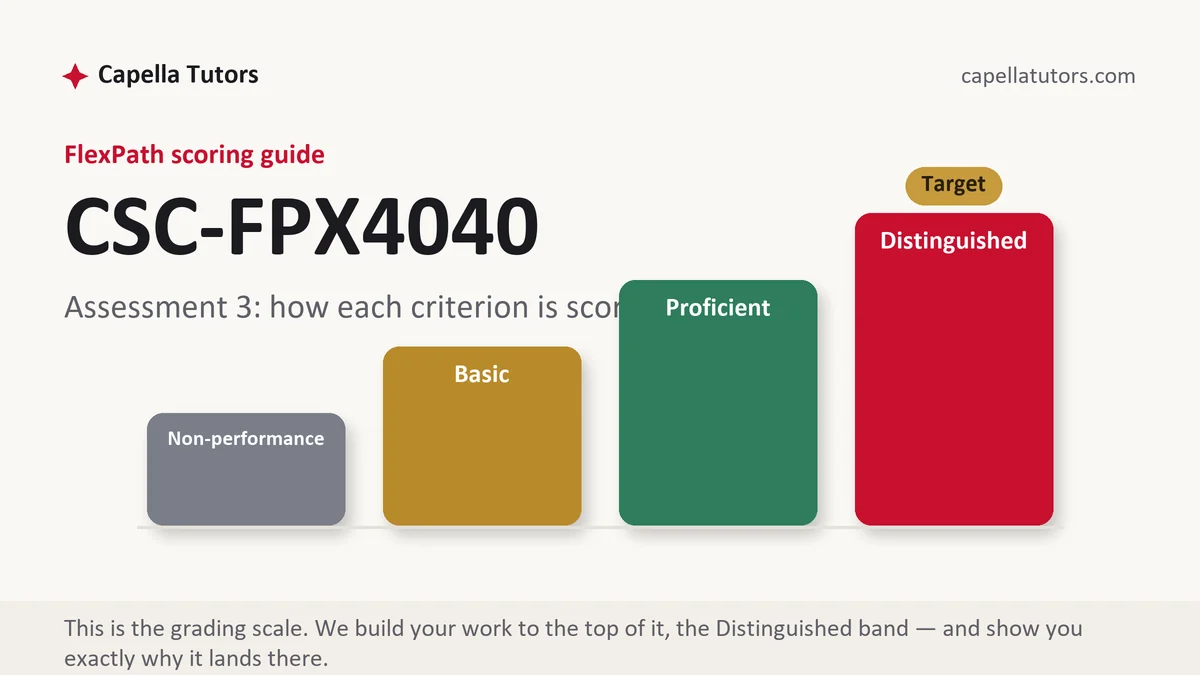
How CSC FPX 4040 Assessment 3 is scored
A criterion here is placed at one of four named levels and judged on its own. On a comparison of this kind they usually mean this:
| Level | What it means on a classical against learned comparison |
|---|---|
| Distinguished | Both approaches are measured on the same labelled set, the decision is argued from labelling budget, hardware, and whether a wrong answer must arrive with a reason, and the paper says what its own test set does not represent. The rejected approach keeps its genuine advantage. |
| Proficient | Both approaches tried and compared, with a defended choice. Sound, and the constraints that should drive the decision stay in the background. |
| Basic | The newer technique preferred because it scored higher, with cost, labelling effort, and explainability unmentioned. A result rather than an engineering decision. |
| Non-performance | A required element is missing, most often the second approach or the account of where the method should not be used. |
Decide from the constraint rather than from the technique's reputation. How many labelled images exist, what hardware you can use, whether a miss has to come with a reason, and how far the scene is allowed to drift will settle this between them, and naming those four is most of the argument.
The CSC FPX 4040 Assessment 3 method, step by step
-
Criteria into headings, then write the constraints down
Four numbers decide this deliverable: how many labelled images you have, what the machine can do, how fast a frame must be handled, and whether somebody will have to be told why the system was wrong. Put all four on the page before either approach is described.
-
Build the hand-tuned version first
The classical pipeline is cheap to build, costs nothing to run, needs no labels, and can be inspected stage by stage when it breaks. Building it first gives you a reference point and often reveals that the task is easier than it looked, which is a finding worth reporting rather than hiding.
-
Fine-tune rather than train from nothing
Starting from a pretrained backbone turns a few hundred labelled images into a usable model, where training from scratch would need orders of magnitude more. Report the backbone, the number of labelled examples, the augmentation used, the resolution, and the hardware, since those five settings are what the reproducibility criterion is asking for.
-
Measure both on the identical labelled set
Same frames, same labels, same threshold, and the results in one table. A comparison run on different data is not a comparison, and the criterion will read it as two separate reports sitting next to each other.
-
Report speed and effort beside accuracy
Milliseconds a frame on named hardware, hours spent labelling, and hours spent tuning all belong in the table. Accuracy alone cannot settle a choice between an approach that runs anywhere and one that needs an accelerator and a labelling campaign.
-
Diagnose the failures by cause, then self-score
Group the errors rather than listing them, name what the members of each group share, and estimate the effort a fix would take. Then mark yourself on every criterion, and write the paragraph that explains the system to a non-specialist, because most submissions never write it at all.
A structure that maps to the criteria
The counts below are the planning targets our tutors use on a comparison of this shape, not Capella requirements; grow any section your criteria weight heavily.
| Section | What it must do | Guide |
|---|---|---|
| Task and constraints | The decision the system supports, plus labels available, hardware, frame budget, and explainability need. | ~250 words |
| The hand-built approach | Stages, parameters, and the measured result, with what it depends on to keep working. | ~250 words |
| The learned approach | Backbone, labelled count, augmentation, resolution, hardware, and the measured result. | ~250 words |
| Comparison table | Accuracy, speed on named hardware, labelling hours, and explainability, side by side. | ~200 words |
| Failure analysis and limits | Errors grouped by cause with fixes costed, and what the test set does not represent. | ~300 words |
| References | Toolkit and framework documentation with versions, the papers behind the operators and the backbone, dataset licence, current APA. | as needed |
Annotated sample excerpt
A last original excerpt from our team, printed as a model of how a choice survives being the slower option. Take the shape and argue your own constraints with it.
On the same 400 labelled belt frames the threshold pipeline placed 71 percent of items in the right material class and the network fine-tuned from a small pretrained backbone on 640 labelled images reached 92 percent, so on accuracy alone the argument is over.1 The rest of the table is what makes it a decision: the pipeline runs in 8 milliseconds a frame on the plant's existing computer and can be traced stage by stage when it fails, the network takes 45 milliseconds on the same machine, cost eleven hours of labelling before it worked at all, and returns no reason with a wrong answer, which matters because a misrouted load is inspected by a person who has to be told why.2 The failures group cleanly rather than scattering: crushed clear plastic and wet sheet metal account for four fifths of the network's errors and both present the same bright specular highlight, so the cheapest fix is not more training data but a polarizing filter on the lens, perhaps two hours of work.3
- 1Concedes the accuracy result immediately instead of defending the weaker option. The paper is now free to argue on the ground that actually decides it.
- 2Prices the exchange in milliseconds, labelling hours, and explainability, and ties the last one to a person who needs an answer. Constraints, not reputation.
- 3Groups the failures, names what the group shares, and proposes a fix outside the model with an effort estimate. Diagnosis rather than a list.
The full premium sample for your exact assessment, written fresh to your scoring guide and issue, is free to request. Study it, revise it into your own voice, and submit work you understand.
The five mistakes that cost Distinguished
- The learned approach preferred because it scored higher. Accuracy is one column, and the criterion asked for an engineering decision.
- The two approaches measured on different frames. Two sets of numbers gathered from different pictures sit beside each other without ever meeting.
- Training from scratch on a few hundred images. Fine-tuning a pretrained backbone is the method the constraint calls for, and the paper should say why.
- Failures listed instead of grouped. Ten unrelated errors are an inventory; two causes with four fifths of the errors between them are a diagnosis.
- No plain-language paragraph. The communication criterion carries as much weight as the technical ones and takes twenty minutes to satisfy.
Pre-submission checklist
- Labels available, hardware, frame budget, and explainability need all stated up front
- The hand-built pipeline built and measured, not merely described
- The learned model reported with backbone, labelled count, augmentation, resolution, and hardware
- Both approaches measured on identical frames at an identical threshold
- Speed, labelling hours, and explainability tabled beside accuracy
- Failures grouped by cause with fixes costed, plus a plain-language paragraph and APA reconciled
Both approaches built and the argument will not resolve?
Send the frames, the criteria, and the constraints you are working under. Back comes both measured approaches on one labelled set, the table that prices the exchange, the failures grouped by cause, and the plain-language justification underneath, inside 24 to 48 hours with revisions free until the guide is met. No cost on your opening sample.