This manual is for CSC FPX 4040 Assessment 1, start to submission. Assessment 1 in CSC FPX 4040, Computer Vision, is usually where the picture gets taken away and the arithmetic put in its place: a pipeline built stage by stage, every parameter reported, and each stage defended by its effect on the numbers in the array rather than by how the picture ends up looking. It is marked the FlexPath way, criterion by criterion against a scoring guide. Below is the order our tutors build in, a section plan answering the criteria, and one annotated excerpt. Prefer to delegate this one? Our tutors deliver an original premium sample inside 24 to 48 hours and keep revising at no charge until every criterion is met. Capella's catalog lists the course as CSC-FPX4040, and some courserooms print CSC4040; both point to this same Assessment 1.
One honesty note before the manual: Capella revises courses and scoring guides over time, so always write to the exact scoring guide attached to your assessment in the courseroom. The course identity above is verified on capella.edu; the method and structure below are our tutors' approach to it, not Capella's official rubric text.
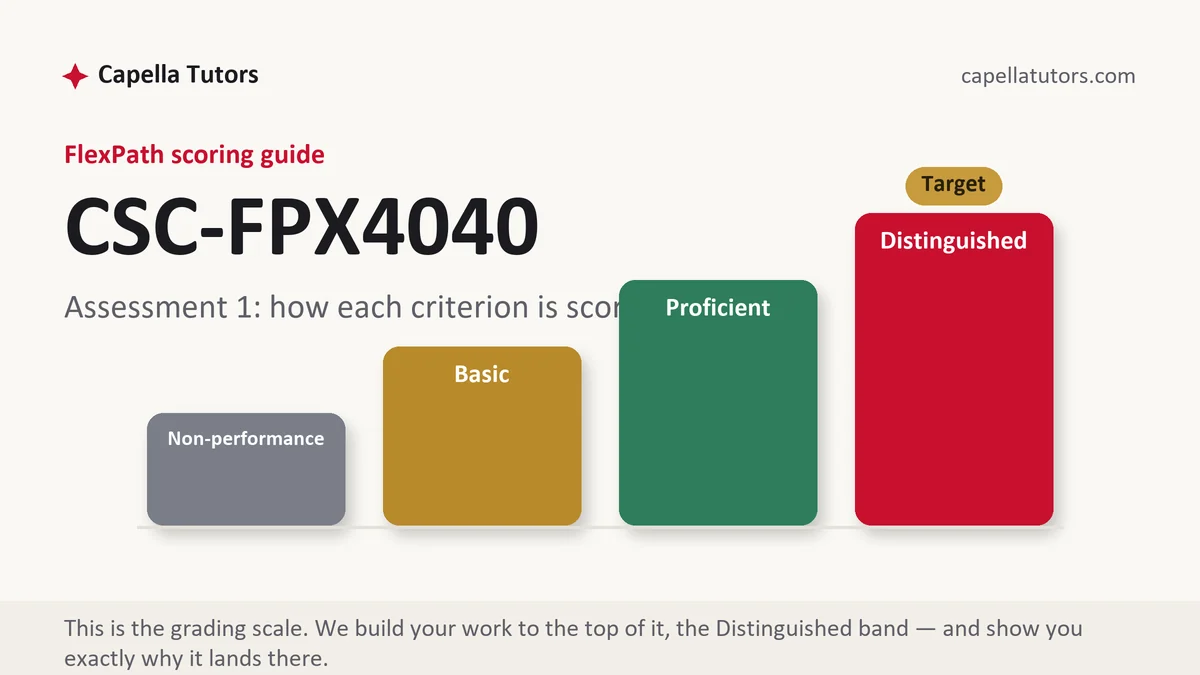
How CSC FPX 4040 Assessment 1 is scored
Nothing here becomes a percentage. Each criterion in the guide is placed at one of four levels, and the level text is the brief you are writing to:
| Level | What it means on a classical pipeline |
|---|---|
| Distinguished | Every stage names its parameter and the reason for that value, the order of the stages is defended, and the arithmetic cost of the pipeline is stated. A reader could rebuild the whole thing from the table without asking a question. |
| Proficient | A working pipeline with the parameters given and the stages described. Complete, and the values arrive without the reasoning that chose them. |
| Basic | The outcome described in visual language, the edges looked clean and the mask came out well, with the numbers left in the code. The stage most submissions land on. |
| Non-performance | A required element is absent, most often the parameter values themselves or any account of why the stages run in that order. |
Start the parameter table on the first day and fill it as you work. It answers the reproducibility criterion by itself, and it rescues you later when a stage behaves differently on the second batch of images and you need to know what changed.
The CSC FPX 4040 Assessment 1 method, step by step
-
Criteria into headings, then say what the pipeline is for
Name the measurement the pipeline produces and who would use it. A vision deliverable with no stated output drifts into demonstrating operators one at a time, and criteria are written about a task rather than about a tour of a toolkit.
-
Choose the colour space before anything else
Pulling hue apart from brightness gives you a channel in which the target stands out, which three interdependent channels will not do, and that choice belongs in the document with a sentence of reasoning. Throwing colour away without considering it is one of the cheapest marks to lose in this course.
-
Reduce noise before you hunt for detail
Point a gradient operator at a grainy frame and it will report the grain with perfect fidelity, so smoothing comes first and its kernel size and sigma are both reported. State what the smoothing costs you as well, because the same blur that removes speckle also softens the boundary you are about to measure.
-
Threshold, then clean the mask with morphology
Give the threshold value and say whether it was fixed, adaptive, or selected automatically by the method that searches for the cut leaving the least variation inside each group of pixels. Then use opening to drop speckle and closing to join parts of one object, with the element size for each, since those two operations do opposite jobs and swapping them changes the count.
-
Measure the contours rather than admiring them
Turn the mask into a number: how many regions, how large each one is, which ones were discarded and by what minimum area. A criterion asking for results wants counts with a rule behind them, and the discard rule is the part students leave in the code.
-
Price the pipeline, then self-score
Work out roughly how much arithmetic one frame costs, because a method that takes four seconds a frame is a different proposal from one that takes forty milliseconds. Then read each criterion, mark yourself, and rewrite whatever falls below the top level.
A structure that maps to the criteria
The lengths below are our tutors' planning targets for a pipeline deliverable, not Capella limits; extend any row your own guide leans on.
| Section | What it must do | Guide |
|---|---|---|
| Task and imagery | The measurement wanted, the frames used, the capture setup, and which conditions appear in the set. | ~200 words |
| Colour and preprocessing | The colour space chosen with its reason, resizing, smoothing, and every value used. | ~250 words |
| Segmentation | The threshold and how it was selected, then the morphological steps with their element sizes and order. | ~300 words |
| Measurement | How regions become numbers, the discard rule, and the counts produced on your own frames. | ~250 words |
| Parameter table and cost | One row per stage holding operation, values, and reason, plus the arithmetic per frame and the machine. | ~250 words |
| References | Toolkit documentation for the installed version, the papers behind the operators, image licence, current APA. | as needed |
Annotated sample excerpt
A model excerpt written by our team, included to show how a stage gets justified. Build your own pipeline description on the same pattern.
The ninety-six tray photographs are 1280 by 960 and the seedlings are green against a brown substrate, so the frame is converted to a hue, saturation, and value representation before anything else, because hue holds the difference the task depends on while brightness varies across the bench with the overhead lamps.1 Smoothing runs next with a 5 by 5 Gaussian kernel at sigma 1.2, which is enough to remove the substrate speckle and costs 25 multiply and add operations for each of the 1,228,800 pixels, about 30.7 million a frame; the boundary of each leaf softens slightly, and the minimum area rule below absorbs that.2 Pixels are kept where hue falls between 35 and 85 and saturation exceeds 60, the mask is opened with a 3 by 3 element to drop the remaining specks and then closed with a 5 by 5 element so the two leaves of one seedling join into a single region, and regions under 240 pixels are discarded as debris.3
- 1Names the colour space and gives the reason in terms of what varies in the scene. A stage justified by the physics of the image rather than by convention.
- 2Reports the kernel and sigma, prices the stage in arithmetic, and volunteers what the smoothing costs. Stating a cost alongside a benefit is the habit that lifts this criterion.
- 3Gives every threshold and element size, in order, with the reason each operation runs. A reader could rebuild this stage exactly, which is what reproducibility means here.
The full premium sample for your exact assessment, written fresh to your scoring guide and issue, is free to request. Study it, revise it into your own voice, and submit work you understand.
The five mistakes that cost Distinguished
- Results described in visual language. The edges looked clean is not a measurement, and the criterion is scoring what happened to the numbers.
- Parameters left in the code. If a reader cannot reconstruct the stages, the reproducibility criterion is lost before the results are reached.
- Colour discarded without a thought. The task was pushed into grayscale when a single converted channel would have separated the object cleanly.
- Opening and closing used interchangeably. They do opposite jobs, and the order changes the count the paper reports.
- An edge operator run on an unsmoothed frame. The output is noise, faithfully detected and confidently reported.
Pre-submission checklist
- The measurement the pipeline produces, stated before any operator appears
- Colour space chosen with a reason drawn from what varies in the scene
- Smoothing kernel and sigma given, with what the smoothing costs acknowledged
- Threshold value and selection method stated, morphology given with element sizes and order
- Regions turned into counts, with the discard rule written down
- A parameter table covering every stage, the per-frame arithmetic, and APA reconciled both ways
Pipeline running and the write-up has no numbers in it?
Send the images, the prompt, and the criteria. Back comes the colour reasoning, every parameter with the value that was used and why, the morphology in the right order, and the cost per frame on stated hardware, inside 24 to 48 hours with revisions free until the guide is met. The first sample is on the house.