Send the prompt, the scoring guide, and whatever code currently compiles, and a premium original sample returns inside 24 to 48 hours with every claim about a language backed by a named mechanism and a runnable fragment rather than by preference. Your program plan records this one as CSC FPX 4010, Principles of Programming Languages, worth 3 program points, a Computer Science specialization course delivered in FlexPath inside an undergraduate computing degree that asks for at least 90 program points with a minimum of 27 of them at the 3000 level or above. In Capella's catalog the course code is written CSC-FPX4010.
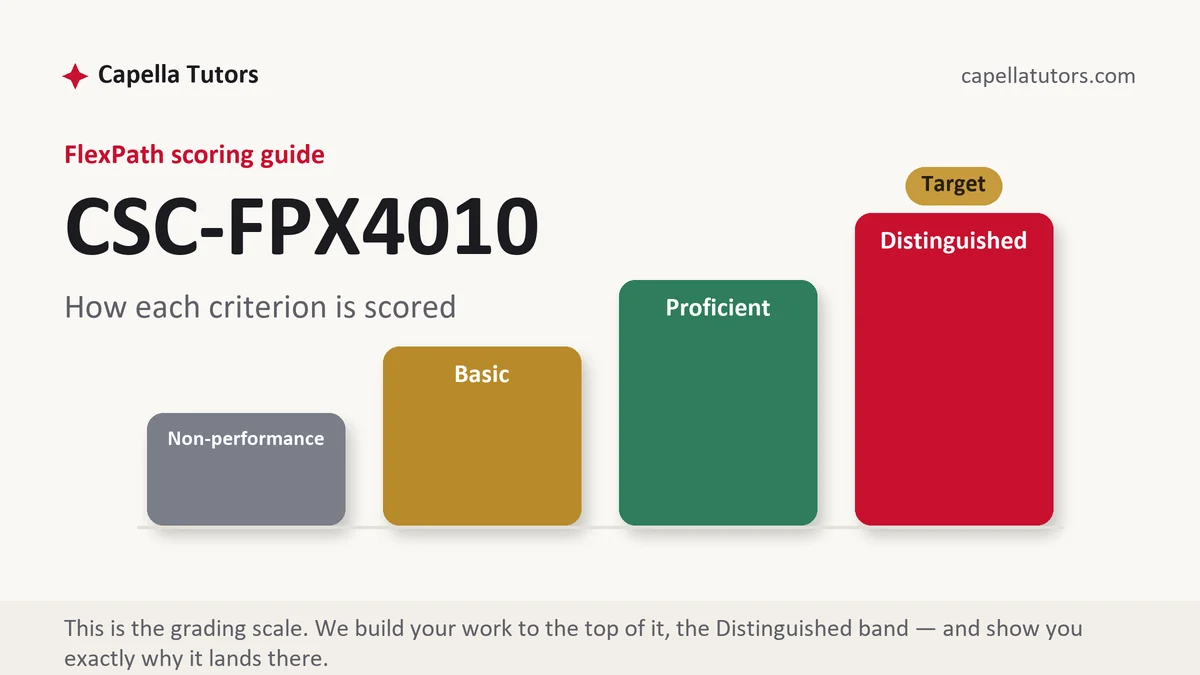
What CSC FPX 4010 actually grades
Most of a computing degree teaches you to use one language well. This course grades whether you can explain why languages disagree. The criteria hand you a feature, a task, or a pair of languages, and they score the mechanism you name rather than the preference you hold. A submission saying that Python is easier and Java is stricter has answered nothing. A submission saying that Python resolves most names at run time by searching a chain of namespaces while Java fixes name resolution when the class is compiled, and then showing the error each choice produces and the moment it appears, has answered the question the criterion actually asked.
The vocabulary is examinable and the terms are not interchangeable. Syntax gets described with a grammar, usually in Backus-Naur form or its extended variant, and a criterion asking for production rules wants rules rather than a paragraph about what the code looks like. Underneath that sit the distinctions the course keeps returning to: a parse tree against an abstract syntax tree, compilation to machine code against interpretation against bytecode running on a virtual machine, static checking against run-time checking, strict conversion rules against permissive ones, written annotations against inference. Binding and lifetime follow, meaning the moment a name gets attached to a thing and how long its storage survives, which is where static allocation, the stack, and the heap enter the discussion. Parameter passing earns its own criterion often enough to prepare for, since passing by value, passing by reference, and passing a reference by value give three different answers to the same looking call.
Two more strands finish the course. Paradigms are graded on what each one buys and what it costs, so imperative sequencing, object-oriented encapsulation and dispatch, functional immutability and first-class functions, and the declarative resolution of logic programming each need a task where the paradigm is the right answer and a task where it is the wrong one. The second strand is quieter and settles more grades than students expect, which is the requirement to explain a technical choice in prose a reader outside the field can follow. Scoring guides here reward a paragraph that says what the code does, what it costs, and what it gives up, and they mark down a listing dropped into a document under a sentence announcing that the implementation appears below.
How we help in this course
Samples for this course arrive with code that runs as printed. Every fragment names the language version and the compiler or interpreter it was checked against, comments sit at the decision points instead of above the obvious lines, and the observed output appears next to the behavior the paragraph claims. Comparison tables point at each language's defining document for the rule being compared, so a statement about how a name is resolved cites the reference manual rather than a tutorial site. Tell us which languages your faculty permits and which environment you have installed, and the comparison gets built on that pair instead of on whichever two are convenient to write about.
Terms are the studio's standing ones. Eight people touch a file in sequence, and in this course the two who matter most are the subject writer who designs the comparison and writes the programs, and the scoring-guide reviewer who marks the result row by row before you ever see it, with research, an APA and originality pass, and a final editor around them. Work is delivered inside 24 to 48 hours, pitched at the Distinguished descriptor instead of at a pass, with revisions included until the guide is satisfied. Anything your evaluator writes back enters the same queue at no charge, which matters when an attempt takes two business days to assess and a rewrite beforehand costs nothing but an afternoon.
The assessments, one by one
Assessment 1
Assessment 1 in CSC FPX 4010, Principles of Programming Languages, is where the course usually asks you to describe a language construct formally: a grammar somebody else could parse by hand, a worked derivation, and every mechanism named the way its own specification names it. Read the full Assessment 1 manual.
Assessment 2
Assessment 2 in CSC FPX 4010, Principles of Programming Languages, is usually where description turns into demonstration: a mechanism claimed in prose and then proved by a program short enough to read, run in two languages that disagree about it. Read the full Assessment 2 manual.
Assessment 3
Assessment 3 in CSC FPX 4010, Principles of Programming Languages, is where the course usually stops asking what a mechanism does and starts asking which one you would choose: a paradigm recommended for a stated task, with the losing options given a fair hearing and every advantage priced. Read the full Assessment 3 manual.
How to actually write CSC FPX 4010: where to begin
Open the scoring guide before you open an editor. One heading per criterion, the Distinguished wording pasted underneath it, and then a rule that carries this whole course: no assertion about a language stands without evidence somebody else could rerun. Evidence takes two forms and you want both. The first is the defining document, so a claim about how assignment behaves cites the section of the reference manual that says so. The second is a fragment of five to fifteen lines producing that behavior on your machine, with its output printed underneath. Faculty here are reading for the gap between what a student believes a language does and what it does, and that gap closes only when the claim, the citation, and the execution all agree.
Work one confusion all the way to the bottom, because a single mechanism explained completely scores above six mentioned in passing. Take the argument students get wrong most often. A Java method receives a list and calls add on it, and the caller sees the new element, which looks like passing by reference. The same method assigns a brand new list to its parameter, and the caller sees nothing change, which looks like passing by value. Both are passing by value, because the thing copied into the parameter is a reference: reaching through it to mutate the object is visible to the caller, and rebinding the parameter is not. Put the two versions side by side, show both outputs, then bring in a language offering the other mechanism, since a C++ parameter declared with an ampersand is a genuine alias and assigning to it does reach the caller. Repeat the exercise for scope using closures in a loop. Three Python functions built in one comprehension over zero, one, and two all report two, because they share the enclosing binding and read it only when called. Three JavaScript closures built in a for loop whose counter is declared with let report zero, one, and two, because that declaration makes a fresh binding on every iteration.
Then write the justification so an evaluator can mark it. Name the task, name the property that matters for that task, and rank the languages on that property alone rather than in general. Attach a cost to every mechanism you praise: automatic memory management removes a class of leaks and introduces pauses you do not schedule, a static checker catches a mismatch before the program runs and makes a twenty-line script longer, an interpreter shortens the edit and test loop and surrenders the warnings a compile step would have given you. Close with a short test table, since the correctness strand of this course gets checked rather than assumed. Four columns are enough: the input, the behavior you predicted from the rule you cited, the behavior observed, and the version the run happened on.
| Section | What goes in it | What Distinguished looks like |
|---|---|---|
| Task and language pair | The problem being solved, the languages compared, and why that pair is a fair test. | Selection justified by the mechanism under examination rather than by familiarity or popularity. |
| Grammar and syntax | Production rules for the construct under discussion, written in a stated notation. | Rules that parse the examples given, with the notation named and applied consistently. |
| Semantics and mechanisms | Typing discipline, binding times, scope rules, parameter passing, and the memory model. | Each mechanism called by the term its own specification uses, and cited to that section. |
| Code evidence | The programs or fragments, with language version, toolchain, and the output each produced. | Code that runs as printed, commented at the decisions, with predicted and observed results shown. |
| Comparison and recommendation | A feature by feature contrast and the language chosen for the stated task. | Each difference converted into a consequence, and the rejected option given its fair case. |
| Sources and format | Language specifications, peer-reviewed work, and current APA in both directions. | Semantic claims traced to the defining document, with versions stated for every tool named. |
Developing the analysis
The argument this course keeps offering is static typing against dynamic typing, and the honest answer is more useful than either side of it. The mechanical part is settled: a checker rejects a program that would fail on a type mismatch before the program ever runs, and it charges you annotations, compile time, and some expressiveness at the edges. The empirical part is not settled. Controlled experiments comparing defect rates across typing disciplines tend to be small, often use students as participants, and disagree with one another, while repository studies reporting fewer bugs in statically typed projects cannot separate the language from the teams and tooling that chose it. Say so in the paper. Argue from the class of error each discipline catches and the moment it catches it, then name the condition that decides your case, such as a codebase two people will maintain for five years against a script that runs once and is deleted.
Citations that survive faculty review
Evidence in this course is ranked, and knowing the ranking is itself part of what gets graded. A language's own defining document outranks everything for questions of meaning, so JavaScript claims go to the ECMAScript specification, Java claims to the Java Language Specification, Python claims to the language reference rather than to the tutorial, and C or C++ claims to the ISO standard for the version you compiled against. Peer-reviewed computer science, reached through the ACM Digital Library and IEEE Xplore inside the Capella library, carries any claim about programmer behavior, defect counts, or measured performance. Concepts get attributed to their origin, so Backus-Naur form traces to the ALGOL 60 report rather than to a lecture slide and the Hindley and Milner style of type inference traces to its own authors. Compiler and runtime manuals, always with a version attached, support anything about how one implementation behaves as against what the standard requires. State versions everywhere, because semantics move between releases and an undated claim ages into a wrong one. Check every citation in the text against the list, and every entry on the list against the text, all of it in current APA.
The mistakes that land Basic instead of Distinguished
- Ranking languages by popularity. A survey of what developers use answers a different question than the one the criterion asked.
- Calling a copied reference pass by reference. That distinction is the entire content of the criterion it usually appears under.
- Fragments with no version and no output. Unrunnable code is an assertion wearing a monospace font.
- Syntax described in English. A criterion that says grammar wants production rules, not a paraphrase of what they would say.
- Speed claimed without a measurement. Calling one language faster reports a benchmark you did not run and cannot show.
CSC FPX 4010 questions students actually ask
Do I have to write in more than one language?
Your scoring guide decides, and the assessments in this course usually ask for a comparison whether or not they ask for two implementations. Even a criterion aimed at a single language is easier to score when a contrast is present, because a mechanism becomes visible only beside an alternative. Choose the pair that isolates the feature under discussion rather than the pair you know best. If the topic is memory, a garbage-collected language against one with manual release makes the point in ten lines. Keep both programs small, keep them doing the identical job, and state the version and environment for each so the comparison can be repeated by somebody else.
Is Java pass by value or pass by reference?
By value in every case, and the confusion is about what the value is. When an argument is an object, what gets copied into the parameter is the reference and not the object, so the method can reach through that copy and change the object's contents while the caller watches it change. What the method cannot do is aim the caller's variable at something else, because it holds a copy of the pointer rather than the variable itself. The test that settles it runs to four lines: assign a fresh object to the parameter inside the method, print the caller's variable after the call returns, and watch it sit exactly where it was. Put that test in the paper and you have answered the criterion with evidence instead of with a definition you repeated.
How much code belongs in the paper itself?
Enough for a reader to check the claim and nothing beyond that. A fragment in the body should be short enough to read without scrolling and should sit directly beneath the sentence it proves, with its output below. Anything longer belongs in a numbered appendix that the body refers to by number, with the file or repository it came from named. Format it as code rather than as prose, and never paste a screenshot of an editor, since a grader cannot search an image and an accessibility check will flag it. One rule keeps this simple: every listing exists to settle one argument, so a listing you cannot attach to a sentence is a listing you can cut.
Language comparison due this week?
Send the prompt, the criteria, and the two languages you are allowed to use. Back comes the code, the grammar, the citations to each specification, and the prose that makes them scoreable. First premium sample free.