This manual is for CSC FPX 4010 Assessment 1, start to submission. Assessment 1 in CSC FPX 4010, Principles of Programming Languages, is where the course usually asks you to describe a language construct formally: a grammar somebody else could parse by hand, a worked derivation, and every mechanism named the way its own specification names it. It is graded the FlexPath way, criterion by criterion against a scoring guide, and it rewards precision over opinion. What follows is the sequence our tutors work in, the section plan that answers the criteria, and one annotated excerpt. Prefer to hand it off? Our tutors will write you an original premium sample against your own criteria, back inside 24 to 48 hours and rewritten as often as the guide requires. Capella's catalog lists the course as CSC-FPX4010, and some courserooms print CSC4010; both point to this same Assessment 1.
One honesty note before the manual: Capella revises courses and scoring guides over time, so always write to the exact scoring guide attached to your assessment in the courseroom. The course identity above is verified on capella.edu; the method and structure below are our tutors' approach to it, not Capella's official rubric text.
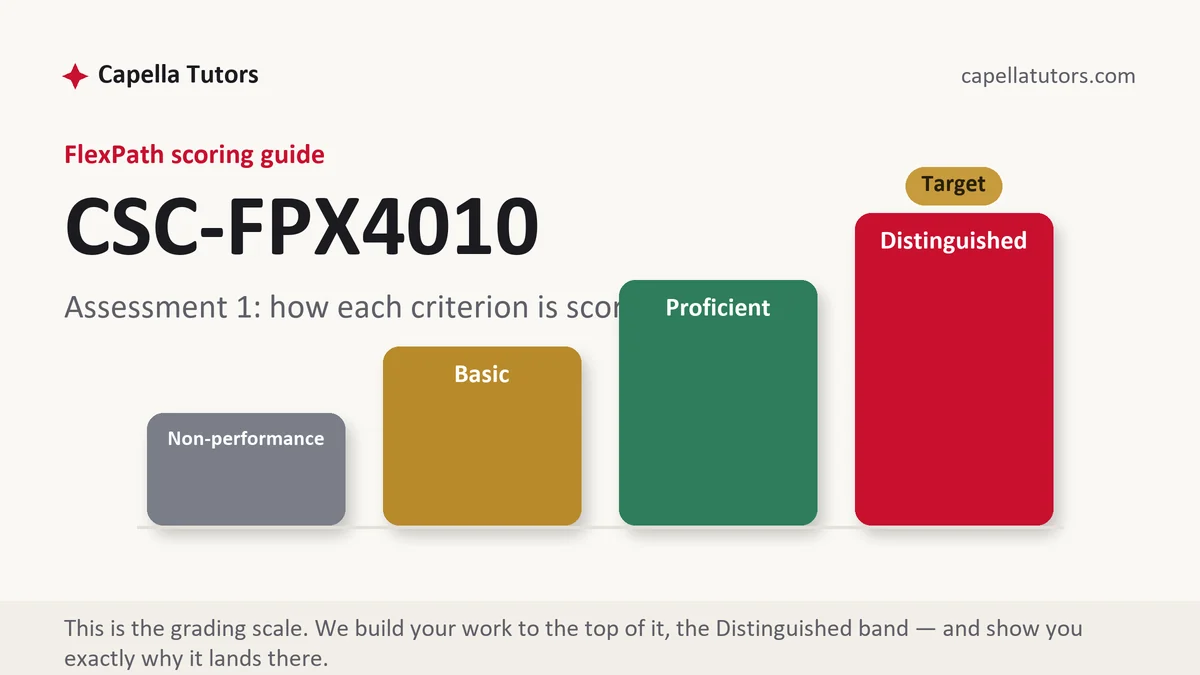
How CSC FPX 4010 Assessment 1 is scored
FlexPath does not award letter grades. Every criterion in the guide is placed at one of four levels, and the wording of those levels is your writing brief.
| Level | What it means on a formal language analysis |
|---|---|
| Distinguished | The grammar parses the examples given, each mechanism carries the name its own specification gives it, and the paper says which behaviors the notation cannot capture. That last admission is what the top column is paying for. |
| Proficient | The construct is described correctly and the notation is applied consistently. Complete work, one step below the level that tests its own grammar. |
| Basic | A paragraph about what the code looks like standing in for production rules. The usual landing spot when a student writes syntax in English. |
| Non-performance | A required element is absent, most often the grammar itself or the worked derivation. Absent scores lower than imperfect, every time. |
Precision here pays forward. The vocabulary you fix in this deliverable is the vocabulary later criteria assume you already own.
The CSC FPX 4010 Assessment 1 method, step by step
-
Turn the criteria into headings before you open an editor
The prompt tells you what to produce and the scoring guide decides what it is worth. Paste each criterion into your outline as a heading, park its Distinguished wording underneath it, and write only inside that skeleton. Anything added outside it is unpaid work.
-
Pick one construct and stay inside it
Choose a single construct small enough to define completely: an arithmetic expression, a conditional, a variable declaration, a function call. One construct defined exhaustively scores above four introduced and none finished, because the criteria measure the depth of a description rather than the territory it covers.
-
Write the grammar in a named notation
State up front whether you are using Backus-Naur form or the extended variant, then hold that choice for the whole document. Give the non-terminals, the terminals, and the production rules, and confirm the rules actually generate the examples you plan to show. A grammar that cannot produce its own examples is the fault an evaluator finds fastest.
-
Derive one example by hand
Take a short input and walk it through your rules, one substitution to a line, until only terminals remain. Draw the parse tree from that derivation, then say what an abstract syntax tree would drop. The contrast is the point: one tree records how the input matched the grammar, the other records only what the next stage of compilation needs.
-
Name mechanisms in the specification's own words
Each claim about meaning takes the term its defining document uses and a citation to the section that says so. Write static type checking rather than strict, write name resolution rather than lookup rules, and give the language version beside both. A term used loosely reads as a concept held loosely.
-
Give the draft a hostile reading, then self-score
Hand your grammar a string it ought to reject and confirm the rules refuse it. Hand it the examples in your paper and confirm they parse. Then read the draft against the guide, assign yourself a level on every criterion, and rewrite anything below the top one. Upload early in the week, since an evaluation can take two business days.
A structure that maps to the criteria
The word targets below are our tutors' planning figures for a construct-level analysis, not Capella limits; stretch any row your own scoring guide asks more of.
| Section | What it must do | Guide |
|---|---|---|
| Introduction and construct chosen | Name the language, the version, and the single construct under analysis, and say in one sentence why it is worth describing formally. | ~150 words |
| Grammar | The production rules in a named notation, with non-terminals and terminals listed, generating every example the paper later uses. | ~250 words |
| Derivation and trees | One worked derivation line by line, the parse tree it produces, and what an abstract syntax tree keeps and discards. | ~300 words |
| Semantics and mechanisms | Typing discipline, binding time, and scope for this construct, each named as its specification names it and cited there. | ~350 words |
| Limits of the description | What the grammar cannot express, and how the language settles that part instead. | ~200 words |
| References | Specification sections, the origin of the notation, and current APA matched both ways. | as needed |
Annotated sample excerpt
An original model excerpt from our team, printed for its register rather than its content. Copy the moves, not the material.
The query box in an issue tracker accepts a filter expression, and the field is small enough to specify completely, which makes it a fair subject for a formal description.1 In extended Backus-Naur form a filter is a term followed by zero or more pairs of a boolean operator and a term, a term is a field name, a comparison operator, and a literal, and a literal is a quoted string or an unsigned integer; those rules generate status = "open" AND priority > 2 and refuse status = AND, which is the pair of results a grammar has to produce first.2 The rules say nothing about whether a priority field may be compared with an integer at all, because that question belongs to the type rules rather than to the syntax, and the tracker's own reference settles it by checking the declared field type when the query is compiled rather than when it runs.3
- 1Names the construct and its boundary in one sentence, with no history of programming languages and no definition of the word syntax. The evaluator learns the scope immediately.
- 2Gives the rules and then tests them, one string accepted and one refused. A grammar shown working on its own examples answers the syntax criterion without further argument.
- 3Separates syntax from semantics out loud and sends the leftover question to the document that settles it, with the moment of checking named. That separation is the distinction this course keeps grading.
The full premium sample for your exact assessment, written fresh to your scoring guide and issue, is free to request. Study it, revise it into your own voice, and submit work you understand.
The five mistakes that cost Distinguished
- Syntax written as description. A criterion asking for a grammar wants production rules, and a paragraph about what the code looks like is not a rule.
- A grammar that fails its own examples. If the rules cannot derive the sample string in the same paper, nothing resting on them survives review.
- Parse tree and abstract syntax tree used as synonyms. The difference is usually the criterion rather than an aside inside it.
- Terms borrowed from a tutorial. A specification has its own word for the thing you are describing, and a looser one reads as a looser understanding.
- No version anywhere in the document. Semantics move between releases, so an undated claim ages into a wrong one.
Pre-submission checklist
- Every criterion in the guide has a labeled section of its own
- The notation is named once and applied the same way throughout
- The production rules generate each example shown, and reject one string that should fail
- One derivation worked line by line, with its parse tree and the abstract tree contrast
- Each mechanism named in specification vocabulary, cited to its section, version stated
- Self-scored at the top level on every criterion, references reconciled both ways in current APA
Grammar due and the rules will not parse?
Send the prompt, the scoring guide, and the construct you were assigned. Back comes the notation, the rules that derive your own examples, the tree contrast, and the specification citations sitting under each claim, inside 24 to 48 hours with revisions until the guide is satisfied. Your first sample is free.