This manual is for CSC FPX 4010 Assessment 3, start to submission. Assessment 3 in CSC FPX 4010, Principles of Programming Languages, is where the course usually stops asking what a mechanism does and starts asking which one you would choose: a paradigm recommended for a stated task, with the losing options given a fair hearing and every advantage priced. It is marked criterion by criterion against a scoring guide, and the recommendation is worth exactly what the reasoning under it is worth. The rest of this page gives our tutors' order of work, a section plan built from the criteria, and an annotated excerpt. Rather hand it off? Ask, and an original premium sample built to your own criteria lands inside 24 to 48 hours, with as many free passes as the guide needs. Capella's catalog lists the course as CSC-FPX4010, and some courserooms print CSC4010; both point to this same Assessment 3.
One honesty note before the manual: Capella revises courses and scoring guides over time, so always write to the exact scoring guide attached to your assessment in the courseroom. The course identity above is verified on capella.edu; the method and structure below are our tutors' approach to it, not Capella's official rubric text.
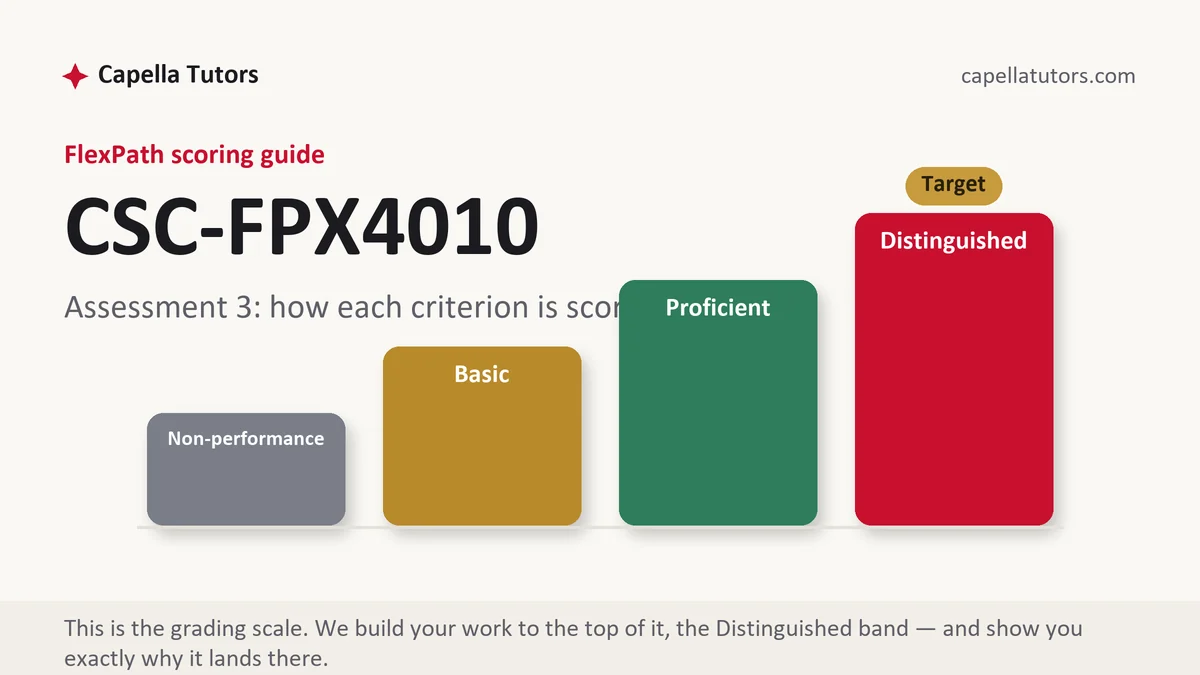
How CSC FPX 4010 Assessment 3 is scored
The scoring guide, not a percentage, decides this one. Each criterion is placed at a named level, and those names describe the writing you were supposed to do:
| Level | What it means on a paradigm recommendation |
|---|---|
| Distinguished | The task fixes the property being optimized, each paradigm is judged on that property alone, and every advantage is quoted with the cost it carries. The rejected option gets its strongest case before it is set aside. |
| Proficient | A defended recommendation with the alternatives genuinely compared. Sound work, short of the column that prices what the choice gives up. |
| Basic | Paradigms defined in turn and a favourite announced at the end, with the argument never leaving the general case. A definition list is not a recommendation. |
| Non-performance | A required element is missing, most often the comparison itself or the task the choice was meant to serve. |
Two habits carry this deliverable. Judge against the task rather than in the abstract, since no paradigm is correct in general, and attach a number wherever one exists, because a stated cost turns a preference into an argument somebody can mark.
The CSC FPX 4010 Assessment 3 method, step by step
-
Let the criteria set the sections, then write the task down first
Nothing can be recommended until the job is fixed on paper. Write the task in one sentence naming what goes in, what comes out, how often it runs, and who maintains it afterwards, and put that sentence at the top. Every later section is judged against it, so a vague task guarantees a vague comparison.
-
Choose the property the task actually cares about
A task cares about one or two things above the rest: throughput, clarity to a stranger, resistance to a wrong answer, cheapness of change. Name it early and rank the candidates on it alone. Papers that never name the property end up ranking paradigms on nothing in particular, which is the failure that reads as Basic.
-
Give each paradigm a job it wins and a job it loses
Imperative sequencing, object-oriented encapsulation and dispatch, functional immutability with first-class functions, and declarative resolution each earn a paragraph holding one task they suit and one they do not. The symmetry is the point: a paradigm you cannot criticize is one you have not understood.
-
Write the same small operation twice
Take one step of the task, express it in two of the paradigms, and keep both versions doing identical work. Ten lines each is enough, and the pair does more argumentative work than a page of prose, because a reader can see what each style makes easy and what it hides.
-
Price every advantage
Immutability removes a class of accidental change and allocates more memory; a class hierarchy localizes behavior and spreads a simple edit across files; a declarative query hands the work to an engine you cannot profile from the inside. State the exchange in the same sentence as the benefit and the maintainability criterion gets answered as you go.
-
Recommend, then say what would reverse it
Close with the choice, the property it was chosen on, and the condition that would send you the other way, such as the run outgrowing one machine or the team growing past two people. Then mark yourself on every criterion and rewrite whatever sits below the top level.
A structure that maps to the criteria
The counts below are our tutors' planning targets for a recommendation of this shape, not Capella requirements; expand any section your scoring guide weights more heavily.
| Section | What it must do | Guide |
|---|---|---|
| The task, stated once | Inputs, outputs, run frequency, and who maintains it, in a paragraph the rest of the paper can be checked against. | ~150 words |
| The deciding property | The one or two qualities this task needs most, named and defended before any paradigm is discussed. | ~150 words |
| Paradigms weighed | Each candidate with the task it suits and the task it does not, judged on the stated property rather than in general. | ~400 words |
| The same step, written twice | One operation expressed in two paradigms, both doing identical work, with versions and output given. | ~250 words |
| Recommendation and price | The choice, the exchange it accepts, and the condition that would reverse it. | ~250 words |
| References | Specification sections, peer-reviewed work on maintainability, and current APA checked in both directions. | as needed |
Annotated sample excerpt
One more original excerpt from our team. It is here as a model of how a recommendation carries its own cost, and it is study material rather than something to submit.
The job is narrow and its maintainers are known: one nightly run over roughly two million usage records, producing a summary for each account, kept alive by two people who also do everything else.1 On that task the property that matters is not speed, since the window is eight hours and the work finishes in minutes, but the cost of changing a billing rule eighteen months from now, and a pipeline of small pure transformations wins on exactly that, because a rule change touches one named function whose output can be checked without standing up the rest of the job.2 The exchange is real and belongs in the same breath: the functional version allocates a fresh collection at every stage and runs about a third slower than the imperative loop it replaces, a cost worth paying while the window stays eight hours and a cost to revisit the first night the run does not finish.3
- 1Fixes the task with numbers and names the maintainers, so the recommendation has something concrete to be right about.
- 2Chooses the deciding property, then argues from it instead of from the merits of the paradigm in general. This is the move that lifts the criterion.
- 3Prices the advantage and states the condition that would reverse the decision. An evaluator reading this is watching engineering judgment rather than preference.
The full premium sample for your exact assessment, written fresh to your scoring guide and issue, is free to request. Study it, revise it into your own voice, and submit work you understand.
The five mistakes that cost Distinguished
- A paradigm crowned in the abstract. Nothing is better in general, and a recommendation with no task attached has answered a question the guide did not ask.
- Definitions in place of comparison. Four paragraphs defining four paradigms is a glossary with a conclusion stapled to the end.
- Advantages listed without costs. Every property has a price, and a paper that never names one reads as advertising.
- Popularity used as evidence. A survey of what developers use answers what is common, not what suits the task in front of you.
- No reversal condition. A decision that cannot be revisited was never presented as a decision.
Pre-submission checklist
- The task written in one paragraph, with inputs, outputs, frequency, and maintainers
- The deciding property named before any paradigm is judged
- Each candidate given a task it fits and a task it does not
- One operation written in two paradigms, both runnable, versions stated
- Every advantage quoted with its cost, plus one condition that would reverse the choice
- Self-scored against each criterion, references reconciled in current APA both directions
Recommendation written and the reasoning still feels thin?
Send the task, the criteria, and the paradigms your prompt allows. Back comes the deciding property, the fair case for each option, the two small implementations, and the costed recommendation, in 24 to 48 hours with revisions free until your guide is satisfied. The opening sample carries no fee.