This manual is for CSC FPX 4010 Assessment 2, start to submission. Assessment 2 in CSC FPX 4010, Principles of Programming Languages, is usually where description turns into demonstration: a mechanism claimed in prose and then proved by a program short enough to read, run in two languages that disagree about it. Evaluators mark the evidence rather than the preference, criterion by criterion against a scoring guide. Below you will find the working order our tutors use, a section plan tied to the criteria, and an annotated excerpt. Would you rather hand it over? One request puts an original premium sample in your hands within 24 to 48 hours, and it keeps being revised at no charge until the guide is answered. Capella's catalog lists the course as CSC-FPX4010, and some courserooms print CSC4010; both point to this same Assessment 2.
One honesty note before the manual: Capella revises courses and scoring guides over time, so always write to the exact scoring guide attached to your assessment in the courseroom. The course identity above is verified on capella.edu; the method and structure below are our tutors' approach to it, not Capella's official rubric text.
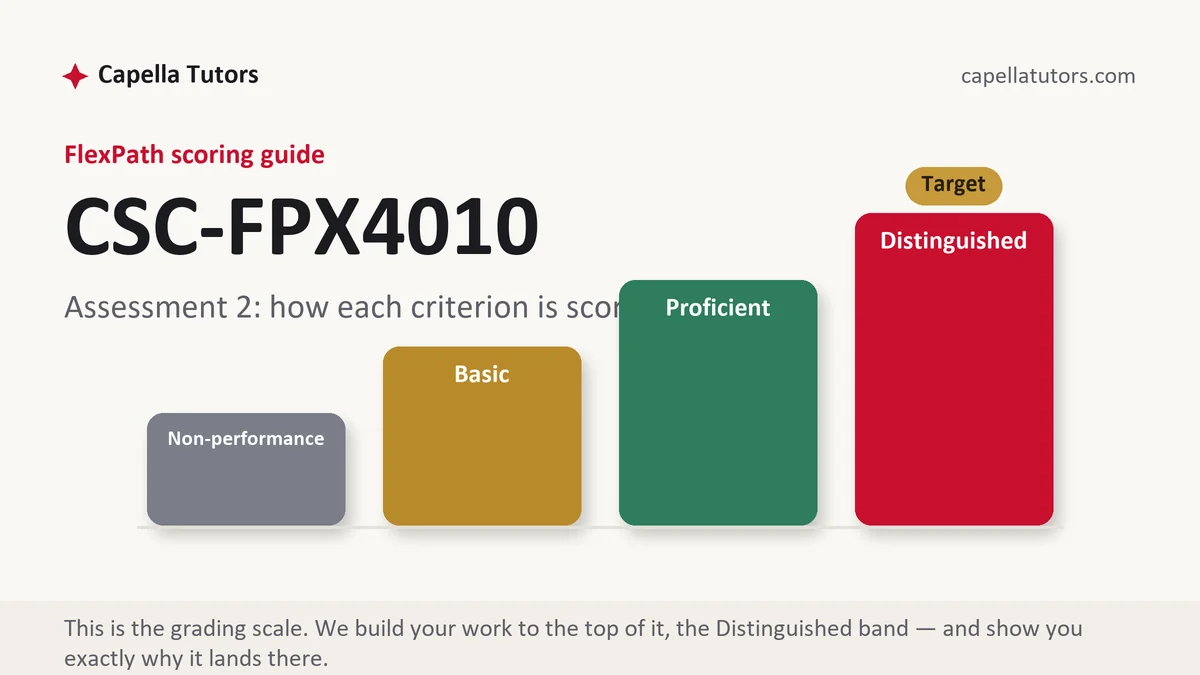
How CSC FPX 4010 Assessment 2 is scored
Nothing in FlexPath is averaged into a letter. A criterion sits at one of four levels, and the level descriptions tell you what to write:
| Level | What it means on a code-evidence comparison |
|---|---|
| Distinguished | Every claim carries a fragment that runs as printed and an output matching the prediction, and where the two languages diverge the paper names the mechanism responsible. Naming the cause is what separates this column from the one under it. |
| Proficient | The mechanism is explained correctly and the code supports it. Nothing is missing, and the divergence is reported rather than accounted for. |
| Basic | Two languages set side by side with adjectives in place of mechanisms, code pasted without output. Whatever the fragment printed, the reader has to take on trust. |
| Non-performance | A required element never appears, usually the second language or the observed results. An empty criterion scores at the floor however strong its neighbours are. |
One warning about scope. A comparison that takes a single mechanism and settles it completely outscores a tour of six, because each criterion is marked on the depth of one explanation and not on the number of features mentioned near it.
The CSC FPX 4010 Assessment 2 method, step by step
-
Read the guide, then choose the pair of languages that makes the test fair
Criteria decide the grade, so they decide the outline too. Once the headings exist, pick the two languages that isolate the mechanism you were handed rather than the two you write fastest. If the topic is how an argument reaches a function, one language that copies references and one that offers a genuine alias will show the difference in ten lines.
-
Write the claim as a sentence you could be wrong about
Before any code, finish this sentence: I will show that ___. A falsifiable claim gives you something to test, and the test produces the evidence the criterion wants. A claim nobody could disprove yields a paper nobody can mark above Basic.
-
Build the smallest program that could fail
Five to fifteen lines, one job, no framework. Write the version that mutates the object the parameter refers to, then the version that assigns a new object to the same parameter, and print the caller's variable after each. Two runs, four printed lines, and the mechanism is on the page instead of in your memory.
-
Record the environment as part of the evidence
Each fragment gets the language version, the compiler or interpreter, and any flag that mattered. A result with no environment attached is an anecdote, and the reproducibility criterion is checking exactly this. Keep the table as you work rather than reconstructing it at midnight.
-
Predict, run, and reconcile
Write the behavior your cited rule predicts, run the program, then set the observed output beside the prediction. Agreement is evidence. Disagreement is better material, provided you find the cause, because a student who explains why the rule and the run parted company has shown the understanding the criterion exists to find.
-
Mark your own draft against the guide
Read the criteria one at a time, assign yourself a level on each, and rewrite everything below the top one. Then check the thing students skip: every listing in the document is attached to a sentence it proves, and any listing you cannot attach has been cut.
A structure that maps to the criteria
These figures are the planning targets our tutors use for a two-language demonstration, not rules from Capella; add words wherever your own criteria ask for more.
| Section | What it must do | Guide |
|---|---|---|
| Task and language pair | The mechanism under test, the two languages chosen, and one sentence saying why that pair is a fair comparison. | ~150 words |
| The claim and the rule behind it | The falsifiable claim, plus the section of each language's defining document that predicts an outcome. | ~200 words |
| Programs and environment | The fragments as printed, with versions, toolchain, and comments placed at the decisions rather than above obvious lines. | ~300 words |
| Predicted against observed | A short table holding the input, the predicted behavior, the observed behavior, and the version each run happened on. | ~250 words |
| What the difference costs | The consequence of each mechanism for a program somebody has to maintain, with the cost stated as plainly as the benefit. | ~300 words |
| References | Specification sections, toolchain documentation with versions, and current APA reconciled in both directions. | as needed |
Annotated sample excerpt
A model excerpt from our team, here for its register rather than its subject. Read how the claim, the run, and the citation are made to agree, then do the same with your own mechanism.
A dispatcher object hands a helper method its list of delivery stops, and the two things that helper can do to the list are routinely mistaken for one another.1 Adding a stop inside the helper is visible to the dispatcher afterwards, because the parameter holds a copy of the reference and the copy still points at the dispatcher's list; assigning a brand new list to that same parameter is invisible, because the copy is what got redirected and the caller's own variable was never touched.2 Both runs printed what the language reference predicted, four stops after the first call and three after the second, on OpenJDK 21, while the C++ version of the same helper taking a reference parameter printed a replaced list in both cases, which is the behavior the two mechanisms genuinely differ on.3
- 1Frames the mechanism as a confusion a working programmer has rather than as a textbook heading. The evaluator sees the point of the experiment before any code arrives.
- 2Explains the behavior in terms of what was copied, which is the entire content of the criterion this usually sits under, and does it without using the phrase pass by reference loosely.
- 3Puts prediction, observed output, version, and the contrasting language into one sentence. That density is what the top column describes and what a Basic paper leaves out.
The full premium sample for your exact assessment, written fresh to your scoring guide and issue, is free to request. Study it, revise it into your own voice, and submit work you understand.
The five mistakes that cost Distinguished
- A copied reference called pass by reference. That distinction is the criterion, and collapsing it answers a question nobody asked.
- Code with no output printed underneath. An unrunnable fragment is an assertion set in a monospace font.
- Two languages ranked by preference. Easier and stricter are opinions, and the guide is marking mechanisms.
- A screenshot of the editor. A grader cannot search an image, an accessibility check will flag it, and the same lines set as text cost nothing.
- Six features mentioned and none finished. Breadth reads as avoidance when every criterion is marked on the depth of one explanation.
Pre-submission checklist
- One mechanism, stated as a claim a run could have contradicted
- Two languages that genuinely differ on it, with a sentence defending the pair
- Every fragment runs as printed, its output sitting directly beneath it
- Language version and toolchain recorded for each run
- Predicted behavior set against observed behavior in a table, with any gap explained
- Each claim about meaning cited to the defining document, references matched both ways in APA
Two languages, one mechanism, and no working proof yet?
Send the criteria, the mechanism you were assigned, and the languages your faculty permits. Back comes the pair of programs, their real output, the predicted-against-observed table, and the specification citations that carry each claim, inside 24 to 48 hours with free revisions until your guide is met. No charge on the first one.