Give us the prompt, the scoring guide and the reader you have been told to write for, and a premium original sample lands inside 24 to 48 hours, built to the Distinguished descriptors and revised free until the criteria clear. The course reads COM FPX 1250, Workplace Communication, worth 3 points, one of the choices in the Communication category of Capella's FlexPath general education menu, where the requirement is at least 22.5 points overall with no fewer than 2 points taken from each of the four categories. It carries no major attached to it, so the same seat holds business, technology, health care administration and psychology undergraduates at once. In Capella's catalog the course code is written COM-FPX1250.
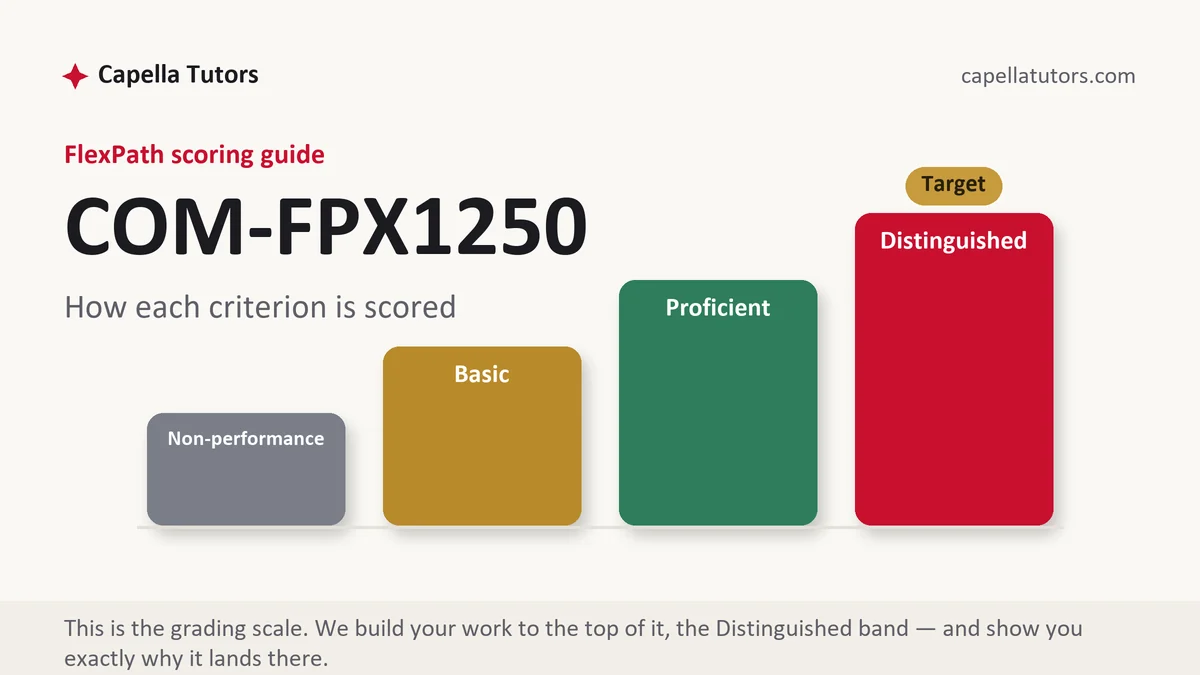
What COM FPX 1250 actually grades
The question behind every criterion here is whether a busy person could read your document once and do the right thing. That is a narrower target than good writing, and it explains scores that otherwise look unfair. Clear grammar, tidy paragraphs and a pleasant tone can still land in the Basic column if the reader has to reach paragraph four to learn what is being asked of them. The deliverables tend to hand you a workplace situation and a named reader, then grade the document you produce for that reader alongside a short explanation of why you built it that way.
Register is the first graded judgment, and register is not the same thing as politeness. It is the level a document is pitched at, and it moves with the reader, the relationship and the permanence of the record. A request to a division director is compressed, leads with the decision needed, and assumes the background. The same request to the crew doing the work is longer, names the tools and the shift, and answers the question everyone will ask before anyone asks it. Both are professional. Reversing them is the error, and it shows up in a criterion as a mismatch between audience analysis and the document itself, because a paper can describe an audience accurately in one section and then write past that audience in the next.
Arrangement is the second graded judgment, and there are two patterns to choose between rather than one habit to apply. The direct pattern puts the conclusion, the request and the deadline at the top, and it suits routine business, good news and anything a reader is expected to act on. The indirect pattern gives the reasoning before the outcome, and it earns its place when the news is unwelcome or the reader has to be brought around before they will accept a conclusion. Saying which pattern you chose and why converts a formatting decision into the reasoned judgment the criteria are written to reward.
The mechanics carry their own line, and here they are graded as function rather than as etiquette. A subject line naming the decision and the date does work no sentence inside the message can do. Bullets that start with the same part of speech can be scanned, and bullets that do not have to be read twice. Every message is also a record that may be forwarded to somebody it was not written for, which is the practical reason the tone advice in this course is more than manners.
How we help in this course
Samples for 1250 come with the document finished, sitting in the format a reader would actually receive: a subject line and a send-ready email, a memo with a header block, an agenda with times and owners, or a slide outline with headings that state conclusions rather than topics. Tell us the workplace, the reader and the outcome you need, and the draft will speak in that setting's vocabulary. Where the assessment also wants the reasoning, the analysis section names the register, the arrangement and the mechanics you chose, in the words your criteria use.
Terms are the same across the studio. Every deliverable is a premium original sample inside 24 to 48 hours, aimed at the Distinguished column of your own guide, then read by eight people including a criterion by criterion review and a separate pass for APA, originality and line editing. The final pass on a course like this one includes reading the document as its reader would, from the subject line down, timing how long it takes to find the request. Revisions stay free until the score lands, and returned faculty comments come back into that cycle at no charge.
The assessments, one by one
Assessment 1
The opening deliverable in Workplace Communication usually hands you a message or a thread that did not work and asks you to repair it, then explain the repair in the words your criteria use. Read the full Assessment 1 manual.
Assessment 2
The middle deliverable in Workplace Communication usually asks for the same news written for two different readers, then grades whether you can defend the difference. Read the full Assessment 2 manual.
Assessment 3
The final deliverable in Workplace Communication usually asks for the message nobody enjoys writing: news the reader does not want, delivered so the working relationship survives it. Read the full Assessment 3 manual.
How to actually write COM FPX 1250: where to begin
Start with the scoring guide and turn its rows into the outline, since the guide is what gets marked and the prompt only supplies the scenario. Underneath the criteria, before drafting anything, answer four questions in one line each: who reads this, what do they have to do, by when, and what will make them hesitate. That last one decides more than the others. A reader who has to spend money wants the cost and the alternative, a reader who has to change a routine wants to know who else is affected, and a document that ignores the objection gets a reply asking for it, which in this course is the definition of a message that did not work.
Then draft in the wrong order on purpose. Write the middle first, the facts and the reasoning, because that is the part you already know. Write the opening once the document exists, so it can state the request in the words the body actually supports. Write the subject line last, when you know what the message turned out to be about. Editing is a separate sitting: cut every sentence that repeats another, replace noun strings with verbs so utilization of the new process becomes use the new process, and make each bullet a parallel item rather than a stray sentence that wandered into a list.
Here is the contrast in the smallest possible space. A Basic version reads, I wanted to reach out regarding the upcoming changes to our inventory process that were discussed at last month's meeting, and continues for 280 words before asking anyone to do anything. The stronger version carries the subject line Inventory counts move to Fridays, starting 12 May, action needed by 5 May, then a first line reading, Please confirm by Friday 5 May that your team can complete counts on Fridays from 12 May. Three bullets follow with what changes, what does not, and who to contact, and the whole message runs 120 words. Same facts, same courtesy, a fraction of the reader's time. The plain language guidance behind that rewrite is public, developed under the Plain Writing Act of 2010 and published at plainlanguage.gov, and it is a citable authority when your guide asks you to justify a choice.
| Section | What goes in it | What Distinguished looks like |
|---|---|---|
| Purpose and request | The outcome you need, the action required, the person responsible, and the date. | The request findable in the first few lines, with a date attached rather than implied. |
| Reader profile | What this reader knows, what they control, what it costs them, and what they will resist. | An objection named in advance and answered inside the document. |
| Register and tone | The formality level chosen, the vocabulary it allows, and the relationship it reflects. | A register defended against the reader and the permanence of the record, not against habit. |
| Arrangement | Direct or indirect pattern, the sequence of points, and what is attached rather than included. | The pattern named and justified, with the reasoning sitting where that pattern requires it. |
| Evidence in the document | Numbers, dates, documents and quotations, each attributed inside the sentence. | Every figure traceable to a named source a reader could open the same morning. |
| Mechanics and references | Subject line, headings, parallel lists, proofreading, current APA in the academic sections. | Formatting that shortens the read, and citation conventions matched to each part of the deliverable. |
Developing the synthesis
The synthesis this course asks for is the resolution of two demands that pull against each other, and naming the tension is the move that scores. Brevity and completeness is the usual pair. Directness and diplomacy is the other. Neither is settled by preference, both are settled by the reader, and the sentence that shows the judgment sounds like this: because this reader has to defend the spend to a committee, the message stays direct but carries the cost breakdown as an attachment, so the top of the message stays short without leaving the reader unarmed. Write the trade-off explicitly rather than hoping the document demonstrates it. Where a source and your own workplace experience disagree, say so and say which one governs here, since an evaluator reading for judgment is reading for the sentence where you chose.
Citations that survive faculty review
Three kinds of authority hold up an assessment in this course. Peer-reviewed business and technical communication research, reached through the Capella library in databases such as Business Source Complete and ProQuest, supports any claim about what a practice does to comprehension or response. Public standards bodies and government guidance supply the rules, with the federal plain language material as the most quotable example. Organizational documents are the third kind, meaning the policy, the invoice, the ticket log or the contract clause your message rests on, and they are named as documents with dates. One journal habit is worth borrowing. Before repeating a claim that a formatting choice improves reading, check whether the study measured comprehension, recall or preference, because the three often disagree and preference is the weakest of them. Then run the reference list against the citations in both directions before you submit.
The mistakes that land Basic instead of Distinguished
- The request buried at the bottom. A reader who scans the first screen and finds no action treats the message as information and moves on.
- One register for every reader. The same paragraph sent to an executive and to a night shift fails one of them, and the criteria name which.
- Please advise with no deadline. A request with no date and no owner cannot be scored as a request, because nothing about it can be tracked.
- Bullets that are not parallel. A list mixing verbs, nouns and half sentences is slower to read than the paragraph it replaced.
- An academic essay wearing a memo header. Formatting alone does not make a document workplace writing, and the mismatch is visible in the first two lines.
COM FPX 1250 questions students actually ask
How long should a workplace message be?
As long as the reader's decision requires and no longer, which for routine email is usually under 150 words. Length is not the real variable, though. Position is. A 400 word update that opens with the decision and the date is easier to act on than a 90 word note that saves its request for the final line. When the content genuinely runs long, split it: the message carries the request and the deadline, the attachment carries the detail, and a line in the message says what the attachment contains and which page matters. If your scoring guide names a length, treat it as a limit rather than a target, because padding shows in a short genre faster than anywhere else.
Can I write in the first person and use contractions?
In the workplace document, usually yes, and the criteria rarely forbid it. First person is normal in email and memos, contractions read as ordinary rather than sloppy in most internal writing, and a plain sentence beats an inflated one every time. Two cautions apply. Documents that carry legal or disciplinary weight, and documents that go outside the organization, tend to drop contractions and lean formal. The academic sections around the document follow a different rule, since the analysis you write about your own choices stays in third person and current APA unless your guide says otherwise. Deciding which convention governs which part of the deliverable is itself a graded judgment.
Does the memo itself need APA citations?
Almost never in the form your English course taught you. A memo attributes inside the sentence, so you write that the March invoice from the vendor shows a 12 percent increase, or that the help desk logged 210 password resets in April, and the reader knows exactly where to check. Reference lists belong to the academic portion of the deliverable, which does need current APA in both directions. Where an outside authority is genuinely doing the work in a workplace document, name it in the text and link or attach it. Handing a supervisor a memo with a hanging indent bibliography is the clearest signal that a document was written for a grader rather than for a reader.
Email, memo or briefing due?
Send the scenario, the criteria and the reader you were given. The document comes back send-ready, with the reasoning written underneath it. First premium sample free.