This manual is for COM FPX 1250 Assessment 3, start to submission. The final deliverable in Workplace Communication usually asks for the message nobody enjoys writing: news the reader does not want, delivered so the working relationship survives it. The indirect pattern is the tool, and the criteria pay for a decision stated once and plainly rather than for softness spread across four paragraphs. What our tutors do with news like this comes next, with a section order from the rows and one excerpt annotated. Would you sooner not write it at all? A premium original message drafted against your own criteria arrives inside 24 to 48 hours, and revisions continue at no charge until the guide is met. Capella's catalog lists the course as COM-FPX1250, and some courserooms print COM1250; both point to this same Assessment 3.
One honesty note before the manual: Capella revises courses and scoring guides over time, so always write to the exact scoring guide attached to your assessment in the courseroom. The course identity above is verified on capella.edu; the method and structure below are our tutors' approach to it, not Capella's official rubric text.
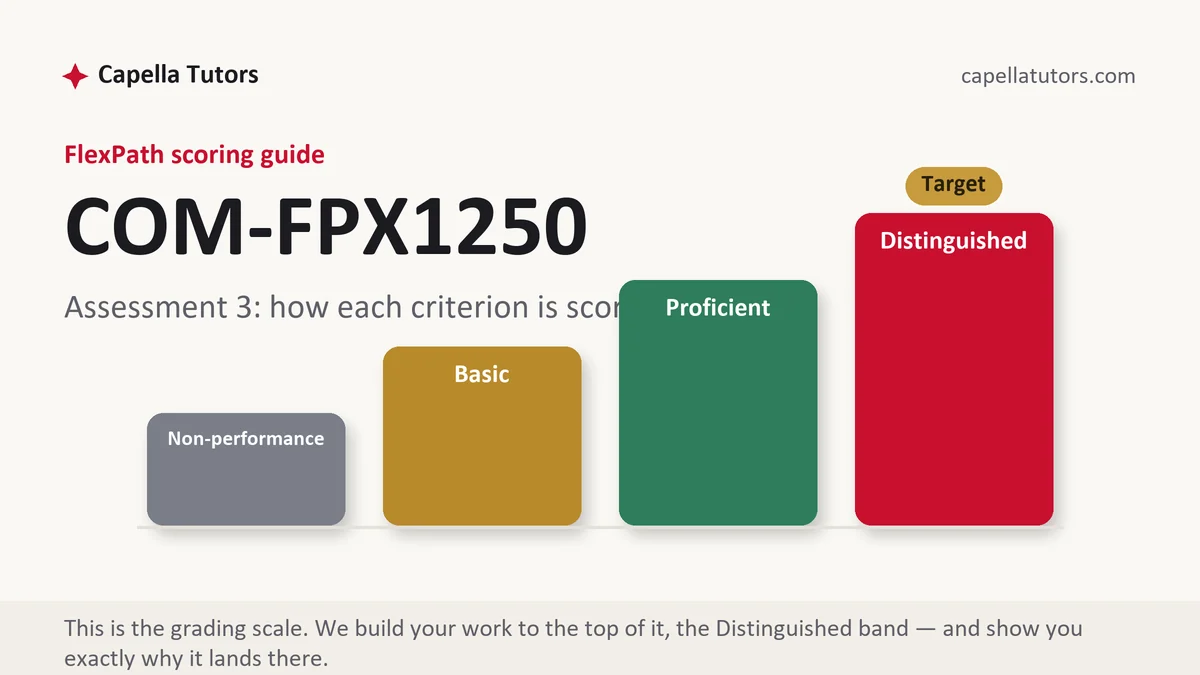
How COM FPX 1250 Assessment 3 is scored
FlexPath scores each criterion at one of four levels and never converts them into a letter. The wording of the level you are aiming at is your brief:
| Level | What it means on a bad-news message |
|---|---|
| Distinguished | The opening is neutral rather than warm, the reasoning arrives before the decision and leads to it, the decision is stated once in plain words, what remains available is named, and the close looks forward without reopening the decision. Whatever the top column asks for that Proficient does not is written into it; do exactly that. |
| Proficient | Bad news delivered clearly and courteously in a defensible order. Good work, one row below the top. |
| Basic | A refusal so cushioned that the reader has to read twice to learn the answer, or a blunt refusal with an apology where the reason belongs. Where most first attempts land. |
| Non-performance | A required element is absent, most often the reason, or the decision itself, left implied rather than stated. |
Every message is a record that may be forwarded to somebody it was not written for, and a non-renewal notice is the kind of record that gets forwarded. That is the practical reason the tone advice in this course is more than manners, and it is why the row asks you to defend the register against permanence as well as against the reader.
The COM FPX 1250 Assessment 3 method, step by step
-
Build from the rows, then decide what is actually being communicated
Under each criterion, write one line naming the outcome: the agreement ends on a date, the reason is a policy or a price, and something specific either remains possible or does not. A writer who has not settled that will hedge, and hedging in a refusal reads as an invitation to negotiate.
-
Open on neutral ground, not on warmth
A buffer is a sentence both parties would agree with and that promises nothing: the review that took place, the period the relationship covered, or the process being followed. Thanking somebody for years of excellent service and then refusing them teaches the reader that praise is a warning, and it is the most common buffer error in the course.
-
Give the reason before the decision, and make it lead there
The reasoning has to be strong enough that the reader sees the conclusion coming. Two competitive bids came in eleven percent below the current rate and the procurement policy requires an award to the lowest compliant bid is a reason that produces the outcome. Costs have been reviewed carefully is not a reason, it is a delay.
-
State the decision once, in plain words, in one sentence
The agreement will not be renewed when the current term ends on 30 September. No qualifier, no repetition, no passive construction hiding who decided. A decision stated twice sounds like an argument the writer is still having, and a decision hidden in the passive voice invites the reader to hunt for somebody to appeal to.
-
Name what remains, then close forward
Say what is still true and still available: the final invoices, the transition period, the right to bid on the next cycle, the reference you will provide. Then close on the next practical step rather than on regret. A close that reopens the decision undoes the message, and a close made only of apology leaves the reader with nothing to do.
-
Read it as a forwarded document, then score yourself
Reread the draft imagining it attached to an email you were not copied on. Cut any sentence you would not want read aloud, check the date and the term are exact, and confirm the reason is one the organization would repeat in the same words. Then score every row yourself, N, B, P or D, before the attempt goes in early in the week.
A structure that maps to the criteria
The last column carries our tutors' planning numbers for an undergraduate bad-news deliverable, not Capella requirements; where the guide asks for more, expand.
| Section | What it must do | Guide |
|---|---|---|
| Situation and stakes | What is ending, on what date, and what the relationship has been, stated without adjectives. | ~150 words |
| Reader profile | What this reader expects, what the news costs them, and what they will ask for next. | ~200 words |
| The message | Buffer, reasoning, the decision in one sentence, what remains available, and a forward-looking close. | ~280 words |
| Pattern and register defended | Why the indirect pattern fits this reader and this record, and where the register sits. | ~250 words |
| Legal and ethical care | What can be said accurately, what cannot, and how the document behaves if it is forwarded or filed. | ~200 words |
| Mechanics, sources and close | Contact details, exact dates, and current APA in the academic sections, matched both ways. | ~150 words |
Annotated sample excerpt
A model sequence from our team, showing the three moves in the order the top row expects. Study the sequence, then write it for the news your own scenario gives you.
The three year grounds maintenance agreement reached its scheduled review in April, and the property put the work out to competitive bid as the procurement policy requires for contracts above $50,000.1 Two compliant bids came in at rates eleven and fourteen percent below the current schedule, and the policy directs an award to the lowest compliant bid.2 The agreement will therefore not be renewed when the current term ends on 30 September. Invoices for work through that date will be paid on the existing terms, the transition walkthrough is scheduled for 12 September, and the next bid cycle opens in February with your firm on the invitation list.3
- 1The buffer is a fact both parties hold and it promises nothing, so nothing in the opening will read later as a warning dressed up as a compliment.
- 2The reason arrives before the decision and points at it, which lets the reader reach the conclusion a beat before the sentence that states it.
- 3The decision occupies one plain sentence, then the paragraph moves to what remains true, in dates a reader can act on. The close looks forward without reopening anything.
The full premium sample for your exact assessment, written fresh to your scoring guide and issue, is free to request. Study it, revise it into your own voice, and submit work you understand.
The five mistakes that cost Distinguished
- Praise used as a buffer. A compliment followed by a refusal trains the reader to distrust the compliment, and it is scored as a register failure.
- A reason that is not a reason. After careful consideration explains nothing, so the decision arrives unsupported and reads as arbitrary.
- The decision stated three times. Repetition sounds like an argument the writer is still having, and it invites a reply that continues it.
- The passive voice hiding the decider. It has been decided leaves the reader hunting for somebody to appeal to, which is the opposite of a close.
- A close made of apology. Regret with no next step leaves the reader with feelings and no action, and the action row has nothing to grade.
Pre-submission checklist
- The buffer is neutral and contains no praise doing the work of a cushion
- The reason appears before the decision and leads to it
- The decision is stated once, in active voice, with an exact date
- What remains available is named with dates a reader can use
- The close looks forward and does not reopen the decision
- The document survives being forwarded, citations matched both ways, self-scored D
Bad news to deliver and the draft keeps apologizing?
Send the scenario, the reader and the criteria. A team of eight, including a research analyst and two QA reviewers, returns a premium original message in 24 to 48 hours with a neutral buffer, a reason that leads to the decision, and the pattern defended in the analysis.