This manual is for COM FPX 1250 Assessment 1, start to submission. The opening deliverable in Workplace Communication usually hands you a message or a thread that did not work and asks you to repair it, then explain the repair in the words your criteria use. The graded question is narrower than good writing: could a busy person read this once and do the right thing. Our tutors' method for a repair like this comes next, with the section order the rows imply and an annotated excerpt. Want the rewrite done for you? A premium original message written to your own criteria arrives inside 24 to 48 hours, revised free until every row clears. Capella's catalog lists the course as COM-FPX1250, and some courserooms print COM1250; both point to this same Assessment 1.
One honesty note before the manual: Capella revises courses and scoring guides over time, so always write to the exact scoring guide attached to your assessment in the courseroom. The course identity above is verified on capella.edu; the method and structure below are our tutors' approach to it, not Capella's official rubric text.
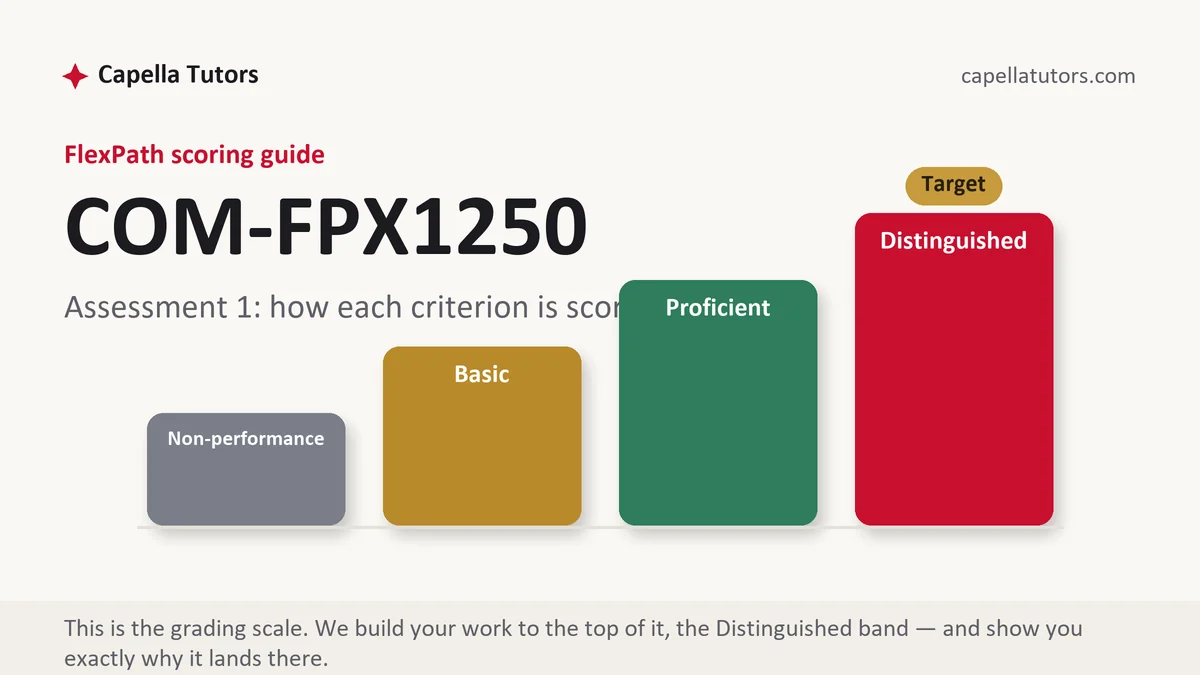
How COM FPX 1250 Assessment 1 is scored
No letter grade is produced anywhere in FlexPath. Each criterion is marked at one of four levels, and the level wording tells you what the document has to do:
| Level | What it means on a repaired message |
|---|---|
| Distinguished | The rewritten message states the request in the first line with an owner and a date, the subject line names the decision, the register matches the reader named in the analysis, and the analysis explains each change in the criteria's own vocabulary rather than narrating what was done. The additional move is stated in the column, and performing it deliberately is what closes the gap. |
| Proficient | A clearer message and an accurate account of the changes made. Competent work, one row below the top. |
| Basic | A tidier version of the same message, with the request still in the last paragraph, and an analysis saying the tone was improved. The most common first attempt. |
| Non-performance | A required element is absent, most often the analysis, or the reader profile the analysis is supposed to rest on. |
This course carries 3 general education points and seats business, technology, health care administration and psychology undergraduates together. The reader you are writing for is therefore invented, which makes the analysis section the only place an evaluator can see whether your choices were reasoned or lucky.
The COM FPX 1250 Assessment 1 method, step by step
-
Turn the rows into the outline and answer four questions
The guide is what gets marked; the prompt only supplies the scenario. Under the criteria, before drafting, answer four questions in one line each: who reads this, what do they have to do, by when, and what will make them hesitate. The last one decides more than the others, because a document that ignores the objection earns a reply asking for it.
-
Diagnose the thread before you rewrite it
Read the original chain and mark, in the margin, where the request first appears, how many separate asks are in flight, who was added and when, and which message created the confusion. A repair you cannot justify is only a rewrite, and the row that pays is the one asking why each change was made.
-
Count the asks and reduce them to one message each
A thread that has drifted usually contains three requests wearing one subject line. Separate them: what has to be decided now, what needs an answer this week, and what is context nobody needs to act on. Then write the message for the decision and let the rest go into an attachment or a later note.
-
Write the middle first, the opening second, the subject line last
Draft the facts and the reasoning, because that is the part you already know. Write the opening once the message exists, so it can state the request in the words the body actually supports. Write the subject line at the end, when you know what the message turned out to be about, and make it name the decision and the date.
-
Choose the pattern on purpose and say so
Routine requests, approvals and good news take the direct pattern, with the decision or the ask in the first sentence. Refusals and anything that has to change a mind take the indirect pattern, with the reasoning ahead of the outcome. Name the pattern you chose in the analysis and give the reader-based reason, because a formatting decision with a reason attached is the judgment the row rewards.
-
Read it as the reader, then score yourself
Open the message cold and time how long it takes to find the action. Check that every bullet starts with the same part of speech, that the date is written out rather than implied by soon, and that a person's name sits beside the verb. Then mark each criterion N, B, P or D yourself and submit early in the week, since an attempt can wait two business days.
A structure that maps to the criteria
The figures in the last column are our tutors' planning targets for an undergraduate repair deliverable, not Capella rules; grow any section your guide asks more of.
| Section | What it must do | Guide |
|---|---|---|
| What went wrong | The original thread diagnosed: where the request sat, how many asks were live, and which message caused the confusion. | ~200 words |
| Reader profile | What this reader knows, controls and will resist, plus what the message costs them. | ~180 words |
| The rewritten message | Subject line, opening request, supporting detail, parallel bullets, and an action line with a name and a date. | ~250 words |
| Register and pattern | The formality level chosen, the pattern chosen, and the reader-based reason for each of them. | ~230 words |
| Evidence and attachments | Figures, documents and dates attributed inside sentences, with what was moved out of the message and why. | ~180 words |
| Analysis close and references | What the repair is expected to achieve, plus current APA in the academic sections, matched both ways. | ~150 words |
Annotated sample excerpt
An original model from our team, written at the register the Distinguished column describes. Take the ordering, then rebuild the message your own scenario handed you.
Subject: Confirm Thursday lunch count by 4 p.m. Tuesday 12 May.1 Please reply with a final head count for Thursday's session by 4 p.m. on Tuesday 12 May; the caterer holds our order until then and charges for late changes.2 Three things have changed since Friday's thread: the room moved to Hall B, the dietary form closed with 9 responses, and the invoice question is now with Accounts Payable and needs nothing from you.3
- 1The subject line names the decision and the deadline, so the message is actionable from the inbox list without being opened.
- 2The request occupies the first sentence with an owner, a time and a reason for the deadline. A reader who stops here has still received the message.
- 3Three loose threads are resolved in one line, and the one that needs nothing from this reader is closed explicitly rather than left circulating.
The full premium sample for your exact assessment, written fresh to your scoring guide and issue, is free to request. Study it, revise it into your own voice, and submit work you understand.
The five mistakes that cost Distinguished
- The request in the last paragraph. A reader who scans the first screen and finds no action files the message as information.
- Three asks under one subject line. A message with several live requests gets a partial answer at best, and then the thread grows again.
- Please advise with no date. A request without an owner and a deadline cannot be tracked, so it cannot be scored as a request.
- An analysis that narrates the edit. Saying you improved the tone is a description; naming the register and the reader who required it is the judgment being graded.
- Bullets that are not parallel. A list mixing verbs, nouns and half sentences reads more slowly than the paragraph it replaced.
Pre-submission checklist
- The subject line names a decision and a date
- The request appears in the first sentence with an owner and a deadline
- Each bullet begins with the same part of speech
- The reader profile names what this reader controls and what they will resist
- The pattern and the register are each named with a reader-based reason
- Dates written out, citations matched both ways in the academic sections, self-scored D
Handed a thread to fix and unsure what to keep?
Send the original messages, the reader you were assigned and the criteria. A team of eight, including a research analyst and two QA reviewers, returns a premium original sample in 24 to 48 hours with the message rebuilt and the reasoning written underneath it, revised free until the guide clears.