This manual is for COM FPX 1250 Assessment 2, start to submission. The middle deliverable in Workplace Communication usually asks for the same news written for two different readers, then grades whether you can defend the difference. Register is the graded judgment, and register is not politeness; it is the level a document is pitched at, and it moves with the reader, the relationship and how long the record lasts. The method is set out below, followed by the sections the rows ask for and a pair of openings marked up. Rather hand both versions over? A premium original pair of documents written to your own scoring guide comes back within 24 to 48 hours, with revisions free until the rows are satisfied. Capella's catalog lists the course as COM-FPX1250, and some courserooms print COM1250; both point to this same Assessment 2.
One honesty note before the manual: Capella revises courses and scoring guides over time, so always write to the exact scoring guide attached to your assessment in the courseroom. The course identity above is verified on capella.edu; the method and structure below are our tutors' approach to it, not Capella's official rubric text.
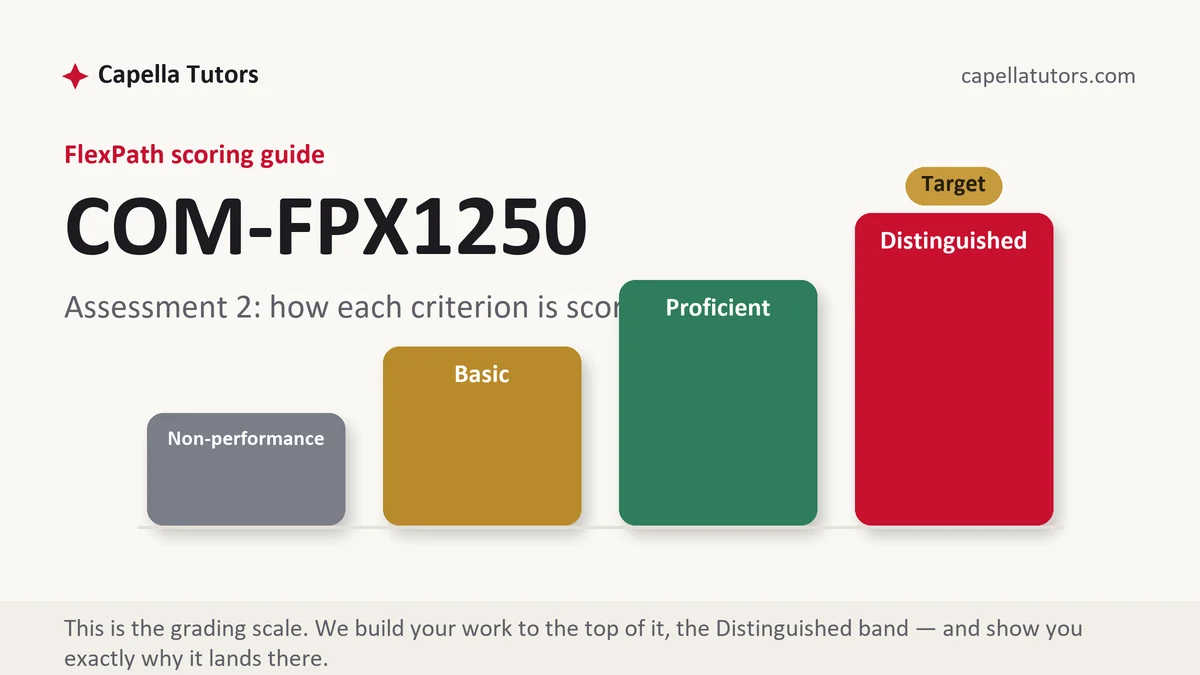
How COM FPX 1250 Assessment 2 is scored
Every row is scored on its own at one of four levels, and none of it adds up to a letter. The description of the level you want is the instruction:
| Level | What it means on a two-audience deliverable |
|---|---|
| Distinguished | Each version reaches the reader it was written for, the compression differs because the readers differ rather than because one was written second, the objection each reader will raise is answered inside their own version, and the analysis defends the register against the reader and the permanence of the record. The column itself names the step past Proficient, so lift it from the wording and take it. |
| Proficient | Two versions correctly pitched and an accurate explanation of the differences between them. Solid, one move below the top row. |
| Basic | One message sent twice with the salutation changed, and an analysis noting that executives are busy. The usual first attempt at this deliverable. |
| Non-performance | A required element is absent, most often the second version, or the audience analysis the two versions are supposed to rest on. |
General education points are earned here by transferable behavior rather than by industry knowledge, which is why the same deliverable is graded the same way whether your reader is a division director, a night shift, a clinic front desk or a service team.
The COM FPX 1250 Assessment 2 method, step by step
-
Write the rows into headings, then profile both readers separately
Two profiles, four lines each: what they know, what they control, what this costs them, and what they will push back on. A director controls the budget and will ask what happens if the work runs late. A crew controls nothing about the decision and will ask where they are supposed to park on Tuesday. Those are different documents from the first line onward.
-
Decide what each reader has to do
One reader approves and the other complies, so the request differs accordingly. Write the action line for each version before the body, because a message whose action is unclear to you will be unclear on the page, and a notice that ends by asking a hundred people for their thoughts has given them nothing to do.
-
Compress for the reader who already has the background
The director's version assumes the project, leads with the decision needed and the money, and keeps the detail in an attachment. Compression is not curtness. It is the recognition that a reader who already holds the context does not need it retold, and the row scores that recognition rather than the word count.
-
Expand for the reader who has the practical question
The crew's version answers the question everyone will ask before anyone asks it: which days, which entrance, what happens to the shuttle, who to call when a sign is wrong. Longer is correct here. A notice leaving the practical question unanswered generates fifty replies, which is the working definition of a message that failed.
-
Choose the pattern for each and name it
Good news and routine instructions take the direct pattern. A notice that removes something people rely on is closer to a refusal and often earns the indirect pattern: a neutral opening, the reason, the change stated once and plainly, then a close that keeps the working relationship intact. Say which you chose for each reader and why.
-
Read both cold, then score yourself
Read each version as its reader, from the subject line down, and check that the action is findable in the first few lines and the date is written out. Confirm that neither version would embarrass you if it were forwarded to the other reader, since every message is a record. Then mark each row N, B, P or D yourself and submit early in the week.
A structure that maps to the criteria
Word counts here are the planning targets our tutors use for an undergraduate two-audience deliverable, not Capella instructions; your own guide decides length.
| Section | What it must do | Guide |
|---|---|---|
| The situation and the constraint | What is changing, over what dates, and the budget, policy or schedule limit that fixes it. | ~150 words |
| Two reader profiles | For each reader: knowledge, control, cost, and the objection they will raise. | ~220 words |
| Version one | The document for the reader who decides, compressed, with the detail attached rather than included. | ~230 words |
| Version two | The document for the reader who complies, expanded where the practical questions live. | ~230 words |
| Register and pattern defended | Why each version is pitched where it is, with the permanence of the record accounted for. | ~250 words |
| Mechanics, sources and close | Subject lines, parallel lists, written-out dates, and current APA in the academic sections. | ~150 words |
Annotated sample excerpt
A model pair of openings from our team, showing what the register row is actually measuring. Learn the contrast, then write it for the two readers you were given.
To the facilities director: the staff lot closes for resurfacing from Monday 8 June to Friday 26 June, and I need your approval by 29 May to hold the contractor's June slot at the quoted $18,700.1 To the staff who park there: the staff lot is closed for resurfacing from Monday 8 June to Friday 26 June, and every permit holder keeps a space in the overflow lot behind Building C at no charge, entering from Third Street rather than Vine.2 The second version runs four lines longer, because the questions it has to answer, shuttle times, overnight vehicles, and who to call when a sign is wrong, are the ones the first reader will never ask.3
- 1The decision, the dates, the money and the deadline arrive in one sentence, because this reader already knows what the lot is and what resurfacing involves.
- 2The same news opens with what the reader loses and what replaces it, in that order, and the entrance is named because that is the detail a hundred people will need on the first morning.
- 3The length difference is defended by the readers' questions rather than by tone, which is the distinction the register row is written to test.
The full premium sample for your exact assessment, written fresh to your scoring guide and issue, is free to request. Study it, revise it into your own voice, and submit work you understand.
The five mistakes that cost Distinguished
- One message sent twice. Changing the salutation and leaving the body alone fails one of the two readers, and the row names which.
- Compression mistaken for curtness. A short message that omits the cost has not respected the reader's time, it has withheld what they needed.
- The practical question left unanswered. A notice that does not say where to park on Monday produces the replies it was written to prevent.
- An objection answered in the wrong version. The reason the schedule cannot move belongs with the reader who could have moved it.
- Soon, shortly, in the coming weeks. An implied date cannot be planned around, and it is the fastest way to lose the mechanics row.
Pre-submission checklist
- Both readers profiled for knowledge, control, cost and likely objection
- Each version carries its own action line with an owner and a written-out date
- The length difference is explained by the readers' questions, not by tone
- Each reader's objection is answered inside their own version
- Both versions would survive being forwarded to the other reader
- Parallel lists, subject lines that name a decision, citations matched both ways, self-scored D
Same news, two readers, and one of them keeps winning?
Send the scenario, both readers and the criteria. A team of eight, including a research analyst and two QA reviewers, returns two premium original documents in 24 to 48 hours with the register defended in the analysis, revised free until the guide is satisfied.