Send the prompt, the scoring guide and the topic you were handed, and a premium original sample returns inside 24 to 48 hours, drafted against the Distinguished descriptors with every link and every DOI opened before delivery. The identity of the course: COM FPX 1150, Introduction to Digital Information and Literacy, worth 3 points, one option inside the Communication category of Capella's FlexPath general education menu, which asks for at least 22.5 points in total and a minimum of 2 points from each of its four categories. Undergraduates across business, information technology, health care administration and psychology all pass through the same course, so nothing here assumes a major. In Capella's catalog the course code is written COM-FPX1150.
What COM FPX 1150 actually grades
The subject of this course is the decision you make before you cite anything. Its criteria tend to grade a process rather than a finished argument: how a broad topic became a question a database could answer, where you searched, what you discarded and on what grounds, and whether the material you kept can hold the weight of the sentence you attached it to. That surprises people. A confident paper with eight references can sit in the Basic column while a plainer one that shows its search trail and defends two rejections sits above it, because only the second has produced evidence about the skill being scored.
Searching is treated as a technique with visible moves. Turning a topic into search terms means listing the words a professional would use rather than the words you would say out loud, so a question about people working from home is searched as remote work, telework and distributed teams before you give up on it. Combining those terms with AND narrows, OR widens, quotation marks hold a phrase together, and the date and peer-reviewed filters in a general database such as Academic Search Complete or ProQuest Central do more for a search than another hour of scrolling. One habit is worth the whole lesson: when an article fits, open its reference list and its subject headings, because the fastest route to the next good source is the one the last good source already found.
Evaluation is the second graded strand and the course wants a method, not a hunch. Mike Caulfield's SIFT routine gives you four moves, stop before reacting, investigate who is behind the source, find better coverage of the same claim, and trace a quote or a statistic back to where it started. The companion habit is lateral reading, which means leaving the page to find out what other people say about its publisher instead of staying inside the page and reading its own About section. Sam Wineburg and Sarah McGrew reported in 2019 that professional fact checkers work this way while students and even academic historians tend to stay put and be persuaded by design cues, which is the same habit the course builds as you research the skills your future career requires, communicate with colleagues, and organize your digital work.
The last strand is conduct with other people's material. Expect attribution treated as an ethical question rather than a formatting chore, copyright weighed against fair use, Creative Commons licenses read for what they actually permit, and privacy handled as a set of choices about what a search engine can assemble about you. Generative tools sit inside that strand now, on a practical rule: an output nobody else can retrieve cannot serve as evidence, whatever it says.
How we help in this course
Drafts for 1150 arrive with the search visible. When the criteria ask for a strategy, the sample names the databases queried, the term combinations tried, the filters applied and the results that were passed over, with a stated reason for each pass, because a described search that nobody could repeat earns less than a modest one that anybody could. Every reference is opened rather than assembled from a citation string, DOIs are resolved, and any page that changes over time is captured with the date it was read.
Turnaround and pricing do not shift between courses. Each deliverable is a premium original sample inside 24 to 48 hours, written to the Distinguished column of your own scoring guide, then handled by eight people including a criterion by criterion review and an APA and originality pass in both directions. Revisions cost nothing until the guide is satisfied, faculty comments re-enter that cycle free, and since faculty have two business days to look at an attempt, the review passes exist to keep you from spending those days twice.
The assessments, one by one
Assessment 1: Researching the Skills Required for a Future Career
Choose a career, research its required skills in credible digital sources, evaluate those sources, and compare the skills with your own. Read the full Assessment 1 manual.
Assessment 2: Communicating with Professional Colleagues
Write professional digital messages for workplace situations, choosing the right channel, tone and structure for each audience. Read the full Assessment 2 manual.
Assessment 3: Making Time to Achieve Your Goals
Track how you spend your time, analyze it, use digital tools to plan, and set a schedule that makes room for your academic and career goals. Read the full Assessment 3 manual.
How to actually write COM FPX 1150: where to begin
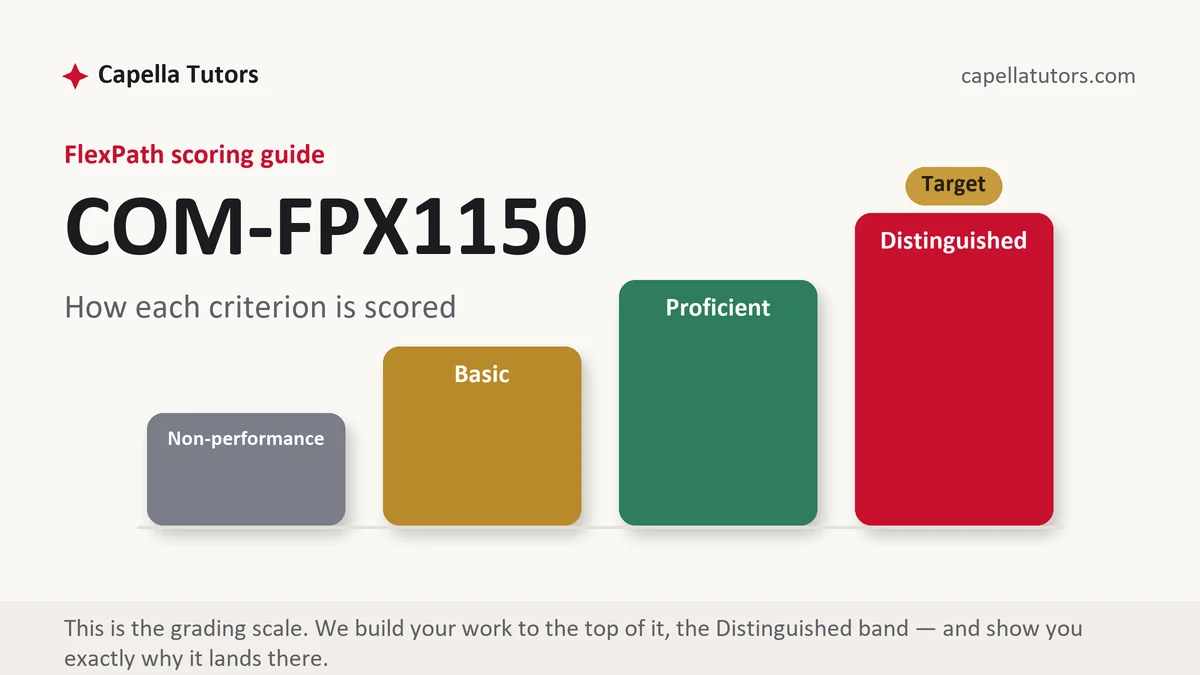
Open the scoring guide before the instructions and build the document from its rows. Paste each criterion into a blank file as a heading, put the Distinguished wording under it in a color you will strip out later, and let the verbs decide your shape, since identify wants a list, evaluate wants stated grounds and a verdict, and apply wants the idea attached to the case in front of you. Each row is marked on its own at one of four levels, Non-performance, Basic, Proficient or Distinguished, so a paragraph attached to no row cannot lift a score no matter how well it reads.
Then narrow the question until it can be searched. A topic such as social media and teenagers returns a million results because it has asked for nothing. Add a population, an outcome and a period and the same subject becomes whether daily social media use is associated with sleep loss among high school students since 2018, which has a vocabulary, a filter and a plausible set of sources built into it. Keep that question at the top of your draft while you work, because the commonest reason a source does not fit is that the question quietly changed halfway through.
Here is the contrast the top column is describing, using a claim of the kind these assessments circulate. Suppose a wellness site reports that 70 percent of employees are burned out. The Basic move cites the site, because the site looks professional and the number is memorable. The stronger move takes ten minutes. Search the sentence, find that the number came from an online poll commissioned by a company selling a wellness product, note that the respondents opted in rather than being sampled, check what the poll counted as burnout and against which definition, then look for a measurement of the same idea in a peer-reviewed source or a federal survey. You may end up reporting a smaller and duller figure with its sample and its year attached. That paragraph outscores the confident one every time, because the criterion was never about the number.
| Section | What goes in it | What Distinguished looks like |
|---|---|---|
| The question | The topic narrowed to a population, an outcome and a period, in one sentence. | A question answerable in the space available, with the search vocabulary already inside it. |
| Search strategy | Databases and tools used, term combinations, filters, and the sequence you worked through. | A trail another student could repeat and get comparable results from. |
| Source evaluation | Each kept source judged on who produced it, why, when, and on what evidence. | Grounds stated for keeping and for rejecting, with at least one rejection explained. |
| Use of the information | What the sources let you say about the question, and where they disagree. | Claims sized to the evidence, with disagreement between sources reported rather than smoothed. |
| Ethics and digital citizenship | Attribution, license or permission, privacy, and any limits on reuse. | A license or a use condition named specifically rather than referred to in general. |
| References | Current APA, DOIs or stable links, retrieval dates where a page can change. | Every entry opened and confirmed, and every in-text citation matched to an entry. |
Developing the synthesis
Synthesis in an information literacy course means putting sources into conversation instead of stacking them. Three paragraphs that each summarize one article, in the order you happened to find them, is the structure that caps a paper at Basic, and the fix is to organize by idea rather than by source. Under one idea you can then say how the sources relate: this survey and that interview study reach the same conclusion by different routes, or these two disagree and the difference tracks the population each one studied. Where sources conflict, resist averaging them. Report the conflict, say which one your question is better served by, and give the reason, since a stated preference with grounds is judgment and a blended summary is avoidance.
Citations that survive faculty review
Three families of source carry a paper like this. Scholarly articles reached through the Capella library are the backbone for anything researched, and they earn their place by being findable again, which is why a DOI belongs in the entry whenever one exists. Institutional publishers are the second family, meaning federal statistical agencies, associations publishing their own standards, and universities hosting research centers, and they are the right citation for a definition, a rule or a national figure. The third family is the object you are analyzing, a website, a video, a social post or a dataset, cited with its date because you are treating it as material rather than as authority. The Association of College and Research Libraries put the principle plainly in the information literacy framework it published in 2016: authority is constructed and contextual, which in practice means a source is authoritative for a particular question rather than in general. Then run the two-way check and open each link one last time, since a dead URL in a course about digital information is a mark handed back for free.
The mistakes that land Basic instead of Distinguished
- Judging a page by how it looks. A clean layout, a padlock and a professional logo cost about forty dollars and predict nothing about accuracy.
- Reporting a statistic with no denominator. A percentage with no sample, no year and no question wording behind it cannot be evaluated, only repeated.
- Citing the site that quoted the study. The study is the source, the site is a relay, and the criterion is watching which one you opened.
- A search that cannot be repeated. I researched online describes nothing, so the databases, terms and filters belong in the paper.
- References that were never resolved. Broken links and DOIs that lead nowhere fail the one thing this course exists to teach.
COM FPX 1150 questions students actually ask
Is peer reviewed enough to make a source acceptable?
It clears the lowest bar and settles nothing else. Peer review tells you that other researchers in the field read the article before a journal printed it. It does not tell you whether the study measured the thing your paper is about, whether the sample resembles the people you are writing about, or whether the finding has held up in the years since. A 2011 study of 34 undergraduates at one university is peer reviewed and is still weak support for a claim about working adults in 2026. The filter in the database is a starting point, and the reading you do afterward is what the criterion is actually paying for.
Can I cite an AI assistant or an AI summary in this course?
Ask your instructor first, because Capella courserooms differ on this and the syllabus statement outranks anything a tutoring site tells you. Where use is permitted, current APA guidance treats the output of a generative model as something you cite and describe, naming the tool, the version and the date, and it is treated as an unrecoverable source because nobody else can retrieve the same response. That is the reason it cannot support a factual claim on its own. Generated text also invents citations that look correct, with real author names attached to articles that were never written, so every reference has to be opened and confirmed before it goes in the list.
The article I need is behind a paywall. What now?
Search the title inside the Capella library rather than on the open web, because the library subscribes to a great deal of what the web quotes at you. If the full text is not held there, the library can request it from another institution, which usually takes a few days and is free to you. Two other routes are legitimate. Search the Directory of Open Access Journals, and check whether a federally funded study has been deposited in PubMed Central, where the accepted version is often posted. Pirate repositories are neither safe nor citable, and an abstract read alone is not a source you can describe in a paper.
Digital literacy assessment due?
Send the criteria and the topic you were assigned. The sample comes back with the search trail written out and every reference resolved. First premium sample free.