This manual is for COM FPX 1150 Assessment 2, start to submission. Communicating with Professional Colleagues asks you to show professional digital communication: usually you write messages, such as emails or workplace chat posts, for situations the courseroom describes, choosing the right channel, tone, structure and level of detail for each audience, and explaining your choices where the guide asks. The grade turns on fit. A message that would work for its reader, with a clear purpose, concise body and appropriate tone, scores above one that is merely polite. Below is the method our tutors use, a structure that maps to the criteria, and an annotated sample excerpt. Prefer to hand it off? A premium original sample for this exact assessment comes back in 24 to 48 hours, revised free until it meets the guide. Capella's catalog lists the course as COM-FPX1150, and some courserooms print COM1150; both point to this same Assessment 2. In current courserooms this assessment typically appears as "Communicating with Professional Colleagues".
One honesty note before the manual: Capella revises courses and scoring guides over time, so always write to the exact scoring guide attached to your assessment in the courseroom. The course identity above is verified on capella.edu; the method and structure below are our tutors' approach to it, not Capella's official rubric text.
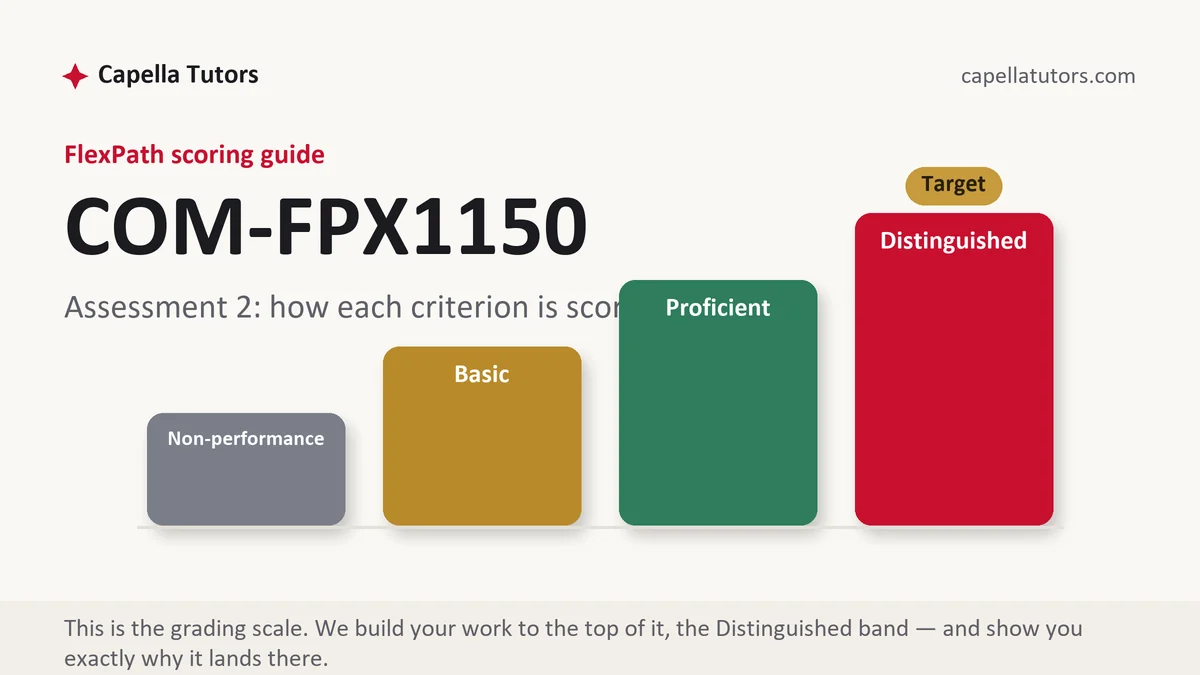
How COM FPX 1150 Assessment 2 is scored
FlexPath does not use letter grades. Each criterion in the scoring guide lands on one of four levels, and the level descriptions are the real writing brief:
| Level | What it means on professional digital messages |
|---|---|
| Distinguished | Each message suits its audience and channel, states its purpose early, is concise and well organized, uses a professional tone, is free of errors, and any explanation of choices is reasoned. |
| Proficient | Messages are professional, but some are long or slow to state their purpose. |
| Basic | Messages are informal or poorly organized. |
| Non-performance | A required message or explanation is missing. |
Follow the scenarios and template in your courseroom exactly; evaluators check each required message.
The COM FPX 1150 Assessment 2 method, step by step
-
Read each scenario
Who the reader is and what they need from you.
-
Choose the channel
Email for formal or detailed messages, chat for quick coordination.
-
Lead with the purpose
The request or key information in the first lines.
-
Keep it concise
Short paragraphs, clear subject lines, bullet points where useful.
-
Set the tone
Courteous and direct, adjusted for a manager, peer or client.
-
Proofread
Check names, dates and attachments.
A structure that maps to the criteria
The scenarios in your courseroom set the messages; these are the parts evaluators check.
| Section | What it must do | Guide |
|---|---|---|
| Message 1 | As the scenario requires. | short message |
| Message 2 | As the scenario requires. | short message |
| Message 3 | As the scenario requires. | short message |
| Explanation of choices, if required | Why the channel and tone fit. | ~100 words |
Annotated sample excerpt
An original model excerpt from our team, written to show the register that reaches the top of the guide. Learn the moves, then write your own version.
Subject: Request to move Thursday's team meeting to Friday at 10 a.m.1 Hi Dana, I'd like to move our Thursday meeting to Friday at 10 a.m., because the quarterly report data won't be ready until Thursday afternoon and I'd rather present final numbers. I've checked the shared calendar and everyone on the team is free then.2 If Friday doesn't work for you, I can present a draft on Thursday instead. Thanks, Jordan3
- 1Uses a subject line that states the request.
- 2Gives the request, the reason and the groundwork in a few lines.
- 3Offers an alternative and closes politely.
The full premium sample for your exact assessment, written fresh to your scoring guide and topic, is free to request. Study it, revise it into your own voice, and submit work you understand.
The five mistakes that cost Distinguished
- Burying the purpose. State it first.
- Wrong channel. Match channel to message.
- Too casual or too stiff. Adjust tone to the reader.
- Long paragraphs. Keep messages scannable.
- Errors. Proofread names and dates.
Pre-submission checklist
- Every required message written
- Channel suits each situation
- Purpose stated early
- Concise and organized
- Professional tone
- Proofread
Want the professional messages written?
Send the scoring guide and any materials from your courseroom. Our team returns a premium original professional messages in 24 to 48 hours, revised free until it meets the guide.