This manual is for COM FPX 1150 Assessment 1, start to submission. Researching the Skills Required for a Future Career asks you to use digital research skills on your own future: choose a career, search credible online sources such as the U.S. Bureau of Labor Statistics and job postings to find the skills it requires, evaluate the credibility of what you find, and compare the required skills with the ones you have. The grade turns on the research process. Listing skills scores lower than showing where you found them, why those sources are credible, and what the comparison means for you. Below is the method our tutors use, a structure that maps to the criteria, and an annotated sample excerpt. Prefer to hand it off? A premium original sample for this exact assessment comes back in 24 to 48 hours, revised free until it meets the guide. Capella's catalog lists the course as COM-FPX1150, and some courserooms print COM1150; both point to this same Assessment 1. In current courserooms this assessment typically appears as "Researching the Skills Required for a Future Career".
One honesty note before the manual: Capella revises courses and scoring guides over time, so always write to the exact scoring guide attached to your assessment in the courseroom. The course identity above is verified on capella.edu; the method and structure below are our tutors' approach to it, not Capella's official rubric text.
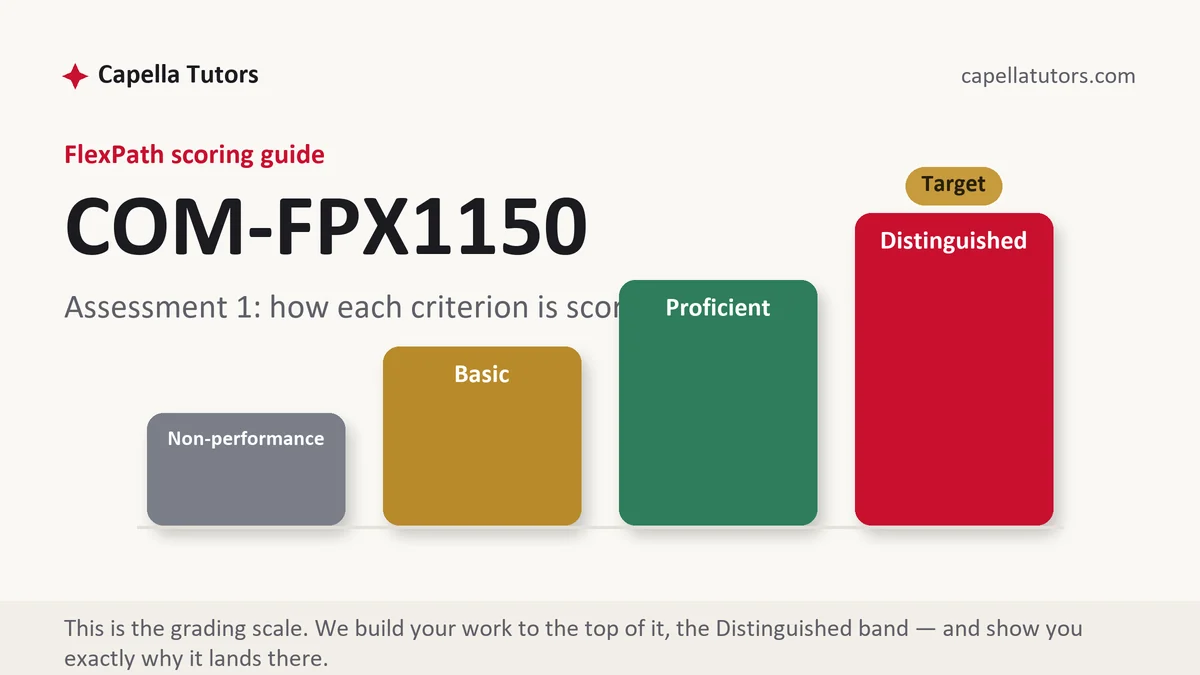
How COM FPX 1150 Assessment 1 is scored
FlexPath does not use letter grades. Each criterion in the scoring guide lands on one of four levels, and the level descriptions are the real writing brief:
| Level | What it means on a career skills research paper |
|---|---|
| Distinguished | The career is defined, research uses credible digital sources that are evaluated, required skills are specific, your own skills are compared honestly, and the next steps are clear. |
| Proficient | All parts are present, but source evaluation is brief. |
| Basic | Skills are listed with little about sources. |
| Non-performance | The source evaluation or the comparison is missing. |
Use at least the number of sources your guide sets, and include at least one government source such as the Occupational Outlook Handbook.
The COM FPX 1150 Assessment 1 method, step by step
-
Choose the career
A specific role you are working toward.
-
Search credible sources
The Occupational Outlook Handbook, O*NET, professional associations and current job postings.
-
Evaluate the sources
Authority, currency, purpose and accuracy.
-
List required skills
Technical and interpersonal skills the sources agree on.
-
Compare with your skills
Which you have, which you need.
-
Plan next steps
How you will close the gaps.
A structure that maps to the criteria
Word counts are planning targets our tutors use, not Capella rules; follow the length and format your scoring guide states.
| Section | What it must do | Guide |
|---|---|---|
| Introduction | The career and why you chose it. | ~50 words |
| Research and sources | Where you searched and source evaluation. | ~100 words |
| Required skills | Skills the sources agree on. | ~75 words |
| Comparison and next steps | Your skills and the gaps, then references. | ~100 words |
Annotated sample excerpt
An original model excerpt from our team, written to show the register that reaches the top of the guide. Learn the moves, then write your own version.
The Occupational Outlook Handbook is my most reliable source, because it is published by the U.S. Bureau of Labor Statistics, updated regularly, and based on labor market data rather than on an employer's interest in hiring.1 Job postings on large employment sites are useful for current, specific skills, such as experience with particular electronic health record systems, but they reflect one employer's wishes, so I counted a skill only when it appeared in several postings.2 Using both kinds of source together gave me a list I trust more than either would alone.3
- 1Evaluates a source by authority, currency and purpose.
- 2Explains the limits of a second source and how they were handled.
- 3Shows a reasoned research process.
The full premium sample for your exact assessment, written fresh to your scoring guide and topic, is free to request. Study it, revise it into your own voice, and submit work you understand.
The five mistakes that cost Distinguished
- Skills without sources. Show where each came from.
- Unevaluated sources. Judge credibility.
- A vague career. Choose a specific role.
- No comparison. Compare with your own skills.
- No next steps. Plan how to close gaps.
Pre-submission checklist
- Specific career
- Credible digital sources
- Sources evaluated
- Required skills listed
- Honest comparison
- Next steps and references
Want the career skills research paper written?
Send the scoring guide and any materials from your courseroom. Our team returns a premium original career skills research paper in 24 to 48 hours, revised free until it meets the guide.