How to write COM-FPX1150 Assessment 3

The short answer

This manual is for COM-FPX1150 Assessment 3, start to submission. The last deliverable in Introduction to Digital Information and Literacy usually turns from finding material to using it: what a license actually permits, what attribution owes an author, and what a search engine can assemble about you. Naming a specific license and a specific use condition is what the criteria buy, while general respect for intellectual property is what the Basic row is made of. The method is below, then the sections the rows ask for, then one reused item handled with notes attached. Prefer to hand the licensing work over? A premium original sample written to your own criteria arrives inside 24 to 48 hours, and revisions run free until the guide is met. Your courseroom may print this as COM FPX 1150 Assessment 3 or COM1150 Assessment 3; it is the same deliverable, and COM-FPX1150 Assessment 3 is what this manual walks through.

One honesty note before the manual: Capella revises courses and scoring guides over time, so always write to the exact scoring guide attached to your assessment in the courseroom. The course identity above is verified on capella.edu; the method and structure below are our tutors' approach to it, not Capella's official rubric text.
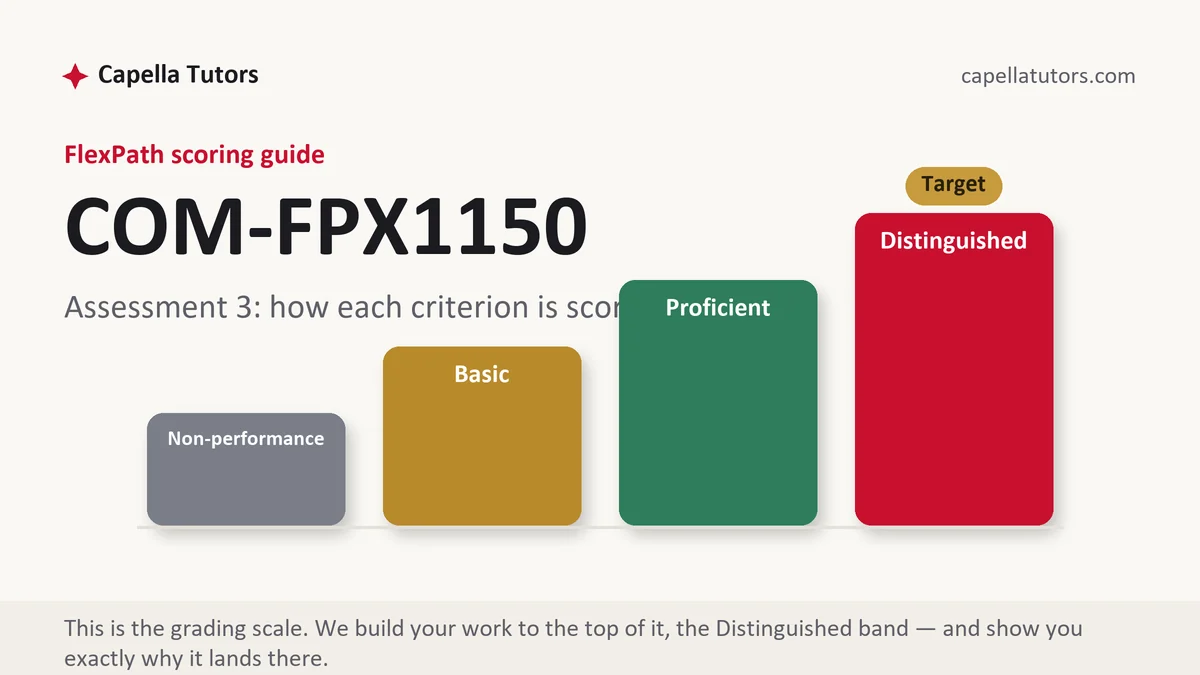
COM-FPX1150 Assessment 3 grading scale at Capella FlexPath, the criterion levels this assessment is scored on, from Capella Tutors
How Capella FlexPath grades COM-FPX1150 Assessment 3, visualized by Capella Tutors.

How COM-FPX1150 Assessment 3 is scored

FlexPath marks each row separately at one of four levels and issues no letter grade at any point, so the level description is the specification:

LevelWhat it means on a digital ethics and reuse deliverable
DistinguishedEach reused item is named with its license or permission, the conditions of that license are applied to the actual use, fair use reasoning is set out factor by factor where it applies, and the privacy section reports something you checked about your own footprint rather than something you believe about privacy in general. What the top column asks beyond the one below it is printed there; carry it out on purpose.
ProficientLicenses identified and attribution handled correctly, with sound reasoning behind both. Solid, and a row below the top.
BasicA section explaining that plagiarism is wrong and copyright should be respected, with no license named anywhere. The usual first attempt.
Non-performanceA required element is absent, most often the license terms for a specific item, or the attribution itself.

Because this course sits in the Communication category of a 3-point general education menu, the reuse decisions it grades are the ones every later course and most workplaces will hand you again. A student who has once read a license to the end argues from the terms; a student who has not argues from a feeling about fairness.

The COM-FPX1150 Assessment 3 method, step by step

  1. Turn the rows into headings, then inventory what you are reusing

    List every borrowed item before writing a sentence: the photograph, the chart, the dataset, the quotation, the screenshot. Each one gets a row of its own with its source, its date and its license, because this criterion is graded item by item and a general statement about attribution covers none of them.

  2. Read the license to the end, then name it exactly

    A Creative Commons license is not one thing. Attribution alone, attribution with share-alike, attribution with no derivatives and attribution with a non-commercial condition permit different acts, and the version number matters. Write the license as it is written, then say in your own words what it lets you do with this item in this document.

  3. Apply the condition to the use in front of you

    A no-derivatives condition means the photograph cannot be cropped for your slide. A share-alike condition follows your document if you build on the item. A non-commercial condition needs a definition, and a course deliverable is rarely the hard case while a promotional flyer is. Say which condition binds you and what you did about it.

  4. Where no license exists, reason through fair use in factors

    Purpose, the nature of the work, the amount taken relative to the whole, and the effect on the market are four separate questions and none of them decides alone. Educational purpose is a factor rather than a permission slip. Write a short paragraph per factor, reach a conclusion you could defend, and where the answer is genuinely unclear, ask permission or choose a licensed item instead.

  5. Write attribution that lets a reader find the original

    Creator, title, source link, license, and any change you made. Photograph by a named creator, cropped, from a named repository, under a named license, is attribution. Source: internet is not. Then check every link resolves, since a dead link in a course about digital information hands a mark back for free.

  6. Audit your own footprint with evidence, then score yourself

    Search your own name in a browser you are not signed into, list what a stranger can assemble, name the settings you changed and the ones you decided to leave, and say why. Specific findings and specific decisions score; a paragraph about the importance of privacy does not. Then mark each row yourself and submit early in the week.

A structure that maps to the criteria

Targets in the last column are what our tutors plan against for an undergraduate ethics and reuse deliverable; they are guidance, and your scoring guide is not.

SectionWhat it must doGuide
Inventory of reused materialEvery borrowed item with its source, date, creator and license or permission status.~180 words
License terms appliedWhat each license permits, and what that means for the exact use in this document.~280 words
Fair use reasoningFor unlicensed material, the four factors worked through separately, with a defensible conclusion.~250 words
Attribution as writtenThe attribution lines themselves, complete enough for a reader to reach the original.~180 words
Privacy and footprintWhat a search of your own name returns, what you changed, and what you decided to leave alone.~250 words
ReferencesCurrent APA, stable links or DOIs, retrieval dates where a page can change, every entry opened.as needed

Annotated sample excerpt

One model passage from our team, showing a single reused item handled the way the top row describes. Take the sequence, then apply it to each item in your own inventory.

Sample excerpt: one reused image handled to the letter Original model · Capella Tutors

The photograph on slide 4 is Harbor at Low Tide by A. Mbeki, published in 2021 in a municipal archive's open collection under a Creative Commons Attribution-NoDerivatives 4.0 license.1 The no-derivatives condition rules out the crop originally planned, so the image appears at its published dimensions and the caption sits beside it rather than over it.2 The attribution under the image reads: Harbor at Low Tide by A. Mbeki, from the Rockford Municipal Archive, used unaltered under CC BY-ND 4.0, with the license linked; the same item appears in the reference list with the date it was retrieved, since the collection's pages are revised.3

  • 1Title, creator, year, repository and the exact license with its version are all present, so the permission being claimed can be checked.
  • 2The condition is applied to a real decision rather than described in general. Naming the crop that was given up is what this row was written for.
  • 3The attribution is quoted as it appears in the document, and the retrieval date is justified by something true about the source rather than added out of habit.

The full premium sample for your exact assessment, written fresh to your scoring guide and issue, is free to request. Study it, revise it into your own voice, and submit work you understand.

Get the full sample free

The five mistakes that cost Distinguished

  • Creative Commons treated as one license. Attribution, share-alike, no-derivatives and non-commercial permit different acts, and naming the family without the terms answers nothing.
  • Educational use offered as permission. Purpose is one fair use factor among four, and it does not settle the question on its own.
  • Attribution that cannot be followed. A creator's name with no source and no license leaves a reader unable to reach the original.
  • An image cropped under a no-derivatives condition. The most common license violation in student work, and it is visible on the page.
  • A privacy section with no findings in it. Beliefs about privacy are unscorable; what a signed-out search of your own name returns is evidence.

Pre-submission checklist

  • Every reused item inventoried with creator, source, date and license status
  • Each license named with its version, and its conditions applied to this use
  • Fair use, where relied on, argued factor by factor rather than by purpose alone
  • Attribution lines complete enough to reach the original, with links that open
  • The footprint section reports what a signed-out search actually returned
  • Retrieval dates where pages change, citations matched both ways, self-scored D

Reusing images or data and unsure what the license allows?

Send the criteria and the material you intend to use. A team of eight, including a research analyst and two QA reviewers, returns a premium original sample in 24 to 48 hours with each license named to its version, the conditions applied item by item, and revisions free until the guide clears.

Keep going

Online now