This manual is for BUS FPX 4015 Assessment 1, start to submission. Assessment 1 sits at the analysis stage of Strategic Planning and Implementation: one company, the industry around it, the resources inside it, and a conclusion the later work can stand on. The assessment usually asks for an external and an internal analysis of a firm you choose or are handed, and your scoring guide decides how much weight each side carries. Below is the method our tutors use on it, a structure that answers the criteria, and an annotated sample excerpt. Prefer to hand it off? A premium original sample for this exact assessment comes back in 24 to 48 hours, revised free until it meets the guide. Capella's catalog lists the course as BUS-FPX4015, and some courserooms print BUS4015; both point to this same Assessment 1.
One honesty note before the manual: Capella revises courses and scoring guides over time, so always write to the exact scoring guide attached to your assessment in the courseroom. The course identity above is verified on capella.edu; the method and structure below are our tutors' approach to it, not Capella's official rubric text.
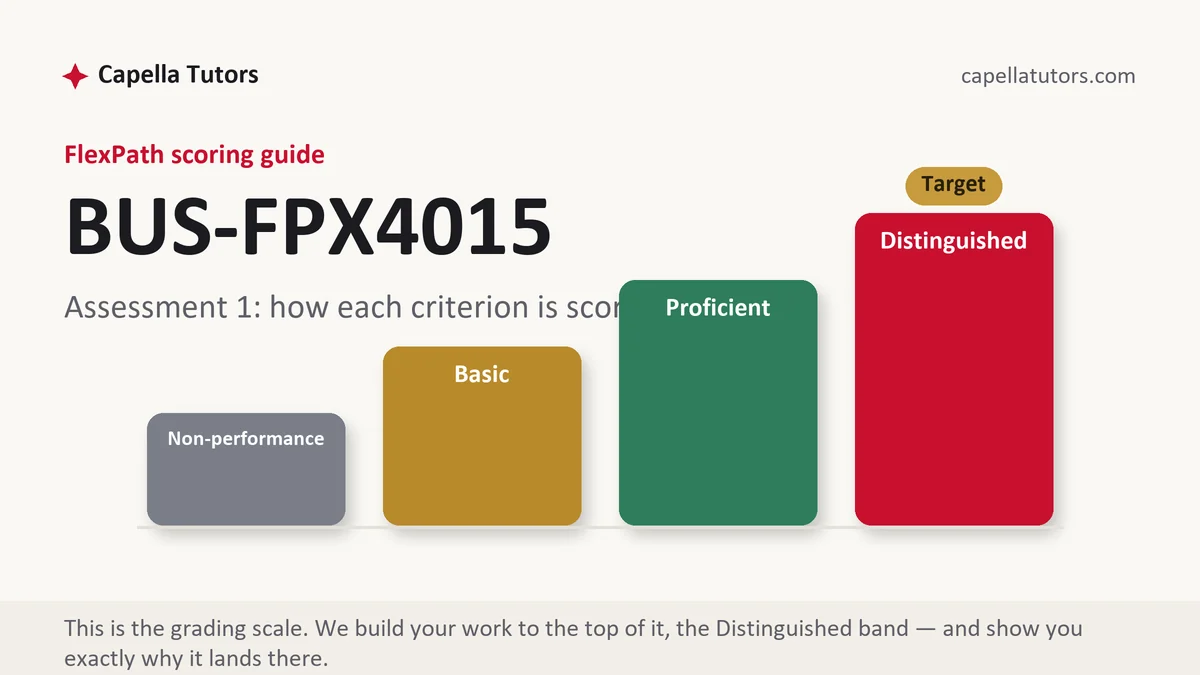
How BUS FPX 4015 Assessment 1 is scored
FlexPath does not issue letter grades. Every criterion is placed on one of four levels, and the wording of those levels is the brief you write to:
| Level | What it means on a strategic analysis |
|---|---|
| Distinguished | Each tool ends in a stated implication, the internal list has been filtered down to advantages that survive testing, and the paper says what the available information cannot settle. That last admission is usually the move the top column is paying for. |
| Proficient | The industry and the firm are both analyzed accurately, with conclusions drawn from each. Complete work, and one step short of the top of the guide. |
| Basic | Frameworks filled in correctly with nothing attached to them. The grid is there, the five forces are there, and no sentence anywhere says what any of it means. |
| Non-performance | A required element is absent. In this stage that is usually the internal analysis, or any figure at all fixing how big the firm actually is. |
The analysis stage sets up everything that follows, which is why evaluators read it strictly. A conclusion you can defend here becomes the option set later, and a vague one leaves you choosing a direction with nothing behind the choice.
The BUS FPX 4015 Assessment 1 method, step by step
-
Turn the criteria into headings before you pick a company
Copy each criterion into your outline as a heading and paste its Distinguished wording underneath. Only then choose the firm, because the criteria tell you what evidence you will need and some companies cannot supply it. Anything you write outside those headings earns nothing.
-
Fix the firm's size with three numbers
Revenue, headcount and one margin figure, stated in the opening section. A paper that describes a business as growing and well regarded has told the evaluator nothing, while a paper that says 1.4 million dollars, eleven employees, two locations has ruled out half the strategies before it starts arguing.
-
Work the industry as five questions, not five paragraphs
How hard is it to enter, how much power do buyers hold, how much do suppliers hold, what can customers switch to, and how do incumbents compete. Each has an answer with evidence behind it. Buyer power is high where buyers are few, switching is cheap and the product is undifferentiated, and public information usually shows all three.
-
Filter the internal list until it is short
Run every claimed strength through four tests: is it valuable to customers, is it rare among competitors, is it hard to copy, and is the firm actually using it. Most items fail two of the four. Discard them in writing, because the discarding is visible analysis and the reader can see you applied a standard.
-
End every section with the implication sentence
After each analytical block, write one sentence beginning with what this means for the decision. If you have found a fragmented supply base and price-driven buyers, the implication is that competing on price is a losing position, so put that on the page. This single habit is the difference between Basic and Proficient in most submissions.
-
Self-score, then check your arithmetic separately
Mark yourself D, P, B or N on each criterion and rewrite anything under D. Then read only the numbers, once, with a calculator, since a percentage that does not reconcile with the dollar figure beside it damages a paper more than a weak paragraph. Submit early in the week, because evaluators have two business days and a Thursday file can wait until Monday.
A structure that maps to the criteria
Word counts are planning targets our tutors use for a typical analysis deliverable in this course, not Capella rules; expand any section your scoring guide weights heavily.
| Section | What it must do | Guide |
|---|---|---|
| Company and scale | Name the firm, what it sells, to whom, and how it makes money, then fix its size with revenue, headcount and a margin. | ~200 words |
| Industry structure | The five structural questions answered with evidence, each closing on what the answer does to the firm's options. | ~350 words |
| Wider environment | The two or three outside forces that genuinely bear on this business, developed properly rather than listed. | ~200 words |
| Internal resources tested | Every resource run through value, rarity, imitability and use, with the popular strengths that fail explicitly dropped. | ~350 words |
| Synthesis | What the two analyses together say about where this firm can and cannot compete, plus what the evidence leaves open. | ~200 words |
| References | Current APA both ways, filings and industry sources named with years, every figure traceable to an origin. | as needed |
Annotated sample excerpt
An original model excerpt from our team, written on an invented firm so you can see the moves without borrowing the content. Learn the register, then write your own.
Larkspur and Vane Floral books about 1.42 million dollars a year across two shops, and 38 percent of that, close to 540,000 dollars, arrives inside the six weeks holding Thanksgiving, Christmas and Valentine's Day.1 Those weeks also carry the thinnest margin, because stem cost runs near 46 percent of retail when wholesale prices climb against 38 percent in an ordinary month, so a peak dollar returns about 54 cents of gross margin where a quiet dollar returns 62.2 The capability worth defending is not the seasonal volume, which any competitor with a cooler and a van can chase, but the standing contract work for four hotels that fills the Tuesdays nobody else can sell.3
- 1Fixes the firm's size and then concentrates it, so the reader meets the actual problem in one line instead of an adjective about seasonality.
- 2Puts the arithmetic in the body where the criterion can see it. Two margin percentages and the cents they imply carry more than a paragraph about cost pressure.
- 3Converts analysis into a finding. The resource that survives the rarity and imitability tests is named, and the one that fails is discarded in the same sentence.
The full premium sample for your exact assessment, written fresh to your scoring guide and scenario, is free to request. Study it, revise it into your own voice, and submit work you understand.
The five mistakes that cost Distinguished
- The framework with nothing under it. A completed grid or a five-force walkthrough that never says what it means for the firm has produced decoration, and the criterion is written to notice.
- A firm described instead of measured. Without revenue, headcount or a margin figure, the reader cannot tell whether your later recommendation is affordable or absurd.
- Every strength counted as an advantage. An experienced team is not rare and a friendly reputation is not hard to copy, so a strengths list that survives untouched shows no test was applied.
- The environment scan as a list of twelve. Two forces developed with evidence beat a dozen mentioned once each, and the criterion rewards relevance rather than coverage.
- Company marketing used as evidence. An about page and a press release describe intentions, and where a firm's stated strategy disagrees with where its money went, the gap is the finding.
Pre-submission checklist
- Every scoring-guide criterion has its own labeled section in the file
- Revenue, headcount and one margin figure appear in the first section
- Each analytical section closes with a stated implication for the decision
- The internal list has been cut, with the discarded strengths named and explained
- Every figure carries a source and a year, current APA matched both directions
- Numbers re-checked on a second pass, self-scored D on every criterion, submitted early in the week
Analysis due and the frameworks are not connecting?
Send the prompt, the criteria and the company you have been assigned. We build the external and internal analysis so each section ends in an implication, with the firm's real numbers fixing its scale, and a reviewer reads the file against your guide before it comes back. First premium sample free.