This manual is for BUS FPX 4015 Assessment 3, start to submission. The BCG Matrix asks you to analyze a company's portfolio with the Boston Consulting Group matrix: classify each division or product line as a star, question mark, cash cow or dog based on relative market share and market growth, show the matrix as a graph, and recommend a strategy for each quadrant. The grade turns on accurate placement and strategy. Each placement needs data on share and growth, and each quadrant needs a recommendation. Below is the method our tutors use, a structure that maps to the criteria, and an annotated sample excerpt. Prefer to hand it off? A premium original sample for this exact assessment comes back in 24 to 48 hours, revised free until it meets the guide. Capella's catalog lists the course as BUS-FPX4015, and some courserooms print BUS4015; both point to this same Assessment 3. In current courserooms this assessment typically appears as "BCG Matrix".
One honesty note before the manual: Capella revises courses and scoring guides over time, so always write to the exact scoring guide attached to your assessment in the courseroom. The course identity above is verified on capella.edu; the method and structure below are our tutors' approach to it, not Capella's official rubric text.
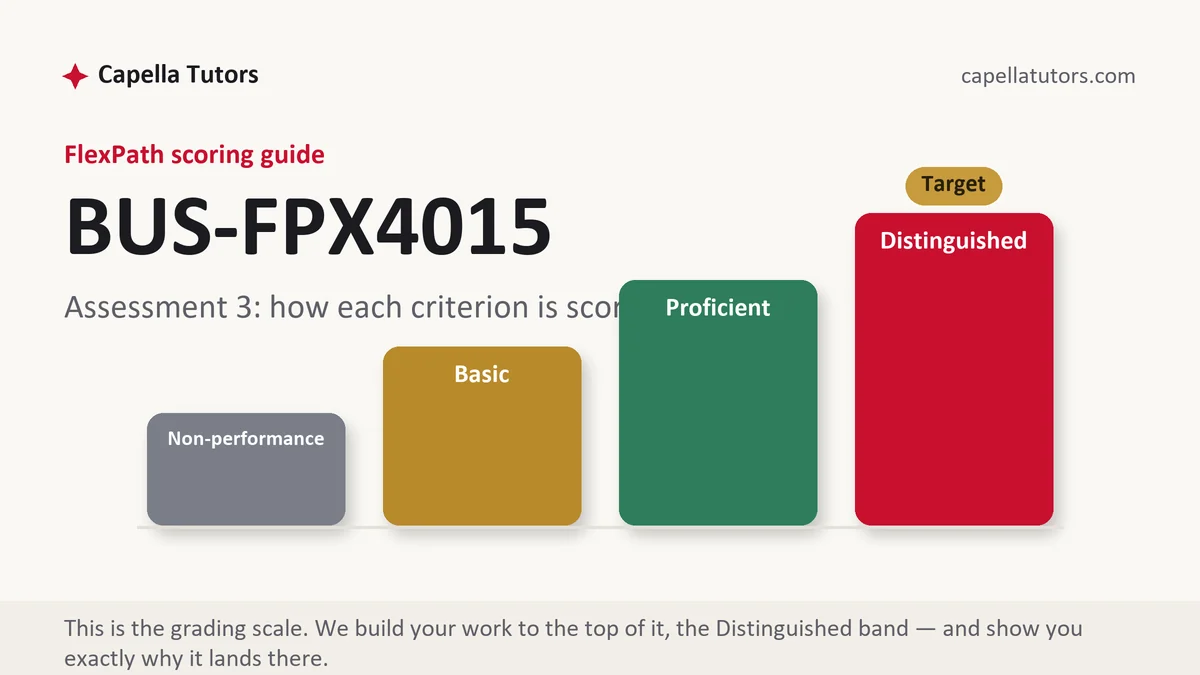
How BUS FPX 4015 Assessment 3 is scored
FlexPath does not use letter grades. Each criterion in the scoring guide lands on one of four levels, and the level descriptions are the real writing brief:
| Level | What it means on a BCG matrix analysis |
|---|---|
| Distinguished | The BCG matrix analysis is specific to the organization or case, applies course concepts accurately with credible sources, and ends in justified conclusions or recommendations. |
| Proficient | The BCG matrix analysis is accurate, but the application or recommendations are general. |
| Basic | The BCG matrix analysis describes concepts with little application. |
| Non-performance | A required part of the BCG matrix analysis is missing. |
Use the same company as your earlier 4015 work and current data on its divisions.
The BUS FPX 4015 Assessment 3 method, step by step
-
Identify divisions
The company's main product lines or business units.
-
Find market share
Relative to the largest competitor.
-
Find market growth
Industry growth rate for each.
-
Place each unit
Star, question mark, cash cow or dog.
-
Draw the matrix
A labeled graph.
-
Recommend strategies
Invest, hold, harvest or divest for each.
A structure that maps to the criteria
Word counts are planning targets our tutors use, not Capella rules; follow the length and format your scoring guide states.
| Section | What it must do | Guide |
|---|---|---|
| Introduction | Company and purpose. | ~50 words |
| Stars and question marks | Placement and strategy. | ~125 words |
| Cash cows and dogs | Placement and strategy. | ~125 words |
| Graph | Labeled matrix. | graph |
| References | Data sources. | as needed |
Annotated sample excerpt
An original model excerpt from our team, written to show the register that reaches the top of the guide. Learn the moves, then write your own version.
The memory chip division is a cash cow: the company holds a leading share of a market that is mature and growing slowly compared with its other businesses.1 It generates more cash than it needs to defend its position, so the strategy is to hold share efficiently and use the surplus to fund the question marks, such as the newer foundry business.2 Overinvesting here would buy little growth, while starving it would risk the share that pays for everything else.3
- 1Places the unit with share and growth reasoning.
- 2Recommends the matching strategy and use of cash.
- 3Explains the risk on each side.
The full premium sample for your exact assessment, written fresh to your scoring guide and topic, is free to request. Study it, revise it into your own voice, and submit work you understand.
The five mistakes that cost Distinguished
- Definitions without application. Apply each concept to the organization or case.
- No sources. Cite credible business sources.
- Vague recommendations. Make them specific and justified.
- Placements without data. Support share and growth.
- Missing graph. Include the matrix.
Pre-submission checklist
- Divisions identified
- Share and growth data
- Correct placements
- Labeled graph
- Strategy for each quadrant
- References
Want the BCG matrix analysis written?
Send the scoring guide and any materials from your courseroom. Our team returns a premium original BCG matrix analysis in 24 to 48 hours, revised free until it meets the guide.