This manual is for BUS FPX 4011 Assessment 2, start to submission. Assessment 2 of BUS FPX 4011, Virtual Team Collaboration, is the design deliverable: having read a distributed team, you now write the rules it will run on, channel by channel, with response expectations and decision rights attached. Your scoring guide decides whether that lands as a plan, a charter or a memo, and those registers are not interchangeable. Below you will find the sequence our tutors work through, a structure keyed to the criteria, and an excerpt with the moves marked. Would rather hand it over? A premium original sample written to your guide arrives in 24 to 48 hours, with revisions included until it scores. Capella's catalog lists the course as BUS-FPX4011, and some courserooms print BUS4011; both point to this same Assessment 2.
One honesty note before the manual: Capella revises courses and scoring guides over time, so always write to the exact scoring guide attached to your assessment in the courseroom. The course identity above is verified on capella.edu; the method and structure below are our tutors' approach to it, not Capella's official rubric text.
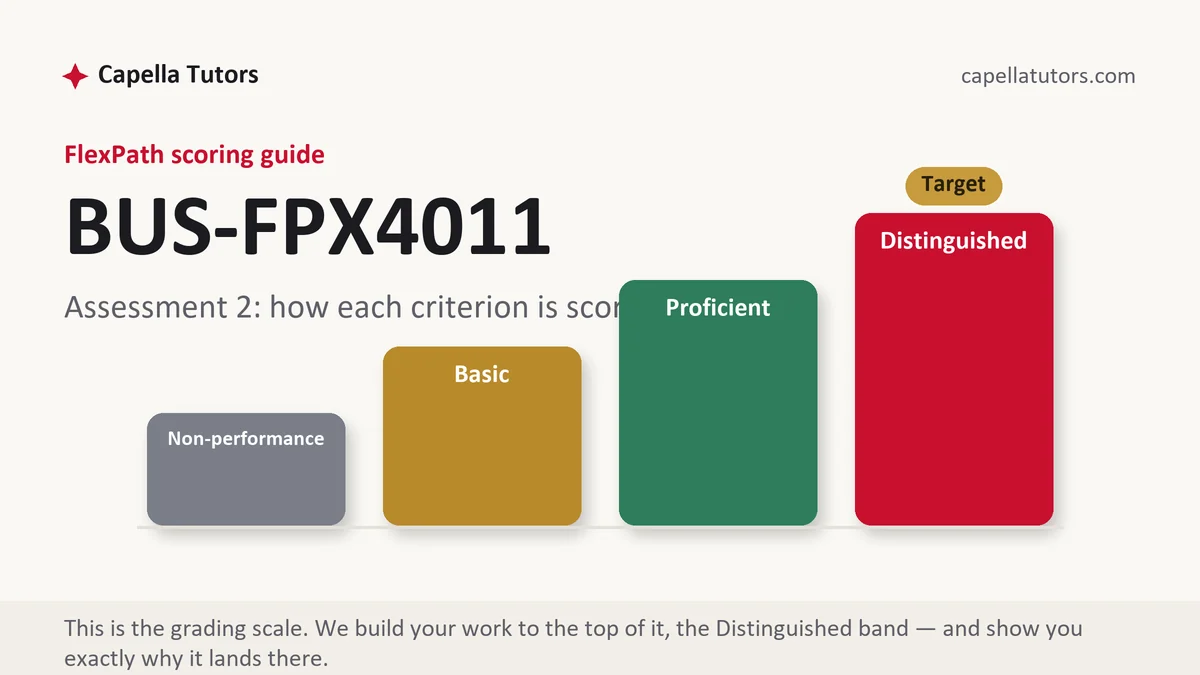
How BUS FPX 4011 Assessment 2 is scored
FlexPath awards no letter grades. Every criterion on the scoring guide is placed at one of four levels, and the wording of those levels is your brief:
| Level | What it means on a coordination plan |
|---|---|
| Distinguished | Each channel carries a rule with a number in it, decision rights are assigned by class of decision, and the plan states what each choice costs the people who have to live with it. The extra move is always written into the criterion; find it and make it. |
| Proficient | Channels, cadence and norms are all specified and defensible. Complete, and still short of the judgment the top column is describing. |
| Basic | A list of tools and good intentions with nothing a member could be held to. Where most first drafts of a plan settle. |
| Non-performance | A required element is missing, usually decision rights or the escalation route. Absence, not vagueness, is what empties a criterion. |
One structural decision decides half the grade before you draft anything. Read the criteria for the verb: establish, define and agree point at a charter written to the team in the second person, while analyze, evaluate and recommend point at a plan written to a manager about the team. A document that switches between instructing colleagues and advising a director reads as unfinished, whatever its content.
The BUS FPX 4011 Assessment 2 method, step by step
-
Read the criteria for the verb, then choose the format
Copy the criteria into your document as headings before deciding anything about format, then look at the verbs. If the guide asks you to agree norms and set expectations, you are writing to the team. If it asks you to recommend and justify, you are writing about the team. Where a prompt genuinely wants both, write the recommendation and attach the charter as a labelled section rather than blending the two voices.
-
Sort the team's traffic into four kinds of exchange
Almost every distributed team moves four things: decisions, status, quick questions, and anything that needs a permanent record. Sort before you assign. Once traffic is sorted, the channel question answers itself, and a criterion asking you to match technology to purpose is largely satisfied by the sorting rather than by the product names.
-
Give every kind of exchange a home and a number
A rule without a figure in it is a preference. Decisions go to a scheduled call with a written summary posted within the working day. Status goes to a shared document updated before a stated cutoff. Quick questions go to chat with acknowledgement expected inside one business day. Records go to email. Write the cutoff, write the acknowledgement window, and the norm becomes something a member can be held to.
-
Assign decision rights by class, not by person
List the classes of decision the team makes, then say for each one whether it is made by an individual, by two named roles agreeing, or by the group. Consensus across a wide spread is slow enough to stall a project, so reserve it for the few decisions that genuinely need everybody. Name the escalation route and the trigger that fires it, such as a thread passing a set number of exchanges without resolution.
-
Price the plan in person-hours
Meetings are the largest recurring cost in the plan and the one students never total. Six people on a one-hour weekly call is six person-hours a week, seventy-eight over a thirteen-week quarter, and half of those hours belong to people whose work the call does not touch. Put that figure in the paper next to the cadence you chose. A plan that knows its own price reads as management.
-
Write the review point in, then self-score the draft
Set a date when the plan gets examined, name who examines it, and state the two or three observable measures they will look at: how long handoffs take, what share of decisions were made without a meeting, how many threads ran past the escalation trigger. Then score your own draft against each criterion, honestly, and rewrite anything below the top level before submitting early in the week.
A structure that maps to the criteria
These lengths are planning targets our tutors use for a typical 4011 plan or charter, not Capella requirements; stretch any section your scoring guide leans on.
| Section | What it must do | Guide |
|---|---|---|
| Purpose and scope | What this document governs, who it binds, and the period it covers, stated without preamble. | ~120 words |
| The team and its window | Members, locations, working hours, the shared window in hours, and the constraint that window creates. | ~200 words |
| Channels and cadence | Each kind of exchange, the channel assigned to it, the frequency, and the reason that channel suits that traffic. | ~300 words |
| Response and availability norms | Acknowledgement windows with figures, how absence is signalled, meeting conduct, and how new members are inducted. | ~250 words |
| Decision rights and escalation | Classes of decision with an owner for each, the escalation trigger, and how outcomes are written back into the record. | ~280 words |
| Measures, review and references | What gets tracked, who reviews it, on what date, the cost of the cadence in person-hours, and APA both ways. | ~180 words |
Annotated sample excerpt
An original model excerpt written by our team to show the register the top of the guide rewards. Treat it as study material, then produce your own.
Northfold Pet and Feed is cutting roughly 1,900 items from an 11,400-item range, and the six people doing it work in three places: merchandising in Boise, the distribution centre in Memphis, and three regional buyers who are in stores four days a week.1 Any message addressed to a named member is acknowledged before the end of that member's next working day, and acknowledgement means a reply that says either the answer or the date the answer will arrive.2 Buyers who are on the road post their reachable hours in the shared calendar each Monday, and a delisting batch that has waited more than two working days for a response moves to the merchandising manager to decide alone rather than waiting for the buyer.3
- 1Scope carried by two figures from the scenario, so the norms that follow are sized for a real workload rather than for a team of unspecified size.
- 2The norm is written as a behaviour with a deadline and a definition of compliance, which is what separates an enforceable expectation from a value statement.
- 3The rule anticipates its own failure and names who decides when it fails. A criterion about accountability is usually paying for exactly this sentence.
The full premium sample for your exact assessment, written fresh to your scoring guide and issue, is free to request. Study it, revise it into your own voice, and submit work you understand.
The five mistakes that cost Distinguished
- Norms written as values. Respect one another and communicate openly cannot be complied with or breached, so no criterion about accountability can be met by them.
- A daily call across a wide spread. Someone is working at an unreasonable hour every day and the plan never says who, which reads as a plan written from one time zone.
- Decision rights left to the group. If everything needs everybody, the first disagreement stalls the project and the escalation criterion has nothing to score.
- Channels chosen by product, not purpose. Naming a platform is procurement. Saying which traffic lives there and under what rule is the design the guide asks for.
- No cost admitted anywhere. Every cadence charges somebody time, and a plan that presents only benefits reads as unexamined whatever else it gets right.
Pre-submission checklist
- The format matches the verbs in the criteria, charter or plan, not both at once
- Every kind of exchange has one named channel and one stated rule
- At least three norms carry an explicit number, hours or days
- Each class of decision has an owner, plus a trigger and a route for escalation
- The recurring cadence is priced in person-hours somewhere in the document
- A review date, a named reviewer, observable measures, and APA both ways
Charter or coordination plan to build?
Send the criteria and whatever you know about the team, including the awkward parts like members who are only reachable two days a week. We will assign the channels, put numbers into the norms, and return a premium original sample aimed at the Distinguished column in 24 to 48 hours, with free revisions until it lands there.