How to write BUS-FPX4011 Assessment 1

The short answer

This manual is for BUS-FPX4011 Assessment 1, start to submission. Assessment 1 of BUS-FPX4011, Virtual Team Collaboration, is the diagnostic deliverable: you take a team that never shares a room, set down how it is really arranged, and show which coordination problems that arrangement produces. FlexPath grades it criterion by criterion against a scoring guide, so being accurate about one team counts for more than being eloquent about teamwork. What follows is the method our tutors run on it, the structure they build from the criteria, and a sample excerpt with its moves marked. Prefer to hand it off? A premium original sample built for this exact deliverable arrives in 24 to 48 hours, revised at no charge until the guide is satisfied. Your courseroom may print this as BUS FPX 4011 Assessment 1 or BUS4011 Assessment 1; it is the same deliverable, and BUS-FPX4011 Assessment 1 is what this manual walks through.

One honesty note before the manual: Capella revises courses and scoring guides over time, so always write to the exact scoring guide attached to your assessment in the courseroom. The course identity above is verified on capella.edu; the method and structure below are our tutors' approach to it, not Capella's official rubric text.
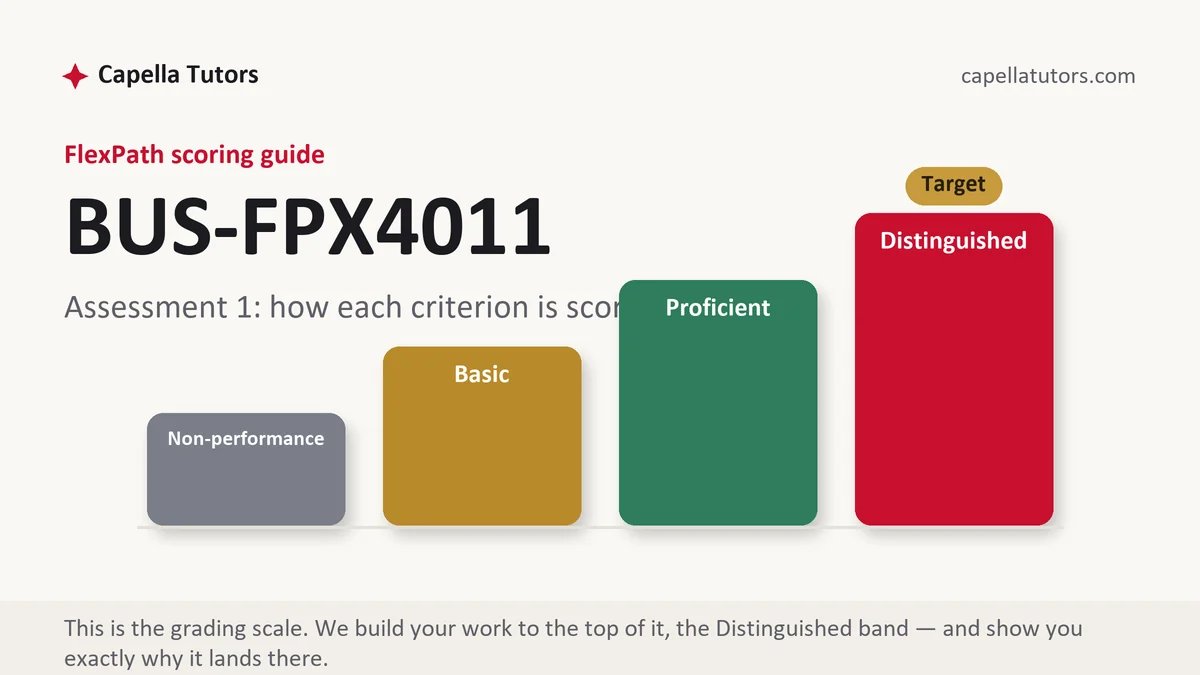
BUS-FPX4011 Assessment 1 grading scale at Capella FlexPath, the criterion levels this assessment is scored on, from Capella Tutors
How Capella FlexPath grades BUS-FPX4011 Assessment 1, visualized by Capella Tutors.

How BUS-FPX4011 Assessment 1 is scored

FlexPath hands out no letter grades. Every criterion on the guide settles at one of four levels, and that level wording is your writing brief:

LevelWhat it means on a virtual team diagnosis
DistinguishedThe team is described in figures a reader could recompute, every problem is traced to a named feature of the arrangement, and the paper says which problem to solve first and why. The extra move is always written into the criterion; find it and make it.
ProficientThe coordination problems are identified and supported completely. Accurate, and still one move short of the top of the guide.
BasicAn account of distributed work in general with this team's details attached loosely. The most common landing spot for a first attempt in 4011.
Non-performanceA required element is absent, most often the technology strand or the trust strand. An absence rather than a weakness is what empties a criterion here.

Treat this one as groundwork. Whatever the later deliverables in the course ask you to design, they will be judged against the team you described here, and a plan built on a vague diagnosis inherits the vagueness. Getting the arrangement on paper properly the first time saves the rewrite.

The BUS-FPX4011 Assessment 1 method, step by step

  1. Turn the criteria into headings before you write a sentence

    Open a blank document, paste each criterion in as a heading, and drop the Distinguished wording underneath it in a colour you will delete before submission. Write only inside those headings. Anything that will not fit under one of them is prose nobody is grading, and in a diagnosis that surplus is usually a paragraph defining virtual teams.

  2. Fix the team on paper: people, places, hours, reporting lines

    Before any diagnosis, produce a roster. How many people, in which cities, working which local hours, reporting to whom, using which tools the employer already pays for. If the prompt supplies a scenario, take the roster from the prompt and change nothing. If you are using a team you know, build the roster from what you can actually verify and say so in one sentence.

  3. Do the overlap arithmetic and put the result in the paper

    Subtract the time zones. Take the earliest start and the latest finish in local terms, convert both to one reference zone, and state how many hours the whole group is reachable together. A group spread across four zones on a nine to six day may share six hours; add one member who starts at seven local and it can fall to three. A reader can check an overlap window. Nobody can check the word challenging.

  4. Sort the symptoms into the strands the guide names

    Most scoring guides for a diagnosis want communication, trust, technology and accountability treated separately. Put every symptom you have collected into one of those four boxes before you write, because a symptom in two boxes becomes two half-answered criteria. A missed deadline is a handoff problem if the file arrived late and an accountability problem if nobody owned it.

  5. Attach something countable to every problem

    One number per problem, taken from the scenario or from what you observed. Days a decision waited, hours the group shares, messages exchanged before a thread was resolved, deadlines missed out of how many. A problem with a figure beside it reads as a finding. The same problem with an adjective beside it reads as an impression, and impressions score in the middle columns.

  6. Rank the problems, then self-score criterion by criterion

    Close by ordering the problems and naming the one to fix first, with a reason a manager would accept. Then read your own draft against the guide, mark each criterion D, P, B or N honestly, and rewrite anything under D. Submit early in the week; an evaluator has up to two business days, so a Thursday submission can sit until Monday.

A structure that maps to the criteria

Word counts are planning targets our tutors use for a typical 4011 diagnosis, not Capella rules; expand wherever your scoring guide asks for more.

SectionWhat it must doGuide
Introduction and purposeName the team, say what it is being asked to produce, and state in the last sentence what the analysis found.~150 words
The arrangement in numbersPeople, locations, local working hours, the overlap window in hours, reporting lines, and the tools already in use.~250 words
Communication diagnosisWhich exchanges run live today and which run in writing, and what each of those choices costs the team in hours or days.~300 words
Trust and responsivenessWhere silence is being read as indifference, which expectations exist but are unwritten, and how a new member currently learns the rules.~250 words
Technology and handoffsEvery point where work changes hands, what the receiving person is missing when it arrives, and which handoff loses the most time.~250 words
Priorities and referencesThe problems ranked, the first fix named with a reason, and current APA in both directions.~150 words

Annotated sample excerpt

An original model excerpt from our team, pitched at the register that reaches the top of the guide. Use it as study material, take the moves, and write the version that fits your team.

Sample excerpt: the arrangement in numbers Original model · Capella Tutors

Larkfield Books runs six shops and one author-events programme, and nobody who works on that programme sits in the same building as anybody else who works on it.1 The events lead is in Portland, the publicity coordinator is in Providence, and the four managers who host the readings are in Boise, Denver, Austin and Nashville; on an ordinary nine to six local day the whole group is reachable together for six hours, and on the days two managers open late for an evening event that window closes to three.2 Forty-two events ran last year, each passing through five handoffs between the booking and the night itself, and printed material arrived late for eleven of them.3

  • 1Opens on the fact that creates the problem. No definition of a virtual team, no throat-clearing about the modern workplace, and the evaluator meets the arrangement in the first clause.
  • 2The overlap stated as hours somebody could recompute from the roster, with the condition that shrinks it named. Distributed papers that skip this arithmetic rarely recover the criterion.
  • 3Two counted outcomes, so every diagnosis later in the paper has something concrete to explain rather than a general worry to restate.

The full premium sample for your exact assessment, written fresh to your scoring guide and issue, is free to request. Study it, revise it into your own voice, and submit work you understand.

Get the full sample free

The five mistakes that cost Distinguished

  • The team nobody can picture. If a reader cannot tell how many people are involved or where they sit, no criterion about the arrangement can be met.
  • Time zones named but never subtracted. Listing four cities is geography. Stating the shared window in hours is the analysis the criterion pays for.
  • Tools inventoried instead of examined. A chat platform and a video service in a list tells the evaluator nothing about which exchange belongs where.
  • Trust handled as a feeling. At a distance reliability is produced by response expectations and visible progress, so a paragraph about warmth answers nothing.
  • Symptoms with no rank. Six problems presented as equally urgent leaves the reader to prioritise, and prioritising was your job.

Pre-submission checklist

  • Every criterion in the guide has a labeled section of its own
  • The roster gives people, locations, local hours and reporting lines
  • The overlap window appears as a number a reader could recompute
  • Communication, trust, technology and accountability each diagnosed separately
  • Every problem carries one countable piece of evidence
  • Problems ranked, first fix named, APA checked in both directions

Virtual team diagnosis due this week?

Send the scoring guide and the roster, or the scenario the prompt gave you. We will build the overlap arithmetic, sort the symptoms into the strands your criteria name, and return a premium original sample written to the Distinguished column in 24 to 48 hours, revised free until it gets there.

Keep going

Online now