This manual is for BUS FPX 2021 Assessment 1, start to submission. Assessment 1 in BUS FPX 2021, Business Law Fundamentals, is typically where a fact pattern arrives and you have to decide whether an agreement exists before you decide who wins. The assessment usually hands you a short run of events and a question about formation, and the criteria are looking for a rule broken into elements and each element walked through the facts you were given. Prefer to hand it off? A premium original sample built to your own fact pattern lands inside 24 to 48 hours, and revision continues free until the guide is satisfied. Capella's catalog lists the course as BUS-FPX2021, and some courserooms print BUS2021; both point to this same Assessment 1.
One honesty note before the manual: Capella revises courses and scoring guides over time, so always write to the exact scoring guide attached to your assessment in the courseroom. The course identity above is verified on capella.edu; the method and structure below are our tutors' approach to it, not Capella's official rubric text.
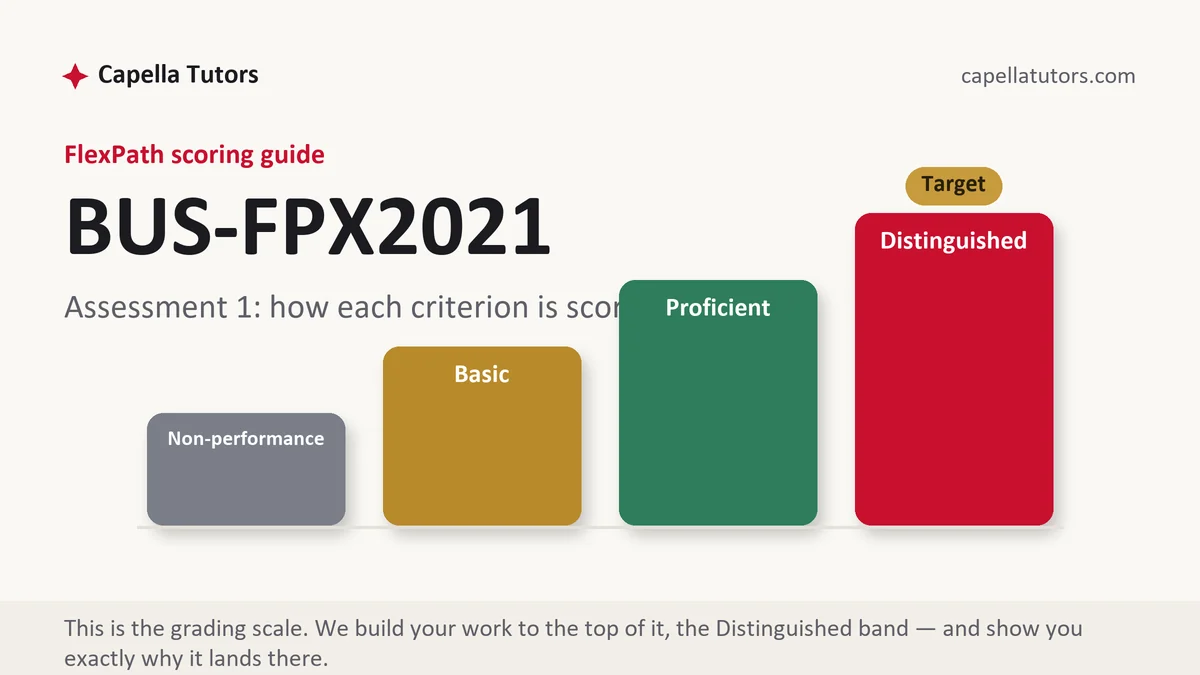
How BUS FPX 2021 Assessment 1 is scored
FlexPath does not issue letter grades. Every criterion on your scoring guide lands on one of four levels, and the wording of those levels is the brief you are writing to:
| Level | What it means on a contract formation memo |
|---|---|
| Distinguished | Each element of formation is applied to a named fact, the strongest reading for the other side is answered, and the point where a different construction of one term would change the result is stated. That last move is written into the criterion; find it and make it. |
| Proficient | The elements are identified and applied accurately, and the conclusion follows from the analysis. Complete, and one deliberate move short of the top. |
| Basic | The rule is stated well and then the application runs three sentences before a winner is announced. First submissions in this course land here more often than anywhere else. |
| Non-performance | An element is never addressed at all, most often consideration or a required term. Missing an element, rather than arguing one thinly, is what drops a criterion to the bottom. |
Read the guide as two rows even when it looks like one. Business law criteria usually score the statement of the governing rule apart from its application, so a memo that quotes the code accurately and then applies it in a paragraph gives up a whole row while looking finished.
The BUS FPX 2021 Assessment 1 method, step by step
-
Open the criteria before you open the facts
Let the guide build the document. Every criterion becomes a labelled section, and the wording of the top level gets pasted underneath while you draft so the target stays visible. Anything you write that does not sit under one of those labels is unpaid work, however good it is.
-
Separate the facts that carry legal weight
Read the pattern twice and split it into two lists: events that touch an element of the rule, and background that merely sets the scene. Dates, the words actually exchanged, amounts, and who acted next belong in the first list.
-
Frame the issue as a question about these parties
State the legal question so it can be answered yes or no about the people in the prompt. Whether a binding agreement formed when a shared-kitchen operator signed a term sheet and then invoiced at a different rate is an issue. What the law says about acceptance is a topic, and a topic produces a summary.
-
Name the governing body of law before analyzing anything
Decide whether the deal is for goods, for services, or mixed, and say which framework governs and why in the opening lines of the rule section. Where the prompt never names a state, write one sentence stating the assumption and the source you are using for the majority rule.
-
Apply element by element, including the one that fails
Give each element its own short paragraph and pair it with the exact fact that satisfies or defeats it. The element that does not hold is the paragraph that earns the criterion, so write it out rather than sliding past it, and say plainly what its failure does to the outcome.
-
Answer the other side, then self-score
One paragraph naming the strongest opposing reading, the fact it rests on, and the reason it does not carry. Then read the draft against the guide, mark every criterion yourself, and rewrite anything below the top level.
A structure that maps to the criteria
Word counts here are planning targets our tutors use on a formation memo of this size, not Capella requirements; stretch whichever section your own guide weights more heavily.
| Section | What it must do | Guide |
|---|---|---|
| Question presented | The formation question stated in one sentence about these parties and this exchange. | ~60 words |
| Facts that matter | The events in order, limited to the ones an element depends on, with the words the parties actually used. | ~200 words |
| Governing law | The framework that applies, code or common law, with the classification justified and the source named. | ~200 words |
| Application | Every element of formation paired with the fact that meets or defeats it, including the weak one. | ~450 words |
| Counterargument | The other side's best reading of the same facts and the reason it does not prevail. | ~200 words |
| Conclusion and references | The likely outcome, what turns on it, and current APA sourcing for every rule cited. | ~150 words |
Annotated sample excerpt
An original model excerpt from our team, written to show the register the top column describes. Treat it as study material: take the moves, then write your own analysis.
Harbor Row Commissary's signed term sheet offered Two Rivers Tacos eighteen weeks of kitchen access at $650 a week and required a response by Friday, which makes it an offer with a fixed expiry rather than an invitation to negotiate.1 Two Rivers returned the sheet on Wednesday, inside the window, but added a line holding the rate for the full term, so the question is whether that addition is an acceptance carrying an extra term or a counteroffer that ended the original.2 The agreement is for the use of a licensed kitchen rather than for the sale of goods, so common law governs and the mirror image rule applies, which means the added rate-hold line prevented formation on Wednesday and left the later invoice as a fresh offer, with the amount in controversy the difference between eighteen weeks at $650, or $11,700, and the same term at $695, or $12,510, a spread of $810.3
- 1Classifies the document before arguing about it. Naming a signed term sheet as an offer, and saying what makes it one, is the sentence most drafts assume instead of writing.
- 2States the real question. The issue is not what acceptance means, it is what this added line did to this offer on this date.
- 3Picks the framework, applies the rule, and prices the dispute in the same breath. The dollar spread tells the reader what the analysis is worth.
The full premium sample for your exact assessment, written fresh to your scoring guide and issue, is free to request. Study it, revise it into your own voice, and submit work you understand.
The five mistakes that cost Distinguished
- A narrative where an analysis belongs. Retelling the fact pattern in order feels like work and earns nothing, because no criterion asks for a summary of the prompt.
- Formation treated as one undivided question. Offer, acceptance, consideration, capacity, and legality are separate tests, and a memo that blurs them cannot show which one decided the case.
- An unnamed jurisdiction and an unnamed framework. State law varies, so a rule asserted with no state and no source behind it is a claim nobody reading the memo can check.
- The other side never gets a paragraph. Prompts in this course are built so the losing party has a real argument available, and the criterion that pays for engaging it is easy to miss entirely.
- A conclusion more confident than the facts. Where the outcome depends on how a term is read, say which reading you expect and what would change your answer.
Pre-submission checklist
- Each scoring-guide criterion has its own labelled section in the memo
- The governing framework named and justified before any element is applied
- Every element of formation paired with a specific fact from the prompt
- The element that fails written out, with what its failure does to the outcome
- One paragraph answering the opposing reading, plus the jurisdiction assumption stated
- Rules and any case authority in current APA, with the list checked both directions
Fact pattern due and the elements will not line up?
Send the prompt, the fact pattern, and the scoring guide. Eight people work the file, including a research analyst who pulls the governing statute or code section and a reviewer who marks the draft the way your evaluator will. A premium original sample comes back in 24 to 48 hours, with revisions until the guide is satisfied.