This manual is for BUS FPX 2021 Assessment 2, start to submission. The Comprehensive Case Fact Summary asks you to analyze a real contract dispute: summarize the facts, identify the contractual terms in dispute, explain the legal principles the court applied, weigh the strengths and weaknesses of each party's arguments, explain the ruling and its rationale, and consider alternative outcomes and what the case means for businesses. The grade turns on legal reasoning. A retelling of the case scores lower than an analysis of why the court ruled as it did and what a business should learn. Below is the method our tutors use, a structure that maps to the criteria, and an annotated sample excerpt. Prefer to hand it off? A premium original sample for this exact assessment comes back in 24 to 48 hours, revised free until it meets the guide. Capella's catalog lists the course as BUS-FPX2021, and some courserooms print BUS2021; both point to this same Assessment 2. In current courserooms this assessment typically appears as "Comprehensive Case Fact Summary".
One honesty note before the manual: Capella revises courses and scoring guides over time, so always write to the exact scoring guide attached to your assessment in the courseroom. The course identity above is verified on capella.edu; the method and structure below are our tutors' approach to it, not Capella's official rubric text.
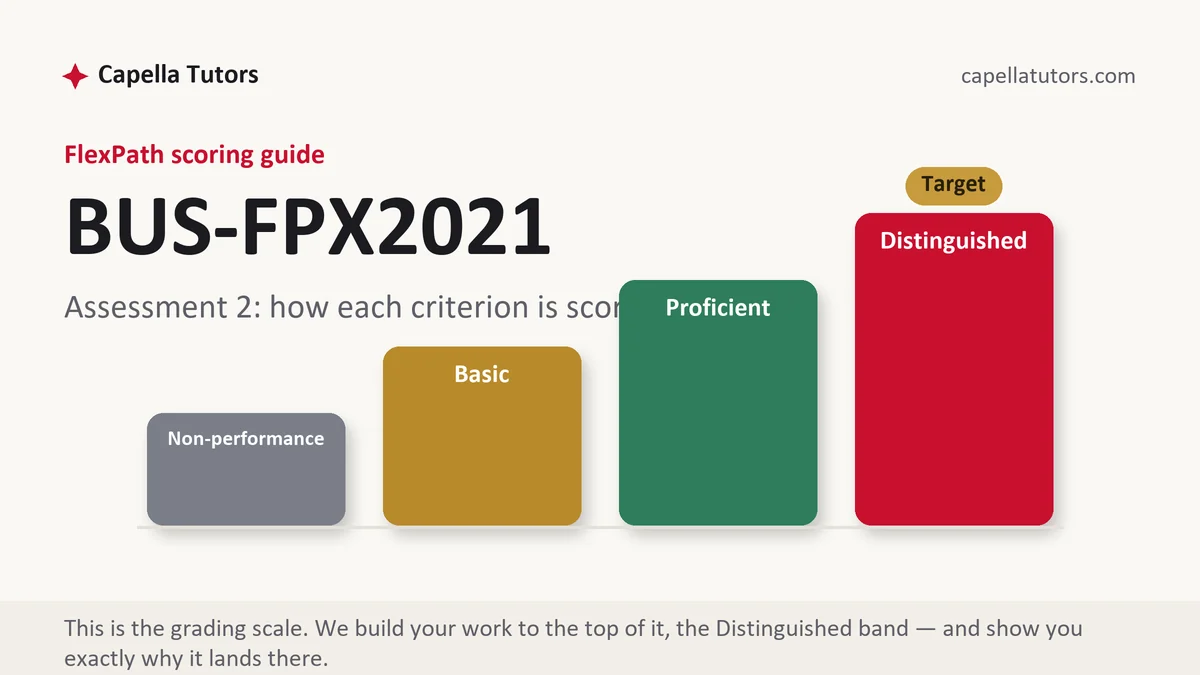
How BUS FPX 2021 Assessment 2 is scored
FlexPath does not use letter grades. Each criterion in the scoring guide lands on one of four levels, and the level descriptions are the real writing brief:
| Level | What it means on a case fact summary |
|---|---|
| Distinguished | Facts are summarized accurately, disputed terms are identified, the correct legal principles are applied, both sides are weighed, the ruling and rationale are explained, and business implications are specific. |
| Proficient | All parts are accurate, but the analysis of arguments or implications is brief. |
| Basic | The paper retells the case with little legal analysis. |
| Non-performance | The legal principles, the arguments or the implications are missing. |
Use a case your courseroom names or a real reported decision you can cite.
The BUS FPX 2021 Assessment 2 method, step by step
-
Summarize the facts
Who, what agreement, and what went wrong.
-
Identify disputed terms
The clauses or obligations in dispute.
-
Explain legal principles
Offer, acceptance, consideration, breach, remedies, as relevant.
-
Weigh arguments
Strengths and weaknesses of each side.
-
Explain the ruling
What the court decided and why.
-
Draw implications
Alternative outcomes and lessons for contract drafting.
A structure that maps to the criteria
Word counts are planning targets our tutors use, not Capella rules; follow the length and format your scoring guide states.
| Section | What it must do | Guide |
|---|---|---|
| Case fact summary | The facts. | ~150 words |
| Disputed terms and legal principles | Terms and the law applied. | ~200 words |
| Strengths and weaknesses of arguments | Both sides. | ~150 words |
| Ruling, alternatives and implications | Decision, other outcomes, lessons. | ~150 words |
| References | Case citation and sources. | as needed |
Annotated sample excerpt
An original model excerpt from our team, written to show the register that reaches the top of the guide. Learn the moves, then write your own version.
The ruling turned on the contract's wording: because it promised up to a set number of courses rather than a minimum, the court found the government had no duty to order more, and the contractor's claim for lost revenue failed.1 Had the contract guaranteed a minimum order, the outcome would likely have reversed, which shows how much depends on a single phrase.2 For businesses, the lesson is to read capacity and quantity terms as obligations only when they say so, and to negotiate a minimum commitment when revenue planning depends on it.3
- 1Explains the ruling through the contract language.
- 2Considers an alternative outcome.
- 3Draws a practical lesson for businesses.
The full premium sample for your exact assessment, written fresh to your scoring guide and topic, is free to request. Study it, revise it into your own voice, and submit work you understand.
The five mistakes that cost Distinguished
- Retelling only. Analyze the legal reasoning.
- Wrong principles. Apply the doctrines the case turns on.
- One side only. Weigh both parties' arguments.
- No implications. Say what businesses should learn.
- No case citation. Cite the decision.
Pre-submission checklist
- Facts summarized
- Disputed terms identified
- Correct legal principles applied
- Both sides weighed
- Ruling and rationale explained
- Business implications and citation
Want the case fact summary written?
Send the scoring guide and any materials from your courseroom. Our team returns a premium original case fact summary in 24 to 48 hours, revised free until it meets the guide.