Hand over whatever this course wants submitted, with the scoring guide attached, and an original premium sample is back with you within 24 to 48 hours, drafted to the Distinguished wording in your own rubric and checked by a second reader first. Your transcript will show BIO FPX 1000, Human Biology, a 3-point course sitting in the Natural Science and Mathematics category of Capella's FlexPath general education menu. That menu asks for at least 22.5 points with a minimum of 2 points from each of four categories, so a single 3-point course clears its category outright and no student is required to pick this particular one. In Capella's catalog the course code is written BIO-FPX1000.
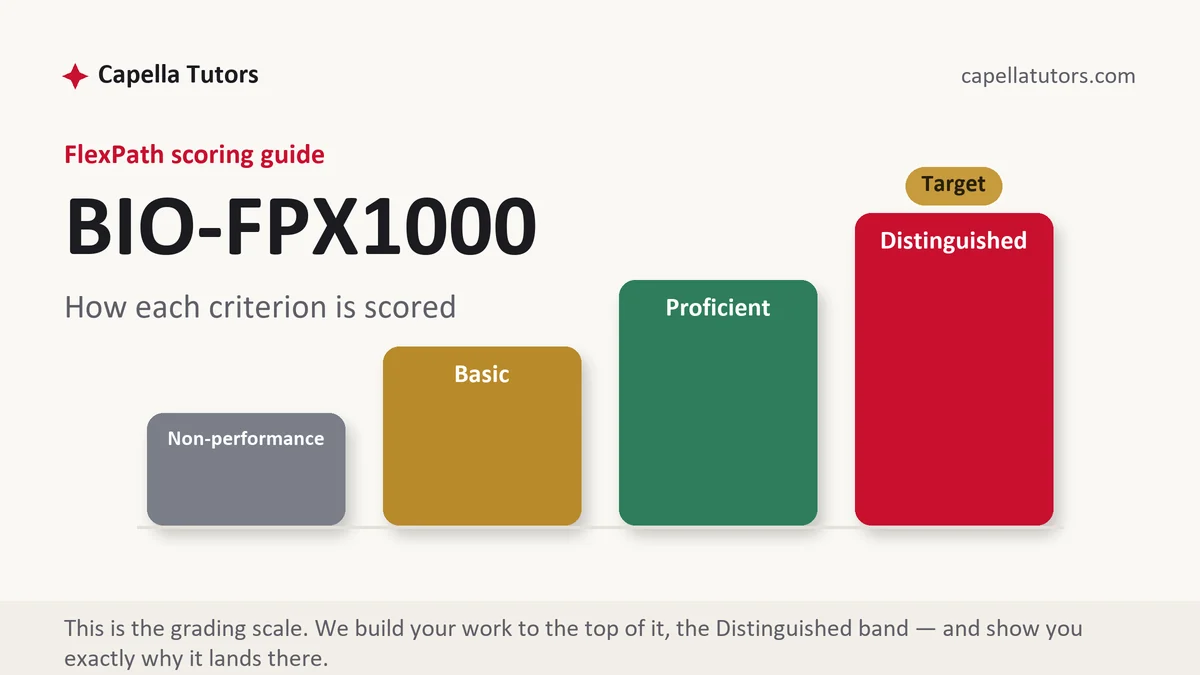
What BIO FPX 1000 actually grades
Human Biology is a survey course for people who are not going to become biologists, and the criteria are built around that fact. In current courserooms the assessments are a series of virtual labs, cardiovascular, neuromuscular, urinary, digestion and genetics, followed by patient case profiles and an evaluation of health information in the media, and each asks you to explain the biology underneath the results to a reader with no scientific training. A response that names the organs and repeats the textbook sentence has produced a label. The column above it traces a mechanism: what the structure is made of, what it does, what happens when it fails, and how the failure shows up in a person. Your scoring guide decides which systems are in scope, and reading it first stops you writing four pages on the heart when the row asked about gas exchange.
Homeostasis is the idea the whole course is organized around, and the one most drafts mention without ever using. A feedback loop has four moving parts: a variable with a set point, a sensor that reads it, a control center that compares the reading against the set point, and an effector that pushes the variable back. Blood glucose is the cleanest place to show you can run that loop. A healthy fasting reading sits between 70 and 99 milligrams per deciliter. Eating pushes it up, beta cells in the pancreatic islets read the rise and release insulin, muscle and liver cells pull glucose out of circulation, and the reading falls back. Name the sensor and the effector, then say what a fasting reading of 118 on three separate mornings implies about which part of the loop has stopped responding.
The third strand is scientific judgment, graded even where the row does not use the phrase. Biology at this level asks you to separate a mechanism from a marketing claim and to use units correctly. A cell is measured in micrometers, a protein in nanometers, a drug dose in milligrams per kilogram of body weight, and a sentence that drops the unit has dropped the meaning with it. Genetics is where confusion costs most: a gene is a sequence, an allele is a version of that sequence, a genotype is the pair a person carries, and a phenotype is what an observer can see, so a sentence saying somebody inherited a phenotype has already lost the row. When a prompt names a condition, say whether the pattern is dominant, recessive, sex-linked, or multifactorial, and say what that implies for a sibling.
How we help in this course
Our 1000 samples explain biology to the reader your criterion names rather than to a physiologist. Give us the system, the condition, or the scenario your prompt is built on and the draft arrives with the mechanism traced step by step, every measurement carrying its unit, and each claim about a treatment or a risk attached to a source a faculty evaluator will accept. Where the prompt asks for a patient handout or a set of slides for a general audience, the register moves with it, because the audience is almost always one of the graded rows.
Commercial terms match every other course on the site. Work returns inside 24 to 48 hours, aimed at the Distinguished column, after eight people have handled it: a research analyst who reads your scoring guide and pulls the physiology and public health sources the criteria imply, a subject writer who drafts, a scoring-guide reviewer who scores the result row by row the way your faculty will, an APA and originality pass that reconciles citations against the reference list in both directions, and an editor who reads last for sense. Revision is free until the work clears the guide.
The assessments, one by one
Assessment 1: Cardiovascular System Lab
Explain blood pressure and heart rate, how they relate, interpret the patient results from the virtual lab, and recommend lifestyle changes. Read the full Assessment 1 manual.
Assessment 2: Neuromuscular Lab
The eye exam and reflex testing in the virtual lab, why reflex measurement matters in diagnosis, the risks of neglecting it, and interpretation of each patient's results. Read the full Assessment 2 manual.
Assessment 3: Urinary Lab
The purpose of urinalysis, diabetes types and their management, reasons for blood in urine, and interpretation of the patient results from the virtual lab. Read the full Assessment 3 manual.
How to actually write BIO FPX 1000: where to begin
Start from the scoring guide rather than from the textbook chapter. Paste each criterion into an empty document as a heading, put the Distinguished sentence underneath it, and treat anything you cannot file under one of those headings as reading you did for your own benefit. Science rows here tend to pair a knowledge verb with a communication verb, describe and explain, or identify and relate, and the second verb is where the marks sit. A row asking you to describe the structure of the respiratory system and explain how it supports cellular respiration wants two things, and drafts routinely deliver the first at length and the second in a closing sentence.
Then decide who you are writing for before you decide what to say. Prompts here frequently name an audience, a patient, a family member, a coworker with no science background, and the register is graded against that. Explaining diffusion to a general reader means saying that oxygen moves from where there is more of it to where there is less, across a barrier thin enough that the trip is short, and that the alveolar wall and the capillary wall together are roughly a micrometer thick, which is why the exchange finishes in a fraction of a second. The same content pitched at a physician would be useless to the person the prompt named.
Write one paragraph twice and keep the better one. The weak version says the kidneys filter blood and remove waste, which is true and unscoreable. The version that earns the top column says the two kidneys receive roughly a fifth of the blood the heart pumps each minute, that the glomeruli filter in the region of 180 liters of plasma a day, that the tubules reabsorb almost all of it so only one or two liters leave as urine, and that a filtration rate below 60 milliliters per minute per 1.73 square meters sustained for three months is what defines chronic kidney disease, which is why a single low reading is not a diagnosis. Same organ, but now there is a quantity, a mechanism, and a threshold with a window attached. Then say what the biology means for a decision, and name the limit, because a confident claim with no boundary loses a criterion that was otherwise scoring well.
| Section | What goes in it | What Distinguished looks like |
|---|---|---|
| The question or scenario | The system, condition, or decision the prompt names, restated in your own words, with the audience identified. | A scope narrow enough to answer properly, and the audience stated in the opening paragraph. |
| Structure | The anatomy involved, from the level the prompt asks for down to the tissue or cell doing the work. | Structure described because it explains a function, never offered as a list of parts. |
| Function and mechanism | The process step by step, with the pathway or feedback loop named and its direction stated. | Sensor, control center, and effector identified, and the loop closed rather than abandoned halfway. |
| Evidence and figures | Reference ranges, rates, doses, and prevalence figures, each carrying its unit and its population. | Numbers with a unit, a denominator, and a date, set against a normal range for comparison. |
| What it means | The consequence for a patient, a family, or a community, and the action that follows from it. | An application bounded by what the evidence supports, with the remaining uncertainty named. |
| Sources and format | Physiology texts, peer-reviewed research, and federal health agencies, in current APA. | Primary research cited for mechanism, agency data cited for prevalence, everything dated. |
Developing the synthesis
Biology at this level rewards a student who can judge the strength of a claim from the way it was produced. A laboratory study of cells in a dish shows that a mechanism is possible. An animal study shows it happening in an organism that is not you. An observational study of people shows that two things travel together. A randomized trial shows that changing one of them changes the other. A systematic review shows what emerges when somebody gathers all of those and looks for a pattern. The sentence a criterion waits for is the one saying which of those produced your claim. Supplement questions are the standard test case, because the mechanism sounds convincing, the observational evidence is often positive, and the trials frequently are not. Write the disagreement instead of quietly choosing the source that agrees with you, say what would settle it, then state your conclusion with the strength the evidence actually carries.
Citations that survive faculty review
Three kinds of source do different work in a biology paper, and using one where another belongs is the most common reason a good draft loses its citation row. Physiology and anatomy texts are the right place for settled mechanism, and there is nothing wrong with citing one for the structure of a nephron. Peer-reviewed research retrieved through the Capella library, PubMed, or MEDLINE carries any claim that an intervention works or a risk is real, and you should be able to say how many people were studied and for how long before you cite it. Federal health agencies carry facts about populations and products: the CDC for prevalence and surveillance, the National Institutes of Health and MedlinePlus for consumer-level explanation, the FDA for what a product is approved to do. Commercial health portals and supplement vendors are not sources; at best they point toward the study underneath, and the study is the thing you cite.
The mistakes that land Basic instead of Distinguished
- Naming parts instead of tracing a process. A labeled list is a description, and description is what the Basic column is for.
- Numbers with no units. A glucose reading of 118 means nothing until the milligrams per deciliter are attached.
- Correlation reported as cause. Two things that move together need a mechanism or a trial before one explains the other.
- Writing past the audience the prompt named. A patient handout full of terminology fails the row that asked for a patient handout.
- Genotype and phenotype used interchangeably. The pair of alleles and the observable trait are different claims, and the criterion notices.
BIO FPX 1000 questions students actually ask
Do I need a science background to do well in BIO FPX 1000?
No, and the criteria are not written for one. What the rows reward is a process explained in the right order and claims kept inside what the evidence supports, both of which are writing skills before they are science skills. The students who struggle are the ones who try to sound like a textbook and copy its structure without its meaning. Read the assigned chapter once for the shape of the system, close it, write the mechanism in your own sentences, then check each step back against the source. If a step will not come out in plain words, that is the step you do not yet understand.
How technical should the writing be?
As technical as the audience in your prompt allows and no further. Every term you use costs the reader something, so spend the budget on the words that carry the mechanism and translate the rest. Alveolus earns its place in a paper about gas exchange because there is no plain substitute for it; idiopathic rarely earns its place when unexplained will do the same job. Define a term the first time it appears, in a clause of six or seven words, then use it freely. If a paragraph defines three terms and only one appears again, two of them were decoration.
Can I use my own health history as the example?
You can, and it often produces a sharper paper, provided you treat it as data rather than as testimony. Keep identifying detail out, describe the condition rather than the person, and separate what a clinician told you from what you found in a source, since only the second is citable. The trap is that personal experience invites persuasion, and a criterion measuring explanation will not reward a paragraph arguing that a treatment worked for you. Report the mechanism, report how often the evidence says it works, and let the personal material make the abstraction concrete.
Biology assessment due this week?
Send the prompt, the criteria, and the system or condition you were given. The sample comes back with the mechanism traced and every figure carrying its unit. We do not charge for the first premium sample you order.