This manual is for BIO FPX 1000 Assessment 2, start to submission. The Neuromuscular Lab asks you to complete the course's virtual neuromuscular lab, which includes an eye exam and reflex testing, and explain the results: why measuring reflexes matters in a diagnostic exam, what can be missed if it is neglected, and what each patient's findings suggest. The grade turns on linking findings to the nervous system. Explaining why a reflex is abnormal, and what it might indicate, scores above listing results. Below is the method our tutors use, a structure that maps to the criteria, and an annotated sample excerpt. Prefer to hand it off? A premium original sample for this exact assessment comes back in 24 to 48 hours, revised free until it meets the guide. Capella's catalog lists the course as BIO-FPX1000, and some courserooms print BIO1000; both point to this same Assessment 2. In current courserooms this assessment typically appears as "Neuromuscular Lab".
One honesty note before the manual: Capella revises courses and scoring guides over time, so always write to the exact scoring guide attached to your assessment in the courseroom. The course identity above is verified on capella.edu; the method and structure below are our tutors' approach to it, not Capella's official rubric text.
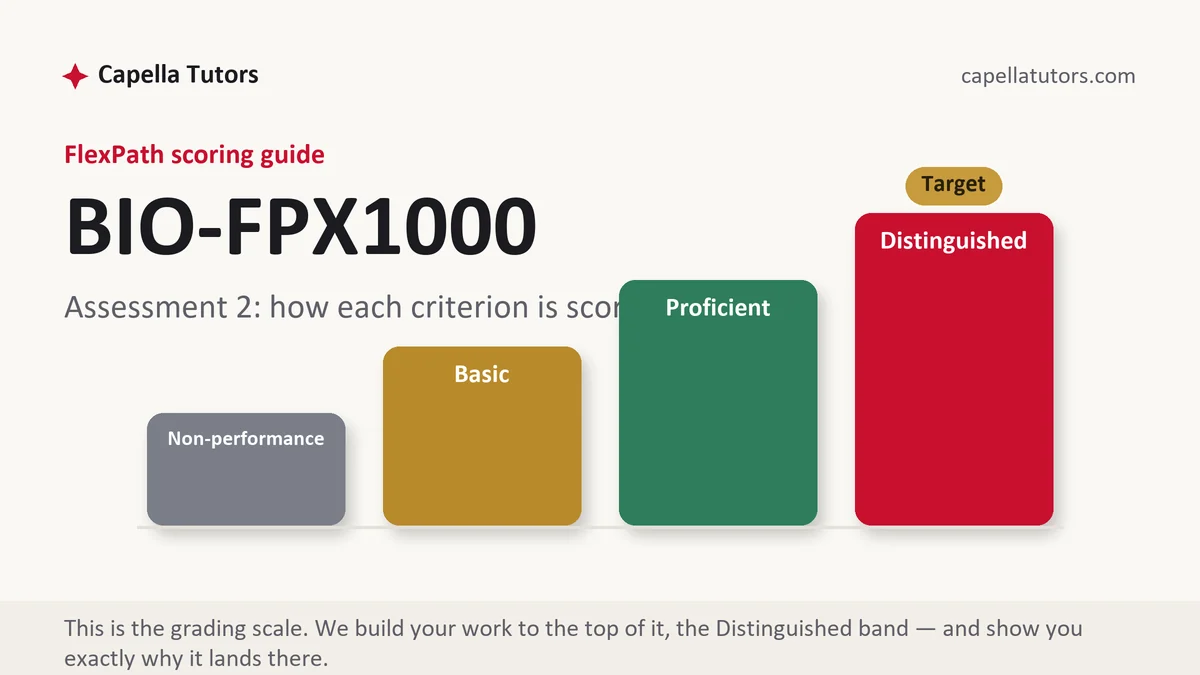
How BIO FPX 1000 Assessment 2 is scored
FlexPath does not use letter grades. Each criterion in the scoring guide lands on one of four levels, and the level descriptions are the real writing brief:
| Level | What it means on the neuromuscular lab |
|---|---|
| Distinguished | The purpose of the eye exam and reflex testing is explained, the significance of reflexes is supported with sources, consequences of neglecting them are specific, and each patient's results are interpreted accurately. |
| Proficient | Explanations and interpretations are accurate, but brief. |
| Basic | Results are listed with little explanation. |
| Non-performance | A patient's results or the significance of reflex measurement is missing. |
Use the lab's patient results exactly as given and explain them in plain language.
The BIO FPX 1000 Assessment 2 method, step by step
-
Describe the exam
What the eye exam and reflex tests check, such as the pupillary light reflex.
-
Explain why reflexes matter
They test the pathway from sensory nerve to spinal cord or brainstem to muscle.
-
Explain the risks of neglecting them
Missed nerve damage, stroke signs or other neurological conditions.
-
Interpret each patient
Normal or abnormal findings and what they may suggest.
-
Connect to health decisions
When a finding should lead to further testing.
-
Cite sources
Reliable medical references.
A structure that maps to the criteria
Word counts are planning targets our tutors use, not Capella rules; follow the length and format your scoring guide states.
| Section | What it must do | Guide |
|---|---|---|
| Introduction | Purpose of the lab. | ~50 words |
| Eye exam and reflex testing | What is tested. | ~125 words |
| Significance of reflex measurement | Why it matters. | ~125 words |
| Consequences of neglecting it | What can be missed. | ~100 words |
| Patient examinations and conclusion | Each patient interpreted, then references. | ~150 words |
Annotated sample excerpt
An original model excerpt from our team, written to show the register that reaches the top of the guide. Learn the moves, then write your own version.
When a light is shone into one eye, both pupils should constrict, because the signal travels along the optic nerve to the brainstem and back out along the nerves that control the pupils.1 A pupil that responds slowly or not at all therefore tells the examiner where along that pathway something may be wrong, which is why the test is part of every neurological exam after a head injury.2 In the lab, the patient whose left pupil reacted sluggishly would need prompt further evaluation, because a delayed response can be an early sign of pressure on the nerves inside the skull.3
- 1Explains the reflex pathway simply and accurately.
- 2Shows why the test is diagnostic.
- 3Applies it to a patient in the lab.
The full premium sample for your exact assessment, written fresh to your scoring guide and topic, is free to request. Study it, revise it into your own voice, and submit work you understand.
The five mistakes that cost Distinguished
- Listing results. Explain what they mean.
- Ignoring the pathway. Show what the reflex tests.
- Missing a patient. Interpret every patient.
- Overstating diagnosis. Say what findings may suggest, not what they prove.
- No sources. Cite reliable references.
Pre-submission checklist
- Lab completed
- Exam and reflex tests explained
- Significance supported
- Consequences of neglect explained
- Every patient interpreted
- Sources cited
Want help with the lab write-up?
Send the scoring guide and your lab results. Our team returns a premium original write-up in 24 to 48 hours, revised free until it meets the guide.