How to write RSCH-FPX7868 Assessment 2

The short answer

This manual is for RSCH-FPX7868 Assessment 2, start to submission. A middle deliverable in this course is normally a full qualitative design: a question that genuinely needs words, a tradition chosen for a reason and cited to its own methodologist, a sampling logic that matches what the tradition requires, and a reflexivity section written as method rather than as apology. The assessment usually asks for a design somebody could run, and your scoring guide decides the sections and their depth. Below is the method our tutors use for it, a structure that maps to the criteria, and an annotated sample excerpt from a grounded theory study of mid-career return to study. Prefer to hand it off? A premium original sample for this exact assessment comes back in 24 to 48 hours, revised free until it meets the guide. Your courseroom may print this as RSCH FPX 7868 Assessment 2 or RSCH7868 Assessment 2; it is the same deliverable, and RSCH-FPX7868 Assessment 2 is what this manual walks through.

One honesty note before the manual: Capella revises courses and scoring guides over time, so always write to the exact scoring guide attached to your assessment in the courseroom. The course identity above is verified on capella.edu; the method and structure below are our tutors' approach to it, not Capella's official rubric text.
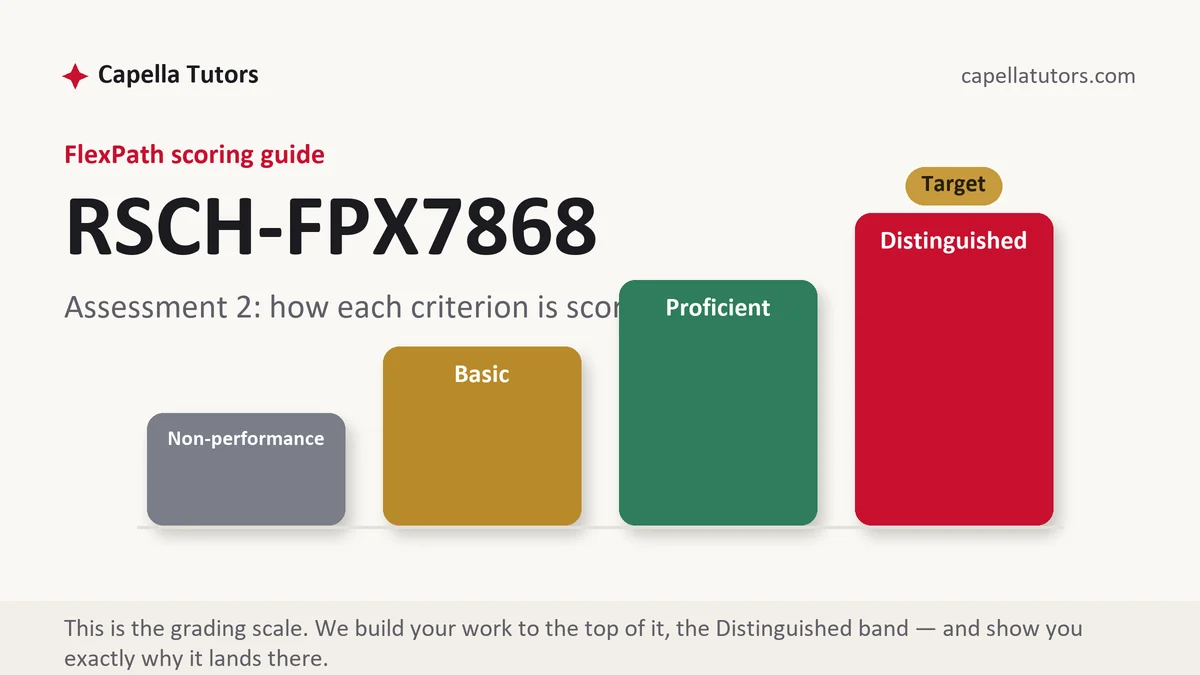
RSCH-FPX7868 Assessment 2 grading scale at Capella FlexPath, the criterion levels this assessment is scored on, from Capella Tutors
How Capella FlexPath grades RSCH-FPX7868 Assessment 2, visualized by Capella Tutors.

How RSCH-FPX7868 Assessment 2 is scored

Four levels, one per criterion, and the description at the top is not praise but the specification you are writing toward:

LevelWhat it means on a qualitative design
DistinguishedQuestion and tradition agree, the traditions you rejected are briefly accounted for, sampling follows what the chosen tradition actually demands, and one reflexive decision is traced through the design rather than declared at the start.
ProficientThe tradition is named and applied consistently and the design would work. Coherent, and one level short, because the alternatives were never weighed and reflexivity stayed a statement.
BasicA tradition named in the introduction and quietly abandoned in the method, with a sample size chosen from a range found in another paper.
Non-performanceA required element is absent, most often the argument that the question needs qualitative data at all, or the tradition's primary citation.

Question and tradition have to agree with each other, and choosing the tradition after the question is written usually means rewriting the question. Phenomenology stays with lived experience, grounded theory builds an explanation of a process and therefore commits you to theoretical sampling and constant comparison, case study bounds a system and looks at it from several sources, and generic qualitative description is legitimate as long as you name it and stop borrowing vocabulary from traditions you are not in.

The RSCH-FPX7868 Assessment 2 method, step by step

  1. Write the paragraph that justifies words over numbers

    Say what your question asks for that a count could not deliver: a process unfolding, a meaning assigned, an experience described from inside. That paragraph is graded on its own, and a design that skips it has left a criterion empty before the method begins.

  2. Choose the tradition against the alternatives

    Name the two you rejected and give one sentence each on why. A reader who can see the comparison can see that the choice was made rather than inherited, and the rejected options usually clarify what your question is really asking.

  3. Let the tradition dictate the sampling

    Grounded theory cannot fix its sample at the start, because the design keeps sampling until the categories explaining the process stop changing. A fixed roster of interviews with a grounded theory label on it is the internal contradiction faculty catch fastest.

  4. Design the protocol to follow the participant

    Open questions, planned probes, and permission for the interview to go where the participant takes it, since a rigid script in a process study collects your assumptions back. Say how the protocol will change as analysis proceeds, and why that is a feature in this tradition.

  5. Define the stopping criterion before collection starts

    Saturation is a claim about your data, not a word placed at the end of a method section. In a grounded theory design the criterion is theoretical rather than descriptive: the categories explaining the process stop changing. If you stop because the term ended, write that as a limitation.

  6. Write reflexivity as method, then self-score

    Name your position and your prior relationship to the setting, then show one specific decision it shaped, such as a probe added after an early interview or a code split because your first label carried a judgment. Then grade each criterion yourself at one of the four levels.

A structure that maps to the criteria

Targets our tutors plan with for a graduate qualitative design, not Capella rules; follow your own guide wherever it asks for more.

SectionWhat it must doGuide word target
Aim and justificationThe question, and the argument that it requires qualitative data rather than a count.~220 words
Tradition chosenThe tradition with its primary citation, and the alternatives rejected with reasons.~300 words
Sampling and recruitmentThe strategy the tradition requires, inclusion criteria, recruitment route, and the stopping criterion.~300 words
Data collectionProtocol, probes, sequence, recording, field notes, and how the protocol evolves.~280 words
Analysis and reflexivityThe coding logic the tradition demands, plus one reflexive decision traced into the design.~280 words
Ethics and referencesConsent for recording, identifiability, storage, methodologists cited directly, current APA.~200 words

Annotated sample excerpt

A short original model from our team, showing what it looks like when the tradition actually governs the design. Study the moves and then write your own.

Sample excerpt: sampling paragraph Original model · Capella Tutors

Because the aim is to explain how a decision unfolds rather than to describe what it felt like, the design is grounded theory, and the sampling cannot be fixed in advance without contradicting the method.1 Recruitment begins with eight electricians and machinists who left a licensed trade for graduate study within the last three years, selected for direct experience of the decision, and each round of analysis then determines who is approached next: if the early interviews suggest the decision turns on an injury or a change in the body's capacity, the next participants are chosen to test that category rather than to fill a quota.2 Collection stops when the categories explaining the process stop changing across successive interviews, which I expect somewhere past twenty and will report as the number actually reached, and if the term ends first I will say so and treat the account as incomplete rather than saturated.3

  • 1Derives the tradition from the aim in one sentence, and says immediately what the tradition forbids. The alignment row is decided here.
  • 2Theoretical sampling is described as a procedure with a trigger, not named as a term. A fixed roster with this label attached is the contradiction faculty look for.
  • 3Commits to a theoretical stopping criterion in advance and states what will be written if the calendar ends the study first, which is honest reporting rather than a hedge.

The full premium sample for your exact assessment, written fresh to your scoring guide and issue, is free to request. Study it, revise it into your own voice, and submit work you understand.

Get the full sample free

The five mistakes that cost Distinguished

  • A tradition named and then ignored. An introduction claiming one logic and a method performing another is the failure this course is built to catch.
  • Sample size borrowed from another paper. A number lifted from a published range is not an argument, and a defended twelve outscores an undefended thirty.
  • Theoretical sampling in name only. If the roster was complete before analysis began, the design did not sample theoretically whatever the label says.
  • Saturation asserted at the end. A stopping criterion invented after collection cannot be checked, and the reader has only your word for it.
  • Reflexivity as apology. Declaring bias and moving on earns nothing; showing one decision your position shaped earns the row.

Pre-submission checklist

  • A paragraph arguing that the question needs qualitative data, not a count
  • Tradition cited to its own methodologist, with two rejected alternatives explained
  • Sampling strategy consistent with what the tradition demands
  • Protocol open, probed, and allowed to evolve with the analysis
  • Stopping criterion defined before collection, with the fallback written honestly
  • One reflexive decision traced into a specific design choice

Qualitative design due?

Send the guide, the aim and the setting. The draft comes back with the tradition governing the sampling instead of decorating it, and the stopping criterion written before the data exists. Premium original sample in 24 to 48 hours, revised at no charge until the criteria are met.

Keep going

Online now