This manual is for PSY FPX 5120 Assessment 2, start to submission. A middle deliverable in this course is normally an evidence appraisal: a contested applied claim, the body of studies behind it read for design and size rather than for conclusion, and a judgment about what the accumulated work actually supports. The assessment usually asks how strong the evidence is rather than whether the idea is appealing, and your scoring guide decides the sections. Below is the method our tutors use for it, a structure that maps to the criteria, and an annotated sample excerpt about whether diversity training changes behavior. Prefer to hand it off? A premium original sample for this exact assessment comes back in 24 to 48 hours, revised free until it meets the guide. Capella's catalog lists the course as PSY-FPX5120, and some courserooms print PSY5120; both point to this same Assessment 2.
One honesty note before the manual: Capella revises courses and scoring guides over time, so always write to the exact scoring guide attached to your assessment in the courseroom. The course identity above is verified on capella.edu; the method and structure below are our tutors' approach to it, not Capella's official rubric text.
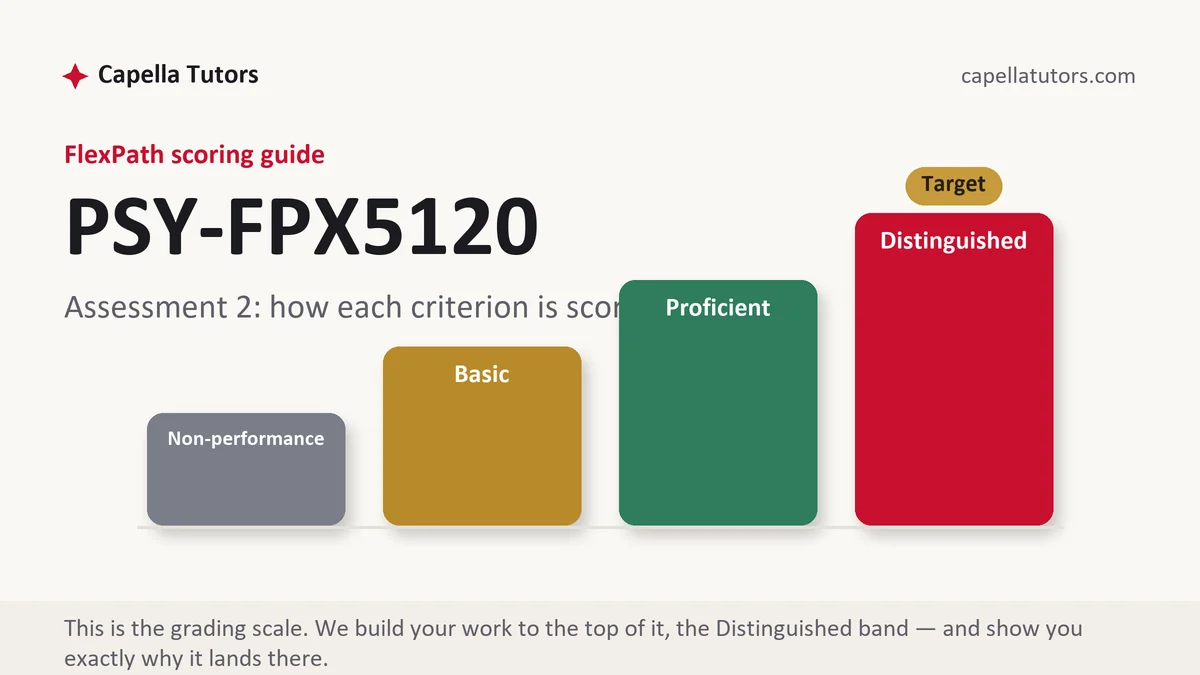
How PSY FPX 5120 Assessment 2 is scored
Every criterion in the guide lands at one of four levels, and the language of the highest level is the instruction, not a compliment:
| Level | What it means on an evidence appraisal |
|---|---|
| Distinguished | Estimates arrive with intervals, the outcome type and the follow-up interval are reported alongside every effect, the spread across studies is explained by design features, and the writer says what evidence would change the verdict. |
| Proficient | The literature is summarized accurately and the strongest studies are identified. Solid, and one level below the top, because the disagreement across studies was reported rather than explained. |
| Basic | One convenient number selected and the matter treated as closed, with attitude outcomes and behavior outcomes counted as the same thing. |
| Non-performance | A required element is missing, most often any effect size at all, or the appraisal of design quality the criterion asked for. |
Most dependable effects in this field are small, small effects across large populations can still be worth buying, and a paper promising a transformation on the strength of a two point shift has told a decision maker something untrue. Arithmetic honesty about size is what separates the top column here.
The PSY FPX 5120 Assessment 2 method, step by step
-
Write the claim as a testable sentence first
Turn the topic into a proposition with an outcome in it: this intervention changes that behavior, in this population, measured over this interval. A claim with no outcome and no window cannot be appraised, and appraisal is what the criteria are buying.
-
Start from the best synthesis, not the most famous study
A meta-analytic estimate with a confidence interval outranks any single experiment for the question of how large an effect is, including a celebrated one. Note how many studies and participants it pooled, and what it excluded, since the exclusions often carry the argument.
-
Separate the outcomes the literature has mixed together
Self-reported attitude, stated intention, and observed behavior are three outcomes with three different literatures, and pooling them inflates apparent success. Tabulate which studies measured which, and report the behavioral subset separately whenever the source allows it.
-
Record the interval, not just the result
An effect measured immediately after a session and an effect measured three months later are different findings. Write the follow-up window beside every estimate, and treat the absence of any delayed measurement as a limitation rather than a silence.
-
Explain the spread by design
Where the estimates disagree, four features do most of the explaining: sample size, whether the outcome was behavior or intention, whether the setting was a laboratory or a real institution, and whether the analysis plan existed before the data arrived. Name which one you think drives it.
-
Commit to a verdict with a condition on it, then self-score
Say what the body of work supports, at what size, for whom, and what evidence would move you. Then grade each criterion at one of the four levels yourself and rewrite whatever sits below the top before submitting.
A structure that maps to the criteria
Targets our tutors plan with for a graduate appraisal, not Capella rules; expand whichever section your guide weights hardest.
| Section | What it must do | Guide word target |
|---|---|---|
| The claim under appraisal | The proposition stated with its outcome, population and interval, and why it matters practically. | ~180 words |
| What the syntheses report | Pooled estimates with intervals, how many studies and participants, and what was excluded. | ~300 words |
| Outcomes disentangled | Attitude, intention and behavior reported separately, with the behavioral evidence weighed on its own. | ~300 words |
| Design quality and spread | Assignment, setting, follow-up window, and the features that explain disagreement across studies. | ~300 words |
| Verdict and conditions | What is supported, at what size, for whom, and the evidence that would change it. | ~200 words |
| References | Syntheses for magnitude, primary articles for existence, current APA matched both ways. | as needed |
Annotated sample excerpt
A short original model from our team, included to show what honest sizing sounds like on a popular intervention. Study it, then write the appraisal your own claim requires.
The evidence on single-session diversity training is stronger about attitudes than about conduct, and the two outcomes have to be counted separately before the claim can be appraised at all.1 Syntheses across several hundred samples report small to moderate average changes on attitude and knowledge measures taken within a day of the session, and a much thinner set of studies measuring what people did in the following weeks, with the behavioral estimates smaller and their intervals frequently including zero.2 Two design features explain most of the spread rather than any dispute about the theory: the studies with immediate self-report outcomes and no comparison group report the largest effects, and the studies with random assignment, an untrained comparison group and a follow-up beyond one month report the smallest, so the defensible statement is that a single session reliably moves what participants say and has not been shown to move what they do.3
- 1Splits the outcome before summarizing anything, which prevents the attitude literature from being spent as evidence about conduct.
- 2Reports the measurement window with each estimate and says the behavioral intervals often include zero, rather than converting a null into an absence.
- 3Explains the disagreement by design features and then commits to a verdict inside the boundary the evidence supports.
The full premium sample for your exact assessment, written fresh to your scoring guide and issue, is free to request. Study it, revise it into your own voice, and submit work you understand.
The five mistakes that cost Distinguished
- Attitude evidence spent on behavior. The two literatures differ in size and in quality, and merging them is the commonest way an appraisal overstates its case.
- Significance reported as magnitude. A p value says the data were unlikely under the null, and only an effect size with an interval says whether the result is worth acting on.
- Intervals dropped. A point estimate with no interval hides how much of the plausible range would change the recommendation.
- Follow-up windows omitted. An effect at ten minutes and an effect at three months are separate findings, and only one of them answers an applied question.
- A null read as proof of nothing there. Failure to reject leaves you holding an interval, and that interval usually still contains effects worth having.
Pre-submission checklist
- The claim written as a proposition with outcome, population and interval
- Best available synthesis reported first, with what it pooled and what it excluded
- Attitude, intention and behavior outcomes counted separately
- Every estimate carries an interval and a measurement window
- Disagreement across studies explained by named design features
- A verdict with its size, its population, and the evidence that would change it
Evidence appraisal due?
Send the guide and the claim you have been told to weigh. A research analyst pulls the syntheses and the primary studies first, and one reviewer checks that every figure in the narrative matches its source. Premium original sample in 24 to 48 hours, revised at no charge until the criteria clear.