This manual is for PSY-FPX5002 Assessment 3, start to submission. A closing deliverable in a foundations course normally pulls the strands together: an applied situation with an ethical question inside it, answered with the enforceable standards named, and a statement of what a non-licensure psychology master's does and does not authorize. The assessment usually asks for a defended decision rather than a discussion, and your scoring guide decides the sections and their order. Below is the method our tutors use for it, a structure that maps to the criteria, and an annotated sample excerpt set in a community nonprofit. Prefer to hand it off? A premium original sample for this exact assessment comes back in 24 to 48 hours, revised free until it meets the guide. Your courseroom may print this as PSY FPX 5002 Assessment 3 or PSY5002 Assessment 3; it is the same deliverable, and PSY-FPX5002 Assessment 3 is what this manual walks through.
One honesty note before the manual: Capella revises courses and scoring guides over time, so always write to the exact scoring guide attached to your assessment in the courseroom. The course identity above is verified on capella.edu; the method and structure below are our tutors' approach to it, not Capella's official rubric text.
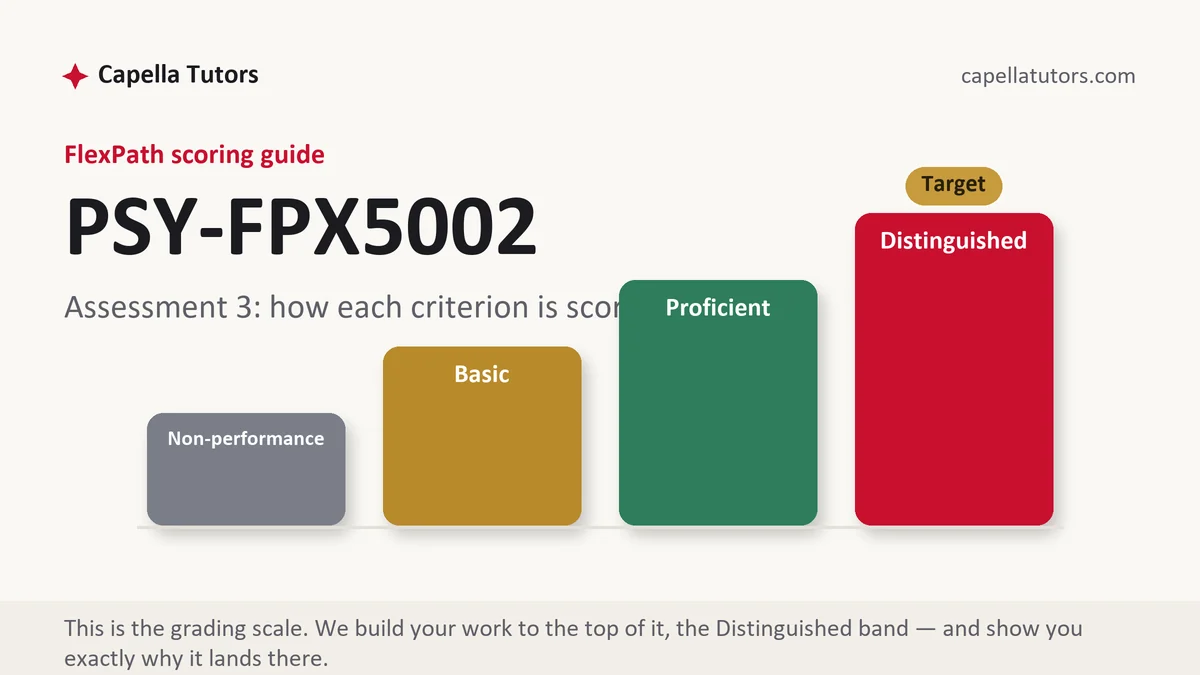
How PSY-FPX5002 Assessment 3 is scored
Nothing in FlexPath arrives as a letter grade. Each criterion is placed at one of four levels, and those level descriptions are the specification for the paragraph beneath them:
| Level | What it means on a scope and ethics deliverable |
|---|---|
| Distinguished | The obligations arrive with their standard numbers, the two that genuinely conflict are set against each other, and the harder one is named as the harder one. The decision is defensible to the party it disadvantages, and the scope limit is written plainly rather than implied. |
| Proficient | The right standards are identified and applied correctly, and a reasonable decision follows. Sound, and one move short, because the tension has been resolved instead of examined. |
| Basic | Ethics argued from values rather than from standards, with the career essay taking over from the scope analysis. The most frequent landing spot for this deliverable. |
| Non-performance | A required element is missing outright, most often the licensure boundary or any citation of the code as a document. |
One distinction earns credit repeatedly in this course. The five General Principles that open the ethics code are aspirational, and nobody is charged under them; the numbered Ethical Standards that follow are enforceable, and those are what a criterion means when it asks for the code. Writing that integrity matters is an opinion. Writing that a standard obliges a particular act, with the number in parentheses, is a citation with an address.
The PSY-FPX5002 Assessment 3 method, step by step
-
Read the scenario for its decision, not its story
Write one sentence naming what has to be decided and who decides it. Then separate the facts you were given from the inferences you are tempted to add. Most weak submissions retell the scenario at length and never state the question the criteria are asking you to settle.
-
Split the request into what is inside your scope and what is not
Applied requests usually bundle several tasks in one sentence, and some of them sit outside a non-licensure degree. Sort them before you answer. That sorting is itself the analysis a scope criterion is looking for, and it converts a vague worry into a decision you can defend.
-
Cite standards by number, not principles by name
Paraphrase the obligation and put the number after it the way you would put a page number. Cite the American Psychological Association's Ethical Principles of Psychologists and Code of Conduct as a document, not the chapter that summarized it, because the chapter is one reader's account of something you can open yourself.
-
Set the competing obligations against each other
Name what each party is owed, then find the two obligations that pull in opposite directions and say which one you are subordinating and why. An analysis in which every duty points the same way has not found the ethical problem the scenario was built around.
-
Write the boundary in capacities and prohibitions
State what the degree permits in concrete verbs and what it forbids in the same register: design and deliver, collect and analyze, refer; not diagnose, not present yourself as a psychologist, not select and interpret a restricted instrument on your own authority. Then name two settings that actually employ your specialization.
-
End in an action, a consultation and a record
Say what you would do, whom you would consult, and what you would document, in that order. Then self-score every criterion at one of the four levels and rewrite anything short of the top before you submit.
A structure that maps to the criteria
Planning targets from our tutors for a graduate scope and ethics deliverable, not Capella rules; follow your own guide where it asks for more.
| Section | What it must do | Guide word target |
|---|---|---|
| The situation and the decision | Facts stated, inferences separated out, and the decision at stake named in one sentence. | ~180 words |
| Scope of the degree | What a non-licensure master's authorizes, in verbs, and what it does not, with the settings that use it. | ~280 words |
| Standards engaged | Each enforceable standard by number, with the obligation paraphrased and tied to a fact in the scenario. | ~300 words |
| Competing obligations | What each party is owed, which two duties conflict, and which one you subordinate. | ~250 words |
| Decision, consultation, record | The action, who is consulted, what is documented, and the competencies you will build next. | ~220 words |
| References | The code cited directly, current APA in text and list, matched both ways. | as needed |
Annotated sample excerpt
One original model paragraph from our team, included to show what the top of the guide sounds like. Study the moves and then write the version that fits your own scenario.
The degree I am completing is a non-licensure master's in psychology, which authorizes me to design and deliver psychoeducational material, to collect and analyze programme data, and to refer, and does not authorize me to diagnose, to present myself as a psychologist, or to select and interpret a screening instrument on my own judgment.1 The nonprofit's board asked for two things in one email, and the answer depends on separating them: a six-session stress-management group, which sits inside that scope while it is described and delivered as education rather than treatment, and a baseline screening of every participant, which does not.2 Standard 2.01 confines practice to the boundaries of one's competence and Standard 9.02 requires an instrument to be used for the purpose and population its validation supports, so the screening question belongs to the licensed clinician the board already contracts with, and I would put the request, the referral and the limits I stated in writing before the first session runs.3
- 1The boundary is written as capacities and prohibitions in plain verbs, which is what the scope criterion is grading. A sentence about feeling unqualified would score nothing here.
- 2Splits a bundled request into the part inside scope and the part outside it, which turns an unease into an analysis the evaluator can follow.
- 3Obligations arrive with numbers, and the paragraph closes on an action, a referral and a record rather than on a verdict about what is ethical.
The full premium sample for your exact assessment, written fresh to your scoring guide and issue, is free to request. Study it, revise it into your own voice, and submit work you understand.
The five mistakes that cost Distinguished
- Ethics answered with values. Confidentiality matters is a sentiment; the standard governing its limits has a number, and the number is the cheapest credit on the page.
- The career essay. Enthusiasm about a future role is not a scope analysis, and the criterion is asking what the degree permits rather than what you hope to do.
- One-sided obligations. When every duty in your analysis points the same way, the ethical problem has been avoided rather than solved.
- The code quoted from a chapter. Citing a textbook for a standard you could have opened directly loses the source criterion by itself.
- A decision with no record. An answer that ends in a judgment, with no consultation and nothing documented, is not the way an applied decision is actually defended.
Pre-submission checklist
- Each criterion carries its own labeled section
- The decision at stake is named in one sentence near the start
- Scope written as concrete permissions and prohibitions, with two real settings named
- Every ethical obligation cited by standard number, code referenced as a document
- Two obligations genuinely in conflict, with the subordinated one identified
- The answer ends in an action, a consultation and a documented record
Ethics and scope deliverable due?
Send the scenario, the guide and your specialization. One of the eight passes on every draft exists purely to confirm that each standard number in the text matches the obligation described beside it. Premium original sample in 24 to 48 hours, revised free until the criteria clear.