This manual is for HRM FPX 5090 Assessment 2, start to submission. HR Challenge: Presentation to Leadership asks you to present the engagement study to the company's leaders for approval: the company context, objectives, the workforce breakdown, for example by generation, the engagement issues, goals, how the data will be used, the process, and the budget, time and resources required. The grade turns on a persuasive, complete proposal for decision-makers. Leaders need the problem, the plan and the cost in a form they can approve. Below is the method our tutors use, a structure that maps to the criteria, and an annotated sample excerpt. Prefer to hand it off? A premium original sample for this exact assessment comes back in 24 to 48 hours, revised free until it meets the guide. Capella's catalog lists the course as HRM-FPX5090, and some courserooms print HRM5090; both point to this same Assessment 2. In current courserooms this assessment typically appears as "HR Challenge: Presentation to Leadership".
One honesty note before the manual: Capella revises courses and scoring guides over time, so always write to the exact scoring guide attached to your assessment in the courseroom. The course identity above is verified on capella.edu; the method and structure below are our tutors' approach to it, not Capella's official rubric text.
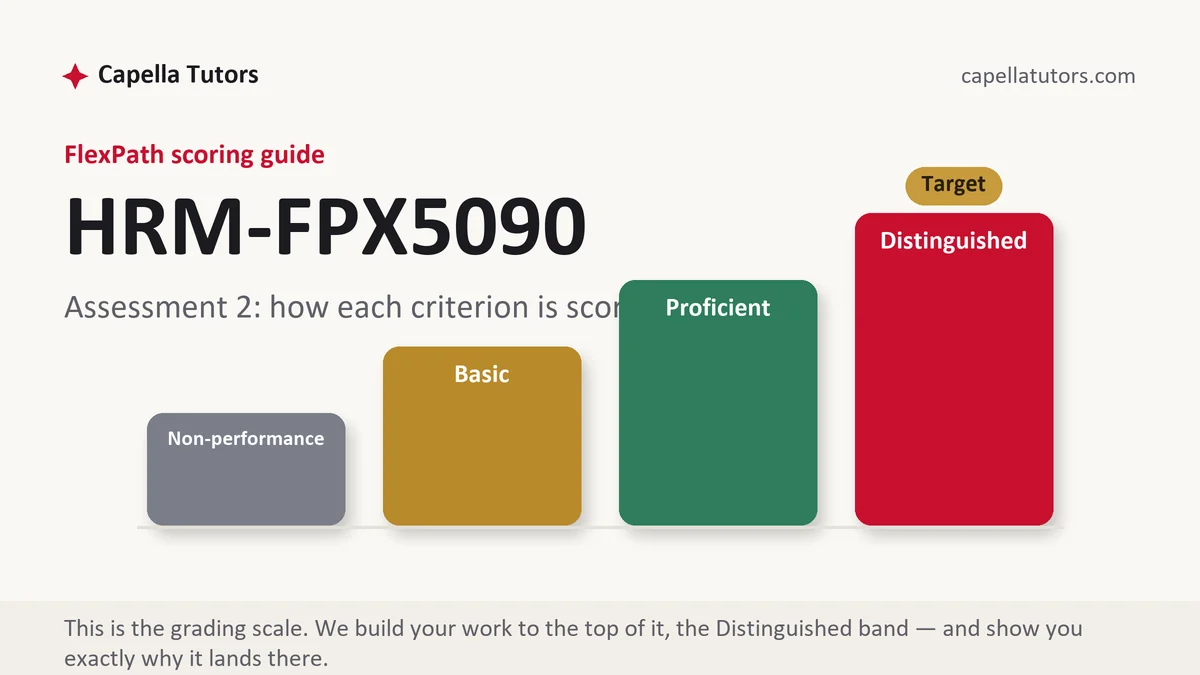
How HRM FPX 5090 Assessment 2 is scored
FlexPath does not use letter grades. Each criterion in the scoring guide lands on one of four levels, and the level descriptions are the real writing brief:
| Level | What it means on a leadership presentation |
|---|---|
| Distinguished | The leadership presentation is specific to the organization or case, applies course concepts accurately with credible sources, and ends in justified conclusions or recommendations. |
| Proficient | The leadership presentation is accurate, but the application or recommendations are general. |
| Basic | The leadership presentation describes concepts with little application. |
| Non-performance | A required part of the leadership presentation is missing. |
Check whether your courseroom asks for slides with notes or a recorded presentation.
The HRM FPX 5090 Assessment 2 method, step by step
-
Open with the problem
Engagement and turnover facts.
-
State objectives
What the study will achieve.
-
Show the workforce breakdown
Groups and their issues.
-
Explain the process
Steps and timing.
-
Show budget and resources
Costs and people needed.
-
Explain how data will be used
Decisions it will inform.
A structure that maps to the criteria
Slide counts vary by version; the note lengths are planning targets our tutors use.
| Section | What the slide and notes must do | Guide |
|---|---|---|
| Introduction and objectives | Context and goals. | 2 slides, ~150 words of notes |
| Workforce breakdown and engagement issues | Analysis. | 2 slides, ~200 words |
| Goals, process and data use | Plan. | 2 slides, ~150 words |
| Budget, time, resources and close | Costs, then references. | 2 slides, ~150 words |
Annotated sample excerpt
An original model excerpt from our team, written to show the register that reaches the top of the guide. Learn the moves, then write your own version.
The study will cost about 18,000 dollars: 6,000 for the survey platform and analysis, 8,000 in staff time for focus groups and reporting, and 4,000 for an outside facilitator so employees trust the process.1 It will take ten weeks from launch to results, timed to finish before next year's budget is set, so any actions can be funded.2 Against the cost of replacing even three mid-level employees, which our own data put at more than 60,000 dollars, the study is a small investment in finding out why people leave.3
- 1Breaks down the cost.
- 2Ties the timeline to a decision point.
- 3Compares cost with the cost of the problem.
The full premium sample for your exact assessment, written fresh to your scoring guide and topic, is free to request. Study it, revise it into your own voice, and submit work you understand.
The five mistakes that cost Distinguished
- Definitions without application. Apply each concept to the organization or case.
- No sources. Cite credible business sources.
- Vague recommendations. Make them specific and justified.
- No budget. Leaders approve costed plans.
Pre-submission checklist
- Problem and objectives
- Workforce breakdown
- Engagement issues
- Process and data use
- Budget, time and resources
- Notes and references
Want the leadership presentation written?
Send the scoring guide and any materials from your courseroom. Our team returns a premium original leadership presentation in 24 to 48 hours, revised free until it meets the guide.