This manual is for HRM FPX 5090 Assessment 1, start to submission. HR Challenge: Engagement Study Preparation asks you to prepare managers for an employee engagement study at the company in the courseroom scenario, usually in a memo: what employee engagement is, the stages of the employee life cycle where it rises or falls, the theories of motivation that explain it, and the data collection tools and ideal state the study will use. The grade turns on preparing managers to act. Clear explanations tied to the study's methods and goals score above a literature summary. Below is the method our tutors use, a structure that maps to the criteria, and an annotated sample excerpt. Prefer to hand it off? A premium original sample for this exact assessment comes back in 24 to 48 hours, revised free until it meets the guide. Capella's catalog lists the course as HRM-FPX5090, and some courserooms print HRM5090; both point to this same Assessment 1. In current courserooms this assessment typically appears as "HR Challenge: Engagement Study Preparation".
One honesty note before the manual: Capella revises courses and scoring guides over time, so always write to the exact scoring guide attached to your assessment in the courseroom. The course identity above is verified on capella.edu; the method and structure below are our tutors' approach to it, not Capella's official rubric text.
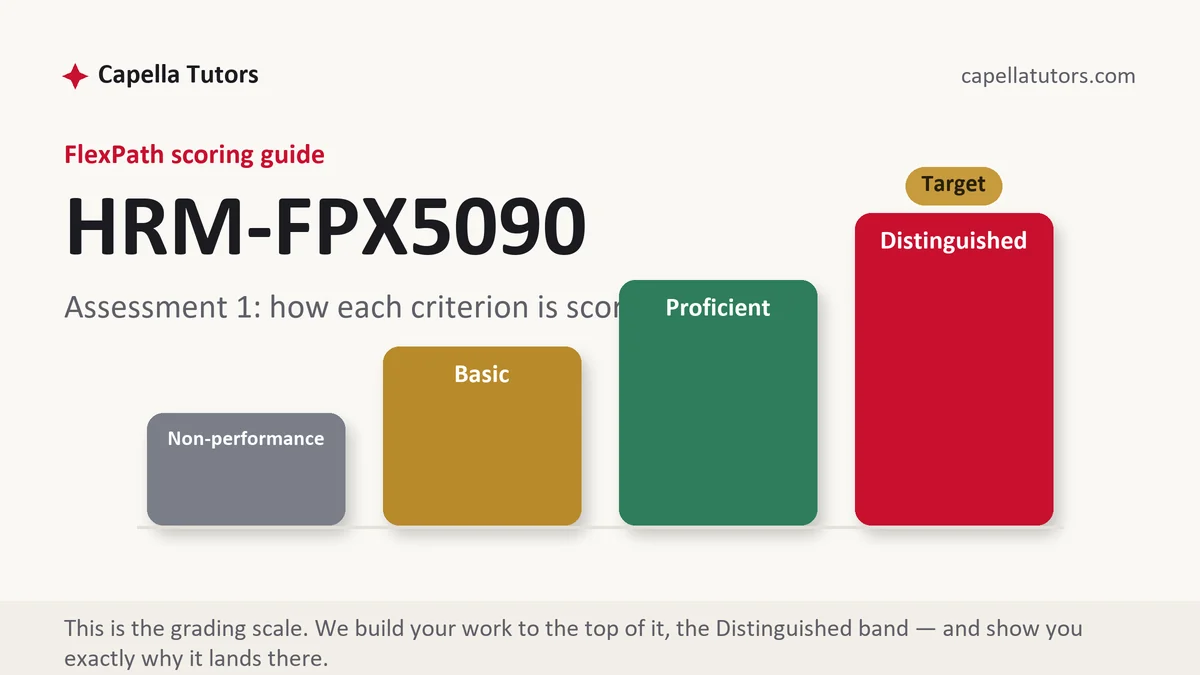
How HRM FPX 5090 Assessment 1 is scored
FlexPath does not use letter grades. Each criterion in the scoring guide lands on one of four levels, and the level descriptions are the real writing brief:
| Level | What it means on a engagement study memo |
|---|---|
| Distinguished | The engagement study memo is specific to the organization or case, applies course concepts accurately with credible sources, and ends in justified conclusions or recommendations. |
| Proficient | The engagement study memo is accurate, but the application or recommendations are general. |
| Basic | The engagement study memo describes concepts with little application. |
| Non-performance | A required part of the engagement study memo is missing. |
Write as HR to managers and use the scenario details.
The HRM FPX 5090 Assessment 1 method, step by step
-
Define engagement
With a source and how it differs from satisfaction.
-
Explain the life cycle
Attraction, onboarding, development, retention, separation.
-
Explain motivation theories
Such as Herzberg or self-determination theory, applied.
-
Describe data tools
Surveys, focus groups, stay interviews.
-
Describe the ideal state
What high engagement would look like.
-
Tell managers their role
How they will support the study.
A structure that maps to the criteria
Word counts are planning targets our tutors use, not Capella rules; follow the length and format your scoring guide states.
| Section | What it must do | Guide |
|---|---|---|
| Memo heading and introduction | Purpose. | ~75 words |
| Employee engagement and the life cycle | Concepts. | ~150 words |
| Theories of motivation | Applied. | ~125 words |
| Data collection tools and ideal state | Methods. | ~125 words |
| References | Sources. | as needed |
Annotated sample excerpt
An original model excerpt from our team, written to show the register that reaches the top of the guide. Learn the moves, then write your own version.
The study will combine an anonymous survey sent to all employees with small focus groups in the two departments where turnover is highest.1 The survey gives a company-wide baseline, while the focus groups explain the numbers, which matters because a low score on recognition, for example, can mean too little praise or praise that feels unfair.2 Managers will not attend the focus groups, so employees can speak freely, but they will receive their team's results and be asked to choose one action to improve.3
- 1Names the tools and where they are used.
- 2Explains why both are needed.
- 3Sets the managers' role.
The full premium sample for your exact assessment, written fresh to your scoring guide and topic, is free to request. Study it, revise it into your own voice, and submit work you understand.
The five mistakes that cost Distinguished
- Definitions without application. Apply each concept to the organization or case.
- No sources. Cite credible business sources.
- Vague recommendations. Make them specific and justified.
- Theory without the study. Connect concepts to the study's design.
Pre-submission checklist
- Engagement defined
- Life cycle explained
- Motivation theories applied
- Data tools described
- Ideal state
- Manager role and references
Want the engagement study memo written?
Send the scoring guide and any materials from your courseroom. Our team returns a premium original engagement study memo in 24 to 48 hours, revised free until it meets the guide.