This manual is for EDD FPX 8050 Assessment 3, start to submission. Assessment 3 of EDD FPX 8050 asks what happens to a number once decisions ride on it, and what routine would keep it honest. The assessment usually wants you to examine an indicator your organization now manages, judge whether the measure or the thing it stood for has improved, and propose a review practice with an owner. Ahead is the order our tutors examine an indicator in, a section plan taken off the criteria, and an annotated analytical passage. Want it handled? A premium original sample reaches you inside 24 to 48 hours and is revised at no cost until the guide is met. Capella's catalog lists the course as EDD-FPX8050, and some courserooms print EDD8050; both point to this same Assessment 3.
One honesty note before the manual: Capella revises courses and scoring guides over time, so always write to the exact scoring guide attached to your assessment in the courseroom. The course identity above is verified on capella.edu; the method and structure below are our tutors' approach to it, not Capella's official rubric text.
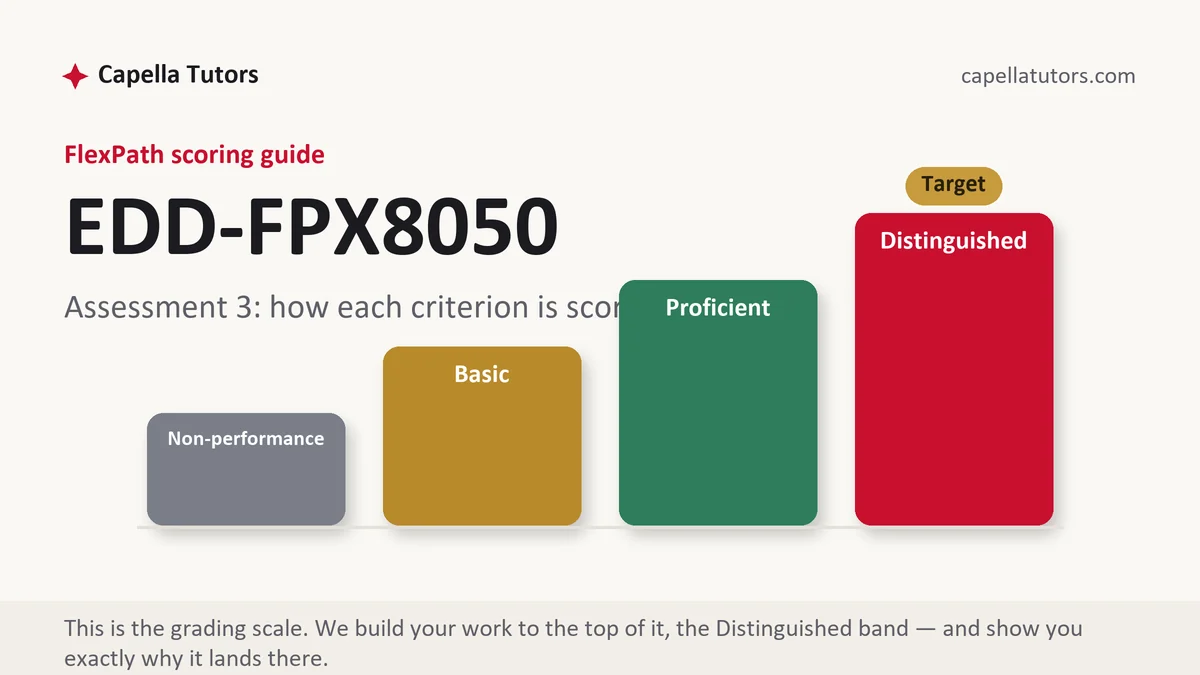
How EDD FPX 8050 Assessment 3 is scored
Four levels per criterion. On this deliverable the separation is between a paper that names a mechanism and a paper that expresses a suspicion:
| Level | What it means on an indicator and routine deliverable |
|---|---|
| Distinguished | The indicator is checked against an outcome nobody is judged on, the mechanism that could raise the measure without moving the thing is named with evidence, and the recommendation is a recurring review with an owner and a decision on the table. The routine, not the dashboard, is the top-column move. |
| Proficient | The indicator is analyzed accurately and a sound recommendation follows. Complete, a level under work that specified who reviews what and when. |
| Basic | Concern about data misuse expressed in general terms, with the local mechanism never identified. Reads as commentary rather than analysis. |
| Non-performance | A required element is absent, most often any recommendation, or any distinction between the indicator and the outcome it was chosen to predict. |
Donald Campbell put the warning most usefully in 1979 when he argued that the more a quantitative indicator is relied on for social decisions, the more it becomes subject to corruption pressures and the more it distorts the process it was meant to monitor. The American Statistical Association made a narrower point about value-added models in 2014, noting how unstable estimates for individual teachers are across years, and citing both is stronger than citing either the enthusiasm or the cynicism about data.
The EDD FPX 8050 Assessment 3 method, step by step
-
Ask what decisions now hang on the number
Write down every consequence attached to the indicator: evaluations, funding, publication, a place on an agenda, a conversation nobody wants to have. Pressure is proportional to consequence, and an indicator with nothing riding on it rarely bends. This inventory is the analysis, not the preamble to it.
-
Look for the movement you would expect if the measure were being managed
Every indicator has a cheap route to improvement, and it is usually visible in an adjacent field. Grades altered after a term closes, referrals reclassified, students moved between categories, cases exited early. Pull the adjacent count for the same periods and print the two series together.
-
Test the indicator against something nobody is judged on
The only real check is an outcome that carries no consequence for anyone in the building. If the managed indicator has moved and the unwatched outcome has not, you have evidence rather than an insinuation, and that pairing is what the criterion rewards.
-
Separate the measure from the construct it stood for
On track was adopted because it predicted graduation, not because passing courses is the goal. Say what the measure was chosen to stand for, then say whether the evidence shows that thing improving. A measure improving while its construct sits still is the finding, and it can be stated without accusing anybody.
-
Propose the routine rather than the dashboard
Kathryn Boudett, Elizabeth City and Richard Murnane sequenced preparation, inquiry and action so that a team examines evidence before debating remedies, and Cynthia Coburn and Erica Turner argued in 2011 that data use is shaped by routines, norms and who is in the room. Recommend the meeting, its membership and its order of business, since identical dashboards produce inquiry in one building and defensiveness in another.
-
Name the decision on the table at each review
Who looks at which measure, how often, with which counts in front of them, and what they are empowered to change that day. A recommendation that ends at a presentation is scored as a presentation. One that ends with a standing decision point is scored as leadership.
A structure that maps to the criteria
Our planning split for a deliverable of ordinary scope; follow the emphasis your own criteria set.
| Section | What it must do | Guide |
|---|---|---|
| The indicator and its definition | What it counts, which cohort, over what window, and the system it comes from. | ~200 words |
| What now depends on it | Every consequence attached to the number, and who carries each one. | ~225 words |
| The adjacent count | The field that would move if the measure were being managed, reported over the same periods. | ~275 words |
| The unwatched outcome | An outcome with no consequence attached, and whether it moved with the indicator. | ~275 words |
| Measure against construct | What the indicator was adopted to predict, and whether the evidence shows that improving. | ~225 words |
| The review routine, and references | Membership, cadence, counts on the table, the standing decision, and seventh edition APA. | ~250 words |
Annotated sample excerpt
An original analytical passage from our team at the level the top column describes.
The ninth grade on-track rate at this high school rose from 71 to 86 percent in the two years after it entered the principal's evaluation, and across the same two years the share of course grades altered after the term closed rose from 3 to 14 percent.1 State assessment performance for those cohorts did not move, and neither did the share of tenth graders carrying enough credits to graduate on schedule, which are the two things the on-track measure was adopted to predict.2 The honest reading is not that anyone falsified a record; it is that a number attached to an evaluation acquires a second purpose, and this one has been improving as a measure while standing still as a fact.3
- 1Sets the indicator's rise beside a mechanism that could produce it with no change in learning, both series carrying the same periods.
- 2Checks the managed number against outcomes nobody is evaluated on, which is the only test that separates improvement from management.
- 3Draws the conclusion without accusing anyone, which is what keeps a paper like this usable inside the organization it describes.
The full premium sample for your exact assessment, written fresh to your scoring guide and issue, is free to request. Study it, revise it into your own voice, and submit work you understand.
The five mistakes that cost Distinguished
- Suspicion offered without a mechanism. Concern about teaching to the test is commentary until you name the field in your own data that moved.
- The indicator checked only against itself. A measure that improved alongside other measures everybody is judged on has been tested against nothing.
- The construct forgotten. An indicator was adopted to predict something, and a paper that never revisits that thing has skipped the analysis.
- An accusation instead of a finding. Writing that staff manipulated data ends the conversation inside the district and adds nothing a criterion can award.
- A dashboard recommended in place of a routine. More visible data changes nothing without a meeting, a membership and a decision anyone is allowed to make.
Pre-submission checklist
- The indicator defined with its cohort, window and source system
- Every consequence attached to the number inventoried with its owner
- The adjacent count pulled for the same periods and printed alongside
- One outcome with no consequences attached used as the check
- The construct the indicator stood for revisited explicitly
- A review routine with membership, cadence and a standing decision, seventh edition APA
Indicator analysis due on a number your district is proud of?
Send the prompt, the criteria, and the indicator plus whatever adjacent fields you can pull. A premium original sample returns in 24 to 48 hours with the mechanism named from evidence, the construct tested against an unwatched outcome, and a review routine somebody could actually chair.