This manual is for EDD FPX 8040 Assessment 3, start to submission. Assessment 3 of EDD FPX 8040 handles the part of a practitioner study that a campus researcher never faces. The assessment usually asks how consent works when you hold authority over the participants, what protects records you can already open, and which approvals have to arrive before anything is collected. Ahead you will find how our tutors build protections, the section plan drawn from the criteria, and an annotated recruitment passage. Want it handled? One premium original sample lands inside 24 to 48 hours and is revised free until the guide is answered. Capella's catalog lists the course as EDD-FPX8040, and some courserooms print EDD8040; both point to this same Assessment 3.
One honesty note before the manual: Capella revises courses and scoring guides over time, so always write to the exact scoring guide attached to your assessment in the courseroom. The course identity above is verified on capella.edu; the method and structure below are our tutors' approach to it, not Capella's official rubric text.
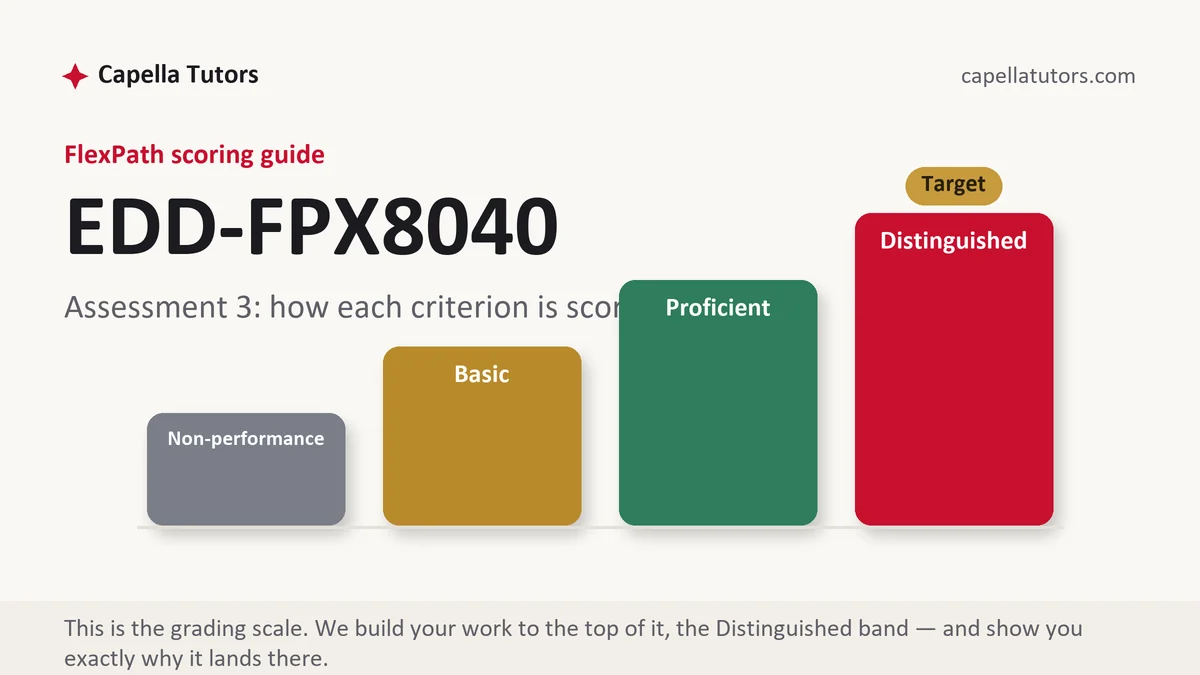
How EDD FPX 8040 Assessment 3 is scored
Four levels, one criterion at a time. On ethics the top column is bought with procedures that cost you something:
| Level | What it means on an ethics and approvals deliverable |
|---|---|
| Distinguished | Voluntariness is solved with named procedures rather than promised, records are treated as their own regime, and the determinations that belong to a review board are left to it with realistic time allowed. A safeguard with a stated cost is what the top column rewards. |
| Proficient | Consent, confidentiality and approvals are all addressed correctly. Complete, a level under work that priced its own protections. |
| Basic | A general assurance of care and a sentence saying approval will be obtained. Compliance language where a procedure was wanted. |
| Non-performance | A required element is absent, most often any account of the pressure your role puts on participation, or any approval route at all. |
The Belmont Report set out respect for persons, beneficence and justice in 1979, and the federal regulations built on those principles decide what counts as human subjects research. In your own building the pressure point is voluntariness, because a parent invited to talk by the office that decides about their child is not in the position of a stranger answering a survey.
The EDD FPX 8040 Assessment 3 method, step by step
-
Write consent as a conversation you could be watched having
What the study is, what participation costs in minutes, what happens to the recording, who will hear it, what changes if they decline, and how to withdraw afterward. Draft it in the languages your families actually speak. A form nobody could understand under pressure is not consent, whatever it is signed.
-
Solve voluntariness where your role creates the problem
Recruit through someone who has no authority over the participant, state in the invitation that participation has no bearing on any service or evaluation, exclude anyone whose situation you personally decide, and hold interviews away from the building if that is what it takes. Each of those costs you participants, and saying so is the point.
-
Treat records as a separate regime from your job
Files you can open as an administrator carry federal protections of their own, and pulling a roster or a set of scores for research is a different act from using them to do your work. Say which fields you need, why each is necessary, where it will live, who else can reach it, and when it is destroyed.
-
Leave the determination of review to the people who own it
Whether your activity is human subjects research, and whether it qualifies for a lower level of review, are determinations for your university board rather than assumptions for your paper. Write that the determination is pending, describe what you have submitted, and never write a sentence that presumes the answer.
-
Put both calendars in the plan
Your district almost certainly runs its own research review, with separate forms, its own meeting schedule and often a required internal sponsor, and neither approval substitutes for the other. Allow real weeks for each, sequence them, and say what you will do if the second arrives after the collection window you planned.
-
Justify the number of participants rather than looking one up
Sample size in qualitative work follows from how narrow the question is, how varied the people who could answer it are, and how much each can tell you. State your logic, say what you will treat as evidence that new participants are only confirming existing categories, and treat that as a finding rather than as permission to stop.
A structure that maps to the criteria
Our planning split for an ethics section of ordinary scope; the weighting in your own guide governs.
| Section | What it must do | Guide |
|---|---|---|
| Participants and the pressure | Who is eligible, how many, and what authority you hold over any of them. | ~200 words |
| Consent and withdrawal | What participants are told, in which languages, and how withdrawal actually works. | ~250 words |
| Voluntariness, protected | The recruitment route, the exclusions, and the setting, each with what it costs the study. | ~275 words |
| Records and data handling | Fields required, justification for each, storage, access and destruction. | ~250 words |
| Approvals and timelines | Board and district routes, what is pending, and the weeks allowed for each. | ~250 words |
| Sampling logic and references | Why this number of participants answers this question, and seventh edition APA throughout. | ~175 words |
Annotated sample excerpt
An original ethics passage from our team at the register the top column describes.
The families invited to this study are the parents of the 27 students referred for special education evaluation in this district last year, and 19 of those referrals were signed by staff who report to me.1 Recruitment therefore runs through the district family liaison rather than through my office, the invitation states in both languages that taking part has no bearing on any service the child receives, and no interview is held inside a building where the child is enrolled.2 Whether this activity is human subjects research, and whether these protections suffice, are determinations for the university review board and the district research office, and the plan allows twelve weeks for both before any family is contacted.3
- 1Puts the pressure on the page: the population, the count, and the writer's authority over most of the referrals.
- 2Answers voluntariness with three procedures rather than a promise, each of which a reader could confirm happened.
- 3Leaves the determinations with the offices that own them and prices the delay into the schedule, which is where practitioner timelines are usually wrong by a term.
The full premium sample for your exact assessment, written fresh to your scoring guide and issue, is free to request. Study it, revise it into your own voice, and submit work you understand.
The five mistakes that cost Distinguished
- Consent treated as a signature. A form nobody could follow under pressure documents compliance and protects nobody.
- Voluntariness promised rather than engineered. If the invitation comes from the office that decides about the child, no sentence about free choice fixes it.
- Records used as though the job licensed it. Access you hold to do your work is not access you hold to do research, and the criteria expect you to say so.
- The review determination made in advance. Writing that the study is exempt takes a decision that belongs to a board and reads as inexperience.
- A timeline with one approval in it. District review and university review are separate calendars, and assuming otherwise costs a full collection window.
Pre-submission checklist
- The authority you hold over eligible participants stated with counts
- Consent written plainly, in the languages your families use, with withdrawal explained
- Recruitment routed away from your own line, with the exclusions named
- Every data field justified, with storage, access and destruction specified
- Both approval routes described as pending, with real weeks allowed for each
- A stated sampling logic tied to the question, and seventh edition APA throughout
Ethics and approvals section due before you can collect anything?
Send the prompt, the criteria, your role and who your participants are. A premium original sample returns in 24 to 48 hours with voluntariness solved by procedure, records handled as their own regime, and both approval calendars written into the plan, revised free until the criteria are met.