This manual is for EDD FPX 8040 Assessment 2, start to submission. Assessment 2 of EDD FPX 8040 is where the design has to survive contact with what could go wrong. The assessment usually asks you to name the specific threats your arrangement leaves standing, say what you did about each, and say what remains uncontrolled after you have done it. Below: the order our tutors work threats in, the structure the criteria reward, and a marked-up limitations passage. Rather hand it over? A premium original sample reaches you in 24 to 48 hours, reworked at no cost until the criteria are satisfied. Capella's catalog lists the course as EDD-FPX8040, and some courserooms print EDD8040; both point to this same Assessment 2.
One honesty note before the manual: Capella revises courses and scoring guides over time, so always write to the exact scoring guide attached to your assessment in the courseroom. The course identity above is verified on capella.edu; the method and structure below are our tutors' approach to it, not Capella's official rubric text.
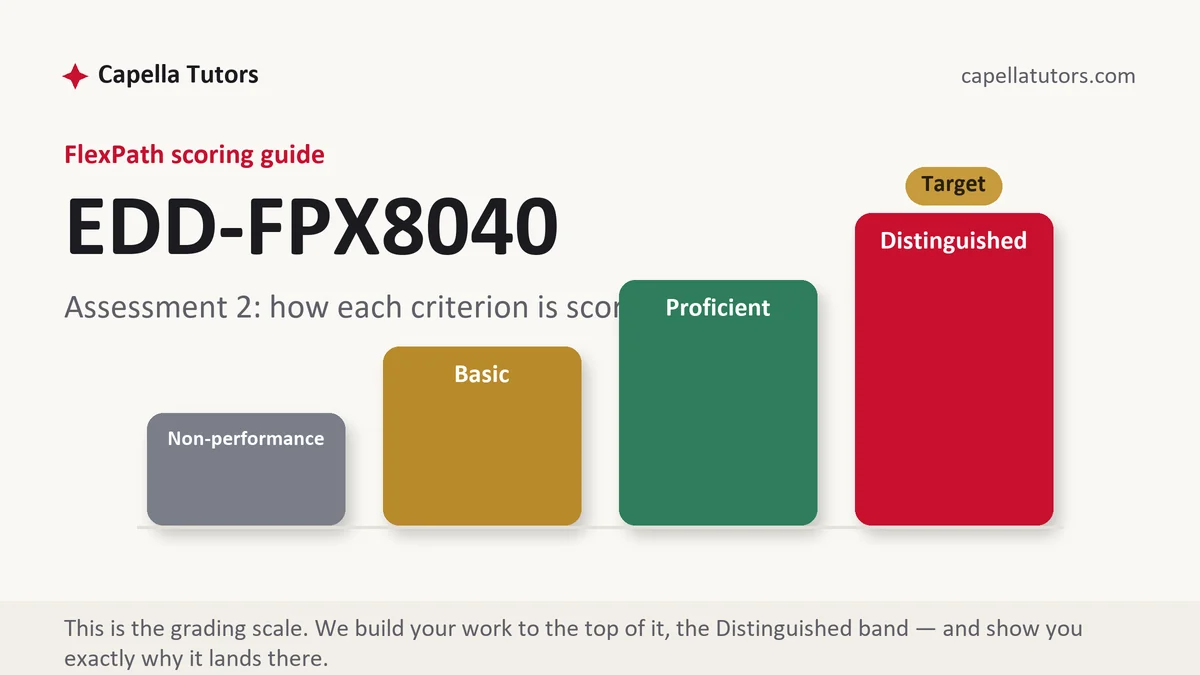
How EDD FPX 8040 Assessment 2 is scored
Four levels per criterion, and on design quality the difference between them is whether the paper argued or promised:
| Level | What it means on a design quality deliverable |
|---|---|
| Distinguished | Each threat is named specifically, paired with the procedure addressing it and the cost of that procedure, and the threat that could not be removed is stated together with its effect on the eventual claim. That last admission is what the top column is buying. |
| Proficient | Threats are identified and reasonable procedures are described. Sound, and a level below work that priced what it could not fix. |
| Basic | Validity discussed in the abstract, or trustworthiness listed as four words with no procedure under any of them. |
| Non-performance | A required element is absent, most often any treatment of quality at all, or causal language over an arrangement that cannot support it. |
William Shadish, Thomas Cook and Donald Campbell catalogued the threats to causal inference from imperfect comparisons in 2002, and the catalogue is worth working through item by item rather than reaching for the three you remember. History, maturation, selection, testing, instrumentation, attrition and regression each have a design remedy, and each remedy has a price you should be willing to state.
The EDD FPX 8040 Assessment 2 method, step by step
-
Work the threat list item by item, not from memory
Take each threat in turn and write one sentence saying whether your arrangement is exposed to it. Most drafts name selection and stop, then lose the criterion to instrumentation or attrition, which are the two that quietly do the most damage in school data.
-
Build the comparison group before you defend it
The value of a non-randomized comparison lies entirely in how it was constructed. Match on the baseline value of the outcome itself where you can, add the two or three covariates that plausibly drive selection, and report how far apart the groups still are after matching rather than asserting equivalence.
-
Take more than two measurements
Two points cannot distinguish a change from a line that was already moving. Several periods before and several after turn a comparison of means into a comparison of trajectories, and that upgrade usually costs nothing because the district already holds the earlier data.
-
Ask what else arrived that year
History is the threat practitioners underrate, because districts never do one thing at a time. List every other initiative, curriculum adoption, staffing change and campaign that overlapped your window, then say which of them you cannot separate from your effect. Naming it is worth more than hiding it.
-
Check whether the instrument moved under you
A benchmark form, a cut score, a referral definition or a coding rule that changed between administrations will produce a difference with no change in students behind it. Confirm the definition held across your whole window and cite the document that told you, because nobody checks this and it invalidates more district analyses than anything else.
-
Earn trustworthiness with procedures if your strand is qualitative
Yvonna Lincoln and Egon Guba proposed credibility, transferability, dependability and confirmability in Naturalistic Inquiry in 1985, and each is earned rather than claimed: prolonged engagement and member checking, thick description, an audit trail. Write the procedure and let the adjective follow from it.
A structure that maps to the criteria
Our defaults for a quality section of ordinary scope; your criteria decide how much weight each part carries.
| Section | What it must do | Guide |
|---|---|---|
| The arrangement restated | What is being compared with what, over which periods, using which measure. | ~175 words |
| Threats your design faces | Each threat from the catalogue, with one sentence on whether this arrangement is exposed. | ~325 words |
| The comparison, constructed | How the comparison group was built, on what, and how far apart the groups remain. | ~275 words |
| Concurrent events | Everything else that overlapped the window, and which of it cannot be separated out. | ~225 words |
| Instrument stability | Whether definitions, forms and thresholds held across the window, with the source that confirms it. | ~200 words |
| Residual threats and references | What stays uncontrolled, its effect on the claim, and seventh edition APA throughout. | ~200 words |
Annotated sample excerpt
A model threat passage from our team, written at the register the top descriptor describes.
Fourteen of this district's twenty-two secondary schools began restorative practices in the same August, which removes the obvious comparison and leaves eight schools differing from the fourteen in enrollment, mobility and prior referral rate.1 Matching on the three-year mean referral rate per hundred students narrows that difference without closing it, and the four earliest adopters were also the four with the highest baseline, so regression toward the mean will move their figures whether the practice works or not.2 The study therefore reports differences in trajectory across five semesters rather than two post-test means, and the limitations state that a district attendance campaign overlapped the first year and cannot be separated from any effect found.3
- 1Says what the rollout did to the design before defending anything, so the reader sees the constraint the writer was handed.
- 2Reports the residual difference after matching and names the specific mechanism that will produce a false gain.
- 3Converts the weakness into a design decision, then concedes the one confound that cannot be removed.
The full premium sample for your exact assessment, written fresh to your scoring guide and issue, is free to request. Study it, revise it into your own voice, and submit work you understand.
The five mistakes that cost Distinguished
- Causal verbs over a non-randomized comparison. Improved and produced are claims the assignment procedure already gave away.
- Selection named and instrumentation ignored. A cut score that moved between administrations manufactures a result out of nothing, and almost nobody checks.
- Equivalence asserted after matching. Groups are never equivalent, only closer, and reporting how much closer is the entire value of the procedure.
- Trustworthiness claimed as four words. Four criteria named with no member check, no audit trail and no thick description reads as vocabulary.
- A limitations section made of apologies. Small sample and time constraints are generic. Name the confound that could produce your result without your intervention.
Pre-submission checklist
- Every threat in the catalogue addressed with one sentence, not just the familiar three
- The comparison group's construction described, with residual differences reported
- More than two measurement points wherever the data allows it
- Concurrent initiatives listed, and the inseparable one named
- Instrument and definition stability confirmed against a cited document
- The residual threat stated with its effect on the claim, seventh edition APA throughout
Quality section due on a rollout you did not control?
Send the prompt, the criteria, and how the change was actually deployed. A premium original sample returns in 24 to 48 hours with each threat named, priced and answered, and the one you cannot remove written into the limitations rather than hidden, revised free until the guide is met.