This manual is for EDD FPX 8040 Assessment 1, start to submission. Assessment 1 of EDD FPX 8040, Research Design for Practitioners, is graded on whether the parts answer each other. The assessment usually asks you to specify a study that would investigate a problem in your own organization, justify the design against the alternatives you rejected, and keep every claim inside what the arrangement can actually support. What follows is how our tutors lock a design together, the section plan the criteria expect, and an annotated purpose statement. Prefer to hand it off? One premium original design comes back inside 24 to 48 hours and is revised free for as long as the guide requires. Capella's catalog lists the course as EDD-FPX8040, and some courserooms print EDD8040; both point to this same Assessment 1.
One honesty note before the manual: Capella revises courses and scoring guides over time, so always write to the exact scoring guide attached to your assessment in the courseroom. The course identity above is verified on capella.edu; the method and structure below are our tutors' approach to it, not Capella's official rubric text.
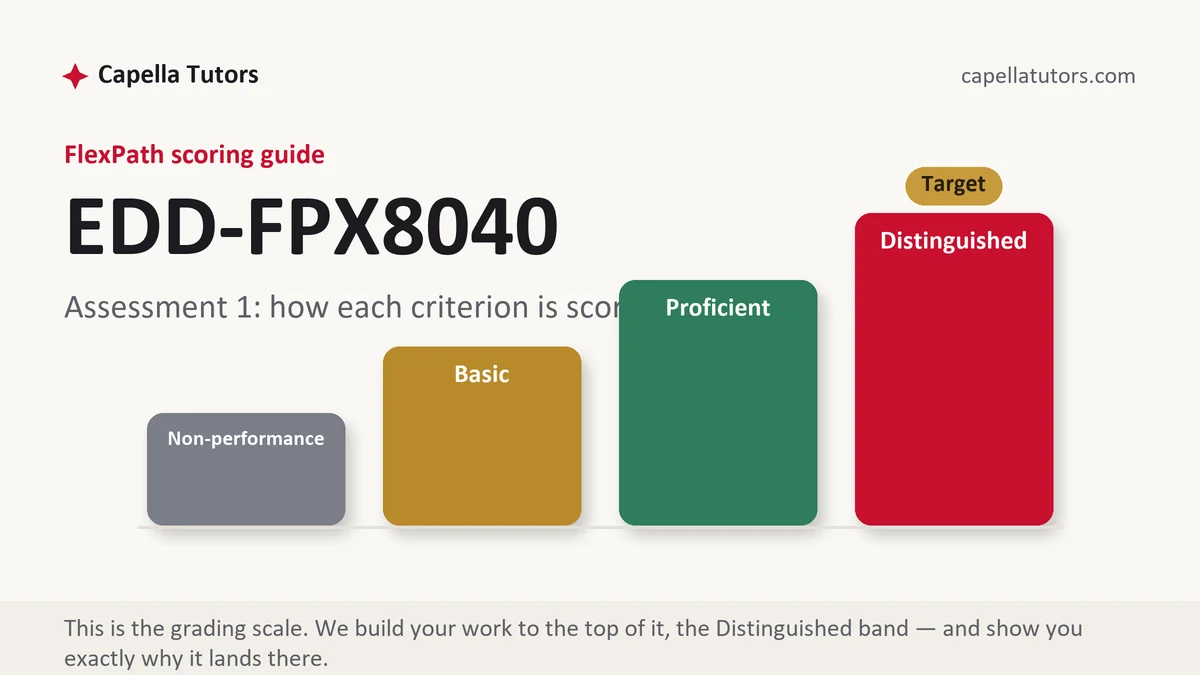
How EDD FPX 8040 Assessment 1 is scored
FlexPath scores criteria rather than papers, four levels each. Alignment sits behind most of the rows, and it is mechanical enough to check with a ruler:
| Level | What it means on a study design deliverable |
|---|---|
| Distinguished | Problem, purpose, questions, sources and analysis form one chain a reader can pull, the design is defended against the alternatives that were rejected, and the concluding claim is no larger than the arrangement permits. Naming the rejected designs with their tradeoffs is usually the top-column move. |
| Proficient | The design suits the question and the parts are consistent. Correct work, a level under work that shows what it declined to do. |
| Basic | Sections that are individually competent and do not answer each other. A qualitative question sitting above a rating scale is the standard version. |
| Non-performance | A required element is absent, most often the analysis plan, or a purpose sentence from which no design can be identified. |
The words for practitioners in the course title add a test a research degree would not apply. Feasibility is graded, so a design you could not run with the access, the calendar and the permission you actually hold is not more ambitious, it is a proposal that will never produce evidence.
The EDD FPX 8040 Assessment 1 method, step by step
-
Draft the alignment table before any prose
One row per research question, with columns for the data source, the participants, the analysis and the claim that row will support. A question that cannot fill all four cells is not yet a research question, and finding that out in a table costs an afternoon rather than a submission.
-
Write the purpose sentence in the conventional form
The purpose of this study is to, then the verb that names the design, then the phenomenon, the population and the setting. Done properly a reader identifies the design from that sentence alone without being told it, and every criterion downstream gets easier because the reader is no longer guessing.
-
Say which designs you rejected and what each would have cost
A single-case study would have given depth and no comparison. A survey would have reached everyone and explained nothing. Writing two or three of those sentences is the cheapest way to demonstrate that the design was chosen rather than assumed, and it is the paragraph most drafts leave out.
-
Match every question to a source and every source to a question
Number the questions, then walk the instrument list twice: once asking which question each source answers, once asking which source answers each question. Anything left over on either pass is either an unanswerable question or data you have no reason to collect.
-
Write the analysis plan as steps somebody else could run
Which comparison, which test or coding approach, which software, what happens to missing cases, and what output would answer the question. Analysis described as themes will be identified tells a reader you have not decided yet, and the criterion is written to notice.
-
Check the plan against the access and the calendar you actually have
Count the observations, the interviews and the transcription hours against the weeks you have and the doors that open for you. Three hundred classroom observations in one semester is not ambition. Build the review timelines in before you commit to anything, because they are frequently the longest item in the schedule.
A structure that maps to the criteria
Planning targets for a design paper of ordinary scope rather than Capella requirements; follow your own guide's weighting.
| Section | What it must do | Guide |
|---|---|---|
| Problem, purpose and questions | The gap in your setting, a purpose sentence in conventional form, and numbered answerable questions. | ~250 words |
| Design and justification | The design chosen, the alternatives rejected, and why the question requires this one. | ~300 words |
| Site, participants and sampling | The setting, who is eligible, how they are selected, and the expected number. | ~250 words |
| Sources and instruments | Every protocol or instrument, its provenance, and the question it answers. | ~275 words |
| Analysis plan | The comparison or coding route, step by step, including what happens to missing cases. | ~250 words |
| Entitlement and references | The largest claim this design supports, stated plainly, and seventh edition APA throughout. | ~150 words |
Annotated sample excerpt
An original passage from our team showing what the alignment criterion actually rewards.
The purpose of this explanatory sequential mixed methods study is to examine the relationship between placement in a co-taught seventh grade mathematics section and spring growth on the district interim assessment across six middle schools, then to explain the pattern found through interviews with the eight teacher pairs whose sections showed the largest and smallest gains.1 The first phase is comparative and quantitative, the second is explanatory and qualitative, and the second is designed after the first rather than beside it, which is the work the word sequential is doing in that sentence.2 Because counselors assigned students to co-taught sections using prior grades and service minutes, this design supports a statement about difference adjusted for prior score and supports no statement that co-teaching caused anything.3
- 1A purpose sentence a reader can name the design from, with the population, the setting and both phases visible in one pass.
- 2Explains why the label fits instead of displaying it, which is the difference between using a typology and citing one.
- 3States the entitlement before an evaluator has to, and gives up the causal verb the placement procedure had already forfeited.
The full premium sample for your exact assessment, written fresh to your scoring guide and issue, is free to request. Study it, revise it into your own voice, and submit work you understand.
The five mistakes that cost Distinguished
- A question the planned data cannot answer. Asking how teachers experience a model and then collecting a rating scale breaks the alignment criterion outright.
- A purpose sentence that hides the design. If a reader cannot name the design from it, every section afterward is read as guesswork.
- No rejected alternatives anywhere. A design presented as the only option reads as the only one you knew, and the justification criterion has nothing to score.
- An analysis plan made of intentions. Data will be analyzed for themes is a promise; a coding route with a stopping rule is a plan.
- A study nobody could execute. A schedule that ignores approval calendars and transcription hours is usually wrong by a full term.
Pre-submission checklist
- An alignment table where every question fills all four cells
- A purpose sentence a reader can name the design from
- At least two rejected designs named with their tradeoffs
- Questions and sources matched in both directions with nothing spare
- An analysis plan written as steps, including treatment of missing cases
- The largest supportable claim stated plainly, and seventh edition APA throughout
Design section due and the parts will not line up?
Send the prompt, the criteria, the access you genuinely have and how long you have to collect anything. A premium original sample returns in 24 to 48 hours with purpose, questions and design locked to each other, and one reader assigned to nothing but confirming each question is answerable by the data planned for it.