This manual is for EDD FPX 8020 Assessment 3, start to submission. Assessment 3 of EDD FPX 8020 is where the diagnosis has to become something testable. The assessment usually asks you to set a measurable aim, show the causal logic that connects your proposed changes to it, and specify how anyone would know whether the change was an improvement. Below is the order we build a plan in, the sections the criteria look for, and an annotated measurement passage. Want it handled? A premium original plan reaches you inside 24 to 48 hours and is revised at no charge until every row is answered. Capella's catalog lists the course as EDD-FPX8020, and some courserooms print EDD8020; both point to this same Assessment 3.
One honesty note before the manual: Capella revises courses and scoring guides over time, so always write to the exact scoring guide attached to your assessment in the courseroom. The course identity above is verified on capella.edu; the method and structure below are our tutors' approach to it, not Capella's official rubric text.
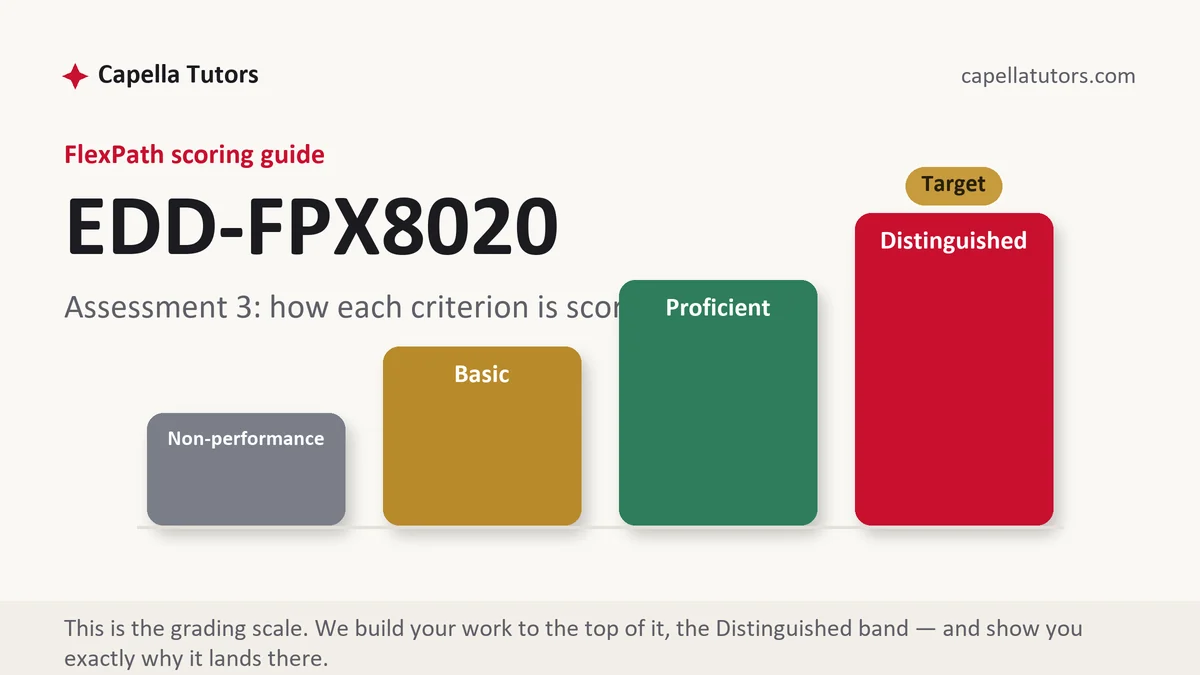
How EDD FPX 8020 Assessment 3 is scored
No grades, four levels, one criterion at a time. On a plan, the top column is almost always about evidence of your own failure conditions:
| Level | What it means on an improvement plan |
|---|---|
| Distinguished | The aim carries a quantity and a date, every change idea traces to a driver and every driver traces to the aim, and the measurement plan includes something that would reveal the change doing harm. That balancing measure is the sentence the top column pays for. |
| Proficient | Aim, drivers and changes are all present and coherent, with measures attached. Complete, and short of work that planned for being wrong. |
| Basic | A list of sound ideas under a general goal. No causal chain, so nothing in the paper can be tested. |
| Non-performance | A required element is absent, most often the measurement plan, or an aim with no quantity anywhere in it. |
Anthony Bryk, Louis Gomez, Alicia Grunow and Paul LeMahieu set out the discipline behind this in Learning to Improve in 2015, and the cycle they use descends from Walter Shewhart by way of W. Edwards Deming, which is worth attributing rather than calling a generic planning loop. Cynthia Coburn's 2003 account of scale in Educational Researcher is the reference that stops a plan from equating reach with depth.
The EDD FPX 8020 Assessment 3 method, step by step
-
Write the aim with a quantity, a date and a denominator
Improve substitute coverage is not an aim. Raise the fill rate from 68 to 85 percent of requested days across 43 schools by the end of next school year, counted from the district's absence management system, is one. Say where the number comes from, because a figure with no source cannot be checked and will not move anyone.
-
Work backwards to the drivers instead of forwards from your ideas
Ask what would have to change for the aim to be reached, then ask it again about each answer. Posting speed, pay relative to neighbouring districts, the size of the eligible pool and how substitutes are treated on arrival are drivers. The tempting shortcut is to start with the intervention you already like, and a one-branch diagram is visible immediately.
-
Break each driver into something a named person could change next month
Posting speed becomes the share of absences entered before the end of the previous day, which a building secretary can move. Treatment on arrival becomes whether a substitute receives lesson materials and a room key at a desk that expects them. Drivers you cannot reach still belong on the diagram, marked as out of scope.
-
Attach three kinds of measure, each with an owner and a source
One outcome measure restating the aim, which moves slowly. At least one process measure telling you weekly whether the change is actually happening. And one balancing measure watching what the change might be quietly costing. Name the person who reports each number and the system it comes out of.
-
Decide in advance what would count as a signal
Say what pattern in the data you will treat as real change before you see any data. Eight consecutive points on one side of the baseline median, or six moving steadily in one direction, are the conventional run-chart signals, and a measure collected quarterly cannot produce either inside a school year. That fact alone often decides which measure you steer by.
-
Make the first test small enough to fail cheaply
One building, one month, one change, with the process measure read weekly. A pilot in three schools with four simultaneous changes cannot tell you which change did anything, and the criteria on evaluating improvement will say so.
A structure that maps to the criteria
Our planning split for a plan of ordinary scope, not a Capella requirement; follow the weighting in your own guide.
| Section | What it must do | Guide |
|---|---|---|
| The problem, quantified | Current performance with its numerator, denominator, source system and period. | ~200 words |
| The aim | One sentence carrying a quantity, a date and the population it covers. | ~125 words |
| Drivers | Primary drivers, secondary drivers, and the ones you are deliberately leaving out of scope. | ~300 words |
| Change ideas | Each proposal traced to the driver it acts on, and each driver traced back to the aim. | ~275 words |
| Measurement plan | Outcome, process and balancing measures, with owners, sources and reporting intervals. | ~300 words |
| First test and references | The smallest test that could fail informatively, and seventh edition APA throughout. | ~175 words |
Annotated sample excerpt
A model measurement passage from our team, at the register the top descriptor describes.
The aim is to raise the substitute fill rate across these 43 schools from 68 to 85 percent of requested days by the end of next school year, counted as filled requests divided by total requests in the district absence management system.1 The outcome measure is that rate, reported monthly to the cabinet; the process measure is the share of absences entered before the end of the previous school day, reported weekly and owned by each building secretary, because it is the driver we can move first.2 The balancing measure is the number of periods covered by pulling instructional coaches off assignment, since a fill rate that rises because coaching stopped is not an improvement and would not show up in the outcome number at all.3
- 1The aim is quantified, dated, denominated and tied to the system the figure comes from, so a reader could recompute it.
- 2Pairs a slow outcome with a fast process measure and gives the fast one an owner, which is what makes a plan steerable rather than reportable.
- 3The balancing measure names a real cost the outcome number would conceal, and that sentence is what evaluators read as understanding rather than compliance.
The full premium sample for your exact assessment, written fresh to your scoring guide and issue, is free to request. Study it, revise it into your own voice, and submit work you understand.
The five mistakes that cost Distinguished
- An aim with no arithmetic in it. Improve coverage has no target, no date and no denominator, so no later section can be evaluated against it.
- Change ideas that answer to no driver. A proposal with nothing above it in the diagram is a preference, and the causal criterion has nothing to score.
- Only an outcome measure. A number that moves twice a year cannot steer anything, and a plan built on it will run blind for a term.
- No balancing measure anywhere. Every change costs something somewhere, and a plan that does not look for the cost has not thought about being wrong.
- Reach mistaken for depth. Rolling a change into more buildings while practice stays unchanged is spread without improvement, and the literature has said so since 2003.
Pre-submission checklist
- The aim carries a quantity, a date, a denominator and a named source system
- Every change idea traces up to a driver, every driver up to the aim
- Drivers out of your reach marked as out of scope rather than omitted
- Outcome, process and balancing measures each with an owner and an interval
- The signal you will accept as real change stated before any data arrives
- A first test small enough to fail cheaply, and seventh edition APA throughout
Improvement plan due with measures attached?
Send the prompt, the criteria, and the aim you are being asked to hit. We build the driver logic, attach outcome, process and balancing measures with owners, and return a premium original sample in 24 to 48 hours, revised free until every criterion is met.