This manual is for EDD FPX 8020 Assessment 2, start to submission. Assessment 2 of EDD FPX 8020 puts the theory to work on something that already failed. The assessment usually asks you to apply named change models to an initiative in your own organization, say what each model reveals, and say where it stops being useful. What follows is how our tutors take an initiative apart, the structure the criteria expect, and a marked-up passage. Rather hand it over? One premium original sample lands inside 24 to 48 hours, reworked free of charge for as long as the guide needs. Capella's catalog lists the course as EDD-FPX8020, and some courserooms print EDD8020; both point to this same Assessment 2.
One honesty note before the manual: Capella revises courses and scoring guides over time, so always write to the exact scoring guide attached to your assessment in the courseroom. The course identity above is verified on capella.edu; the method and structure below are our tutors' approach to it, not Capella's official rubric text.
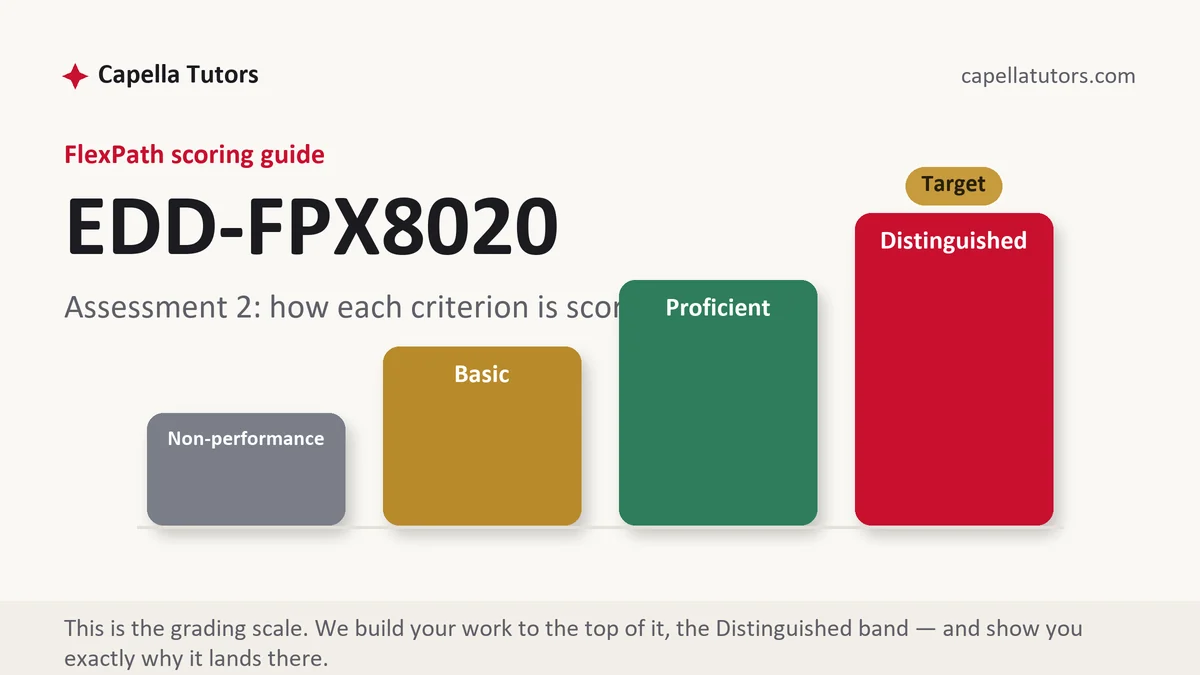
How EDD FPX 8020 Assessment 2 is scored
Each criterion lands on one of four levels. On an application deliverable the distance between the top two is a habit of mind rather than a quantity of work:
| Level | What it means when change theory is applied to a stalled initiative |
|---|---|
| Distinguished | Each model is used as an instrument with its yield and its limit both stated, the technical part of the work is separated from the adaptive part, and resistance is analyzed as a design fault carrying a remedy. Naming where a model stopped helping is usually the paid move. |
| Proficient | Models are applied accurately and the initiative is explained through them. Correct, and a level below work that has argued with its own tools. |
| Basic | A faithful recital of a model with the initiative narrated underneath it. The theory decorates the account instead of cutting into it. |
| Non-performance | A required element is missing, most often any analysis of what people are being asked to surrender, or any model at all beyond a general appeal to change. |
An initiative that failed twice is better material than one that succeeded, because failure exposes the mechanism. Write about the second failure specifically, since the difference between the first attempt and the second is the closest thing to a natural experiment your organization will hand you.
The EDD FPX 8020 Assessment 2 method, step by step
-
Sort the work into technical and adaptive before choosing a model
Ronald Heifetz argued in Leadership Without Easy Answers in 1994 that some problems yield to expertise and others sit in the values and habits of the people who hold them. A schedule that has to fit inside a fixed number of minutes is the first kind. Asking eleven teachers to give up a period they built a career around is the second, and no expert can do that on their behalf.
-
Say exactly what people are being asked to give up
Write the losses down in the specific: a room, a preparation period, a course they designed, an arrangement with a second employer, standing among colleagues. Loss stated concretely can be negotiated, planned around or compensated. Loss described as mindset can only be complained about, and the criteria notice which one you wrote.
-
Use a sequence model for what a sequence model does
John Kotter's eight steps from Leading Change, published in 1996, describe an order of operations and assume everybody agrees where the organization is going. That assumption is often the thing that is false in your case. Apply the model, report what it explained, then say plainly which step it asked you to skip past.
-
Ask why the same change moved elsewhere
Everett Rogers explains adoption in terms of the innovation's attributes and the conditions it lands in, so find a comparable building where this worked and list every difference you can document. The differences are your findings. A change that succeeded three miles away is stronger evidence about your organization than any national study.
-
Convert resistance into a design fault with a remedy
Almost everything called resistance resolves into one of four things when you look: the change consumed time nobody was given, it collided with a measure people are still judged on, it required a skill nobody taught, or it failed here before and nobody explained what changed. Each has an engineering answer, and naming which one you are looking at reads as leadership.
-
Write the limit of every model you used
One sentence per model, at the end of the section where you used it, saying what it could not see in this case. That sentence is short, uncomfortable to write, and reliably the difference between an application and a report.
A structure that maps to the criteria
These lengths are our defaults for an application of ordinary scope; your own criteria decide the proportions.
| Section | What it must do | Guide |
|---|---|---|
| The initiative and its history | What was attempted, when, how far it got, and how it ended, with dates and documents. | ~225 words |
| Technical and adaptive separated | The part expertise can settle, and the part that asks people to surrender something. | ~275 words |
| Models applied | Each model credited to its originating publication, with the specific insight it produced here. | ~350 words |
| Resistance as design | Which of the four design faults you are looking at, the evidence, and the remedy each implies. | ~250 words |
| Limits of the tools | One honest sentence per model about what it failed to explain in this setting. | ~175 words |
| What to attempt next, and references | The next move the analysis licenses, with seventh edition APA throughout. | ~175 words |
Annotated sample excerpt
An original passage from our team showing the separation the top column rewards.
The technical part of this redesign is arithmetic: 1,712 students, 84 sections, seven certificated vacancies and a day that has to close inside 405 instructional minutes.1 The adaptive part is that eleven veteran teachers built their courses, their rooms and in three cases a second job around a fifty-minute period, and the redesign asks them to hand that over in exchange for nothing they have said they want.2 Both earlier attempts solved the arithmetic and left the second problem to a rollout memo, which is why this schedule has been published in March and withdrawn in May twice in four years.3
- 1Puts the solvable half of the problem in numbers first, which earns the right to say the rest is not a numbers problem.
- 2Names the losses in specifics, including the ones nobody writes down, because that is where adaptive work actually lives.
- 3Uses the distinction to explain the documented failure, so the diagnosis produces the recommendation instead of following it.
The full premium sample for your exact assessment, written fresh to your scoring guide and issue, is free to request. Study it, revise it into your own voice, and submit work you understand.
The five mistakes that cost Distinguished
- A model recited rather than used. Eight steps listed with the initiative summarized under each is a book report with a district attached.
- Adaptive work treated as a communication gap. If the change requires someone to give up something they value, no rollout plan substitutes for that conversation.
- Losses described as attitudes. Mindset cannot be negotiated. A preparation period, a room and a schedule can.
- No model limit anywhere in the paper. A tool that explained everything was not used, and evaluators read that as unfamiliarity.
- The comparable case ignored. A building where this worked is sitting in your own district, and skipping it wastes the strongest evidence you have.
Pre-submission checklist
- The initiative's history documented with dates, not recalled from memory
- Technical work and adaptive work separated explicitly
- Every loss named as a specific thing a person holds now
- Each model credited to the publication that introduced it
- Resistance analyzed as one of four design faults, with its remedy
- One stated limit per model, and seventh edition APA throughout
Change analysis due on an initiative that already failed?
Send the prompt, the criteria, and the history of what was tried. We separate the technical work from the adaptive work, credit every model to its originating publication, and return a premium original sample in 24 to 48 hours, revised free until the guide is met.