This manual is for EDD FPX 8020 Assessment 1, start to submission. Assessment 1 of EDD FPX 8020, The Dynamics of Organizational Improvement, is a diagnosis rather than a plan. The assessment usually asks you to describe an organization you can actually see, explain why it produces the result it currently produces, and account for the fixes that were already tried and did not hold. Ahead: the diagnostic order our tutors follow, a section plan taken from the criteria, and an annotated passage from the middle of one. Prefer to hand it off? A premium original diagnosis arrives inside 24 to 48 hours and is reworked at no cost until the criteria are answered. Capella's catalog lists the course as EDD-FPX8020, and some courserooms print EDD8020; both point to this same Assessment 1.
One honesty note before the manual: Capella revises courses and scoring guides over time, so always write to the exact scoring guide attached to your assessment in the courseroom. The course identity above is verified on capella.edu; the method and structure below are our tutors' approach to it, not Capella's official rubric text.
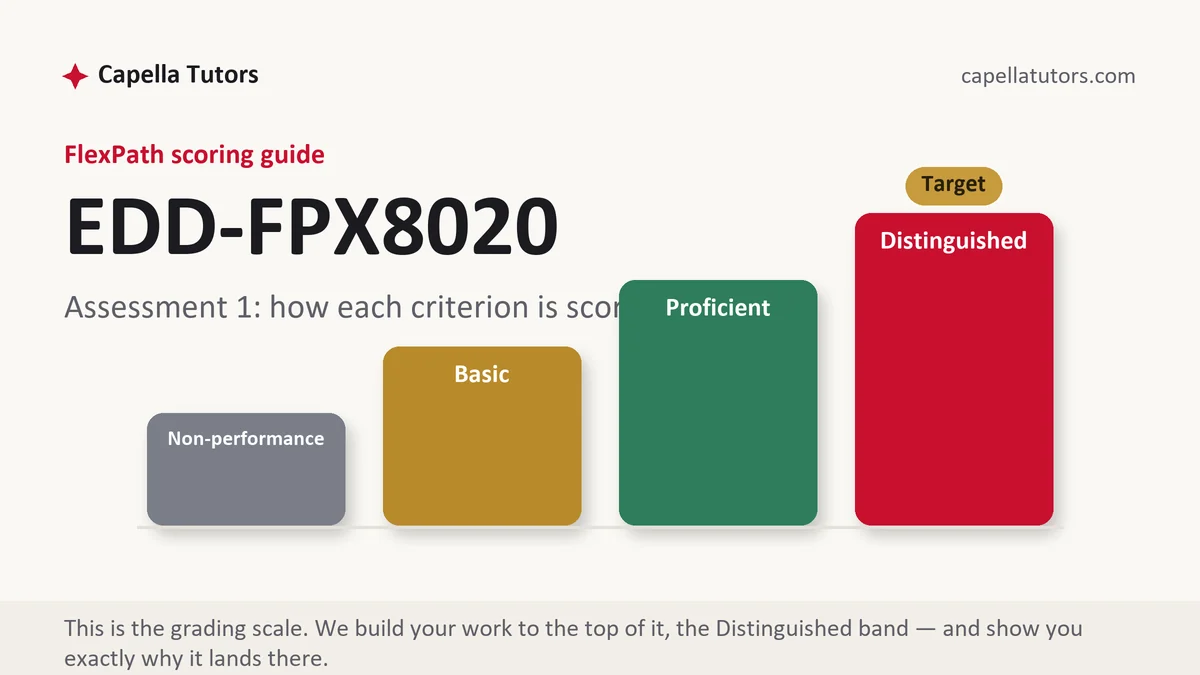
How EDD FPX 8020 Assessment 1 is scored
FlexPath scores each criterion at one of four levels rather than awarding a grade, and the level descriptions are the instructions:
| Level | What it means on an organizational diagnosis |
|---|---|
| Distinguished | The current result is explained by the arrangement producing it, more than one frame is tried with the better fit chosen openly, and the paper says why the problem outlived the last two remedies. That survival question is where the top column usually hides. |
| Proficient | The organization is described accurately and the assigned theory is applied correctly. Solid diagnosis, a level under work that explains persistence. |
| Basic | A clear account of what the district did and when. Chronology rather than causation, and the most common shape submitted in this course. |
| Non-performance | A required element is absent, most often any use of the assigned frameworks, or any evidence about the organization beyond the writer's impression. |
Diagnosis is graded harder here than prescription, which surprises people who arrive from a leadership role. A recommendation is easy to write and impossible to evaluate; an explanation of why today's result is the predictable output of today's design is the thing a committee can test against your evidence.
The EDD FPX 8020 Assessment 1 method, step by step
-
Write the routine down before you name the problem
Describe what actually happens, step by step: who does what, at what point in the day, using which form, and what follows if nobody does it. Most problems in schools live inside a routine that no single person owns, and you cannot see that until the routine is on paper in its unflattering detail.
-
Ask what the current design is optimized for
Every arrangement produces its results reliably, which means it is succeeding at something. Chris Argyris and Donald Schön separated correcting an error from questioning the assumptions that made the error sensible in Organizational Learning in 1978, and the second question is the graded one. Say what the district would have to stop believing for this problem to look solvable.
-
Read the same event through more than one frame
Lee Bolman and Terrence Deal set out structural, human resource, political and symbolic readings in Reframing Organizations, and the discipline is to try at least two before choosing. Most drafts reach for structure without noticing they have, then recommend a reporting-line change for a problem that was about status all along.
-
Trace the decision from the office to a lesson
Karl Weick described educational organizations as loosely coupled in Administrative Science Quarterly in 1976, and that idea explains more failures than resistance ever has. Follow one adopted policy through every handoff and mark the point where it stops changing what an adult does. That point, evidenced, is the centre of your diagnosis.
-
Explain why the previous remedy did not hold
List what has already been tried, state the assumption behind each attempt, and identify which assumption turned out to be wrong. A problem that has survived two serious efforts is telling you something about the system, and a paper that skips the earlier attempts is answering an easier question than the one asked.
-
Evidence the diagnosis with documents rather than adjectives
Board minutes, master schedules, the improvement plan, the professional development calendar, job postings and your own observation notes are all citable, and each one is stronger than a sentence about culture. Name the document, say what it is, and say what it shows.
A structure that maps to the criteria
Planning targets for a diagnosis of ordinary scope rather than Capella requirements; weight the sections your own guide weights.
| Section | What it must do | Guide |
|---|---|---|
| The organization as it stands | Structure, staffing, routines and incentives, described so a reader could find the problem without you. | ~250 words |
| The result being produced | The outcome with its count and window, beside the routine that reliably generates it. | ~250 words |
| Frames applied | The event read through at least two frames, with the better fit chosen and the choice defended. | ~300 words |
| Where the decision stops travelling | The handoff at which the policy loses force, evidenced rather than asserted. | ~250 words |
| Why earlier fixes did not hold | The remedies already tried, what each assumed, and which assumption was wrong. | ~250 words |
| Implications and references | What this diagnosis licenses anyone to attempt next, seventh edition APA throughout. | ~150 words |
Annotated sample excerpt
An original diagnostic passage from our team, written at the level the top descriptor asks for.
The board adopted a thirty-minute daily intervention block for all five elementary schools in 2023, funded it with two additional interventionists, and printed it on every master schedule.1 Visiting twelve classrooms across three buildings last October, I found the block running in nine of them, and in six of those nine it was being used for whole-class review of the morning lesson rather than for the small-group work the adoption memo described.2 The block was never resisted; it was absorbed, which is what happens when a decision arrives with a time slot attached and no change to what a teacher is expected to know how to do inside it.3
- 1Establishes that the decision was made, funded and published, so the analysis cannot be waved away as an implementation excuse.
- 2Reports what the writer observed, with counts and a date. That is the difference between a diagnosis and an opinion about teachers.
- 3Names the mechanism. Absorbed rather than resisted is a claim about the design of the change, and it points the recommendation somewhere useful.
The full premium sample for your exact assessment, written fresh to your scoring guide and issue, is free to request. Study it, revise it into your own voice, and submit work you understand.
The five mistakes that cost Distinguished
- Chronology offered as analysis. A dated account of what the district tried leaves the question of why the result survived unanswered.
- One frame applied without noticing it. A structural answer to a political problem produces a reorganization that changes nothing.
- Teachers installed as the cause. Resistance is evidence about the change, and treating it as a defect in people forfeits the diagnosis criterion.
- A diagnosis with no document behind it. Culture is not evidence. A schedule, a memo or an observation count is.
- The favoured fix visible in the analysis. Reasoning backward from a solution you already like shows up as a diagnosis with exactly one branch.
Pre-submission checklist
- The routine written out step by step, with the owner of each step named
- What the current design is optimized for, stated plainly
- At least two frames applied and the better fit defended
- The handoff where the decision stops changing adult behaviour, evidenced
- Every earlier remedy named with the assumption that failed
- Each organizational claim tied to a document or an observation, seventh edition APA
Diagnosis due and the system will not sit still?
Send the prompt, the criteria, and the initiative you are being asked to analyze. A premium original sample returns in 24 to 48 hours with your organization diagnosed as a system, each framework credited to the scholar who built it, and revisions carried free until the criteria are met.