This manual is for DB FPX 9803 Assessment 3, start to submission. Assessment 3 of DB FPX 9803, Project Results, usually asks for the interview half of the chapter: themes defined rather than labelled, source counts given as fractions of participants, quotations chosen because a paraphrase would lose something, and the participants who disagreed reported in their own right. Your scoring guide decides how much of each the submission carries. The method our tutors use follows, with the structure it produces and an annotated excerpt. Would you rather it were drafted? One premium original sample of this deliverable comes back in 24 to 48 hours, revised at no cost until every criterion clears. Capella's catalog lists the course as DB-FPX9803, and some courserooms print DB9803; both point to this same Assessment 3.
One honesty note before the manual: Capella revises courses and scoring guides over time, so always write to the exact scoring guide attached to your assessment in the courseroom. The course identity above is verified on capella.edu; the method and structure below are our tutors' approach to it, not Capella's official rubric text.
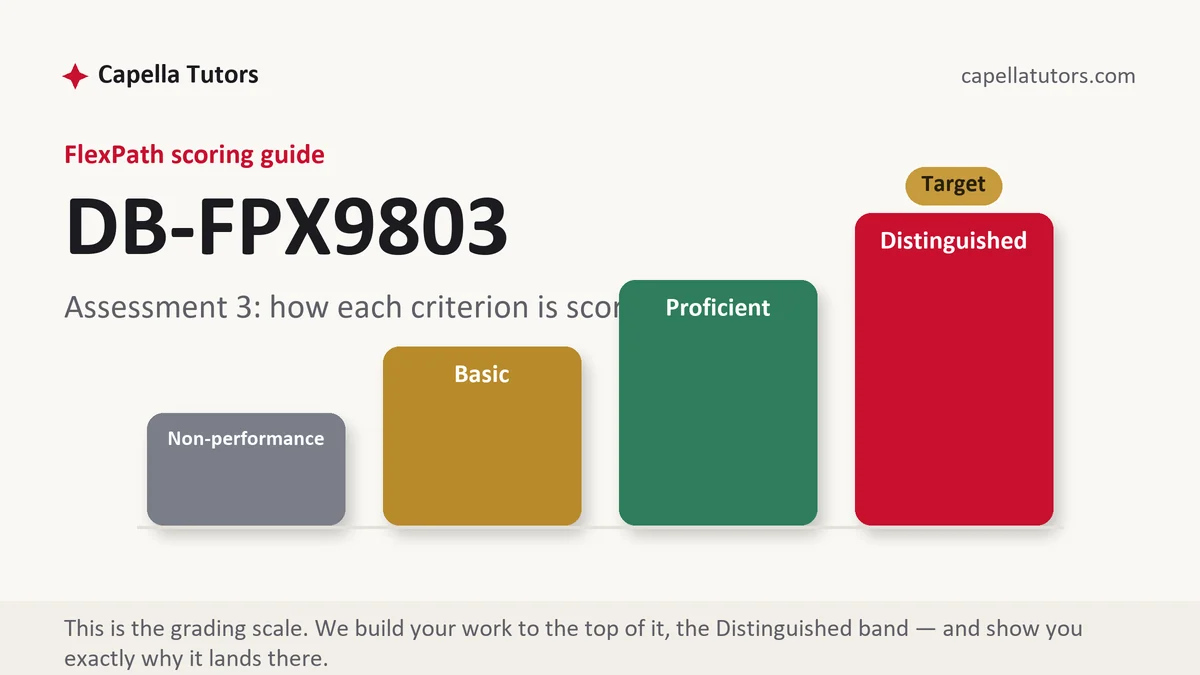
How DB FPX 9803 Assessment 3 is scored
There are no letter grades in FlexPath. Each criterion on the scoring guide lands on one of four levels, and the level language is the writing brief:
| Level | What it means on a qualitative findings submission |
|---|---|
| Distinguished | Themes carry definitions, counts and evidence, the contrary case is reported rather than smoothed, and the boundary of what interviews can show is stated by the writer first. The extra move is naming the theme resting on one articulate voice. |
| Proficient | Themes are supported and clearly presented. Sound, and still saying most participants where a fraction was available. |
| Basic | Theme labels with quotations underneath, no definitions, no counts, and the disagreeing participant absent. |
| Non-performance | A required element is missing, most often the analytic procedure that produced the themes, or evidence for a theme asserted only in the text. |
Interview findings are graded on evidence rather than on eloquence, and the arithmetic discipline is the same as on the quantitative side, so eleven of seventeen is a report while most participants is an impression. This is also the last place where restraint is cheap, because any interpretive claim allowed in here has to be defended twice, once in the discussion and again in the closing review, where a reader traces every claim back to the evidence behind it. Give each theme its definition, its source count and its quotations now, and the final course becomes an audit you pass rather than a rewrite you fund.
The DB FPX 9803 Assessment 3 method, step by step
-
Describe the procedure that produced the themes
Name the coding approach, how many passes the transcripts took, who else coded and on what share, the agreement reached, and where the audit trail of coding decisions lives. Memos written during analysis count as evidence; memos written afterwards are reconstruction.
-
Define each theme before illustrating it
A definition and a boundary: what the theme covers and what a coder should have excluded. A label with quotations under it leaves the reader to guess the boundary, and two readers guessing differently is how a theme stops meaning anything.
-
Count sources and report them as fractions
Twelve of seventeen, not most. Counting participants rather than coded segments keeps one talkative interview from inflating a theme, and a fraction lets a reader weigh the theme without asking you to.
-
Choose quotations that carry information
Take the sentence a paraphrase would flatten, trim it without changing its meaning, and attribute it at the level your approved confidentiality mechanism allows. Three well chosen quotations beat nine, and a block quotation followed by a restatement is transcription rather than analysis.
-
Report the participants who disagreed
The contrary case gets a paragraph of its own, with whatever condition distinguishes those participants from the rest. Smoothing them out is the single thing a reviewer is most likely to catch, because the transcripts are in the appendix.
-
Flag the single-voice theme and draw the boundary
A theme carried by one articulate participant is a hypothesis, and saying so protects everything around it. Then state what interviews in one organization can establish and what they cannot, before the discussion is obliged to.
A structure that maps to the criteria
The targets below are our tutors' planning figures for a qualitative findings submission, not Capella rules; your scoring guide decides how much each criterion needs.
| Section | What it must do | Guide |
|---|---|---|
| Analytic procedure | How coding was done, how many passes, who else coded, and what agreement was reached. | ~300 words |
| Participants in aggregate | Who took part, described at the level your confidentiality mechanism allows, with the spread of roles and tenure. | ~200 words |
| Themes, defined and evidenced | Each theme with a definition, a boundary, a source count as a fraction, and quotations that carry information. | ~900 words |
| Disconfirming cases | The participants who described the opposite, reported in their own paragraph rather than as an exception. | ~250 words |
| Theme strength and weight | Which themes many voices carry, which rest on one, and what that difference does to the reading. | ~200 words |
| Boundary and references | What interviews in one setting can and cannot establish, with current APA throughout. | ~200 words |
Annotated sample excerpt
An original model excerpt from our team, written on a family-business scenario, showing a theme carried by definition, count and evidence. Learn the moves and build your own from your own transcripts.
Deferred authority, defined as assigning a title without transferring the decisions the title implies, was described by 12 of the 17 participants and appears in all three branch regions.1 A second-generation manager put the mechanism in a sentence no paraphrase carries: the letter said general manager, and the credit limit still stopped at my father's desk.2 Two participants described the reverse sequence, reporting that spending authority arrived before the title and that the delay sat on the announcement rather than on the decision rights, and both work in the region where the founder had already withdrawn from daily operations.3
- 1The theme is defined before it is illustrated, and the count arrives as a fraction of participants rather than as a claim about most of them.
- 2One quotation carrying what no summary could, attributed by role rather than by name, consistent with the confidentiality mechanism approved earlier.
- 3The disconfirming cases get their own sentence with the condition that distinguishes them, which is evidence rather than an exception to be managed.
The full premium sample for your exact assessment, written fresh to your scoring guide and setting, is free to request. Study it, revise it into your own voice, and submit work you understand.
The five mistakes that cost Distinguished
- Themes named but never defined. A label with quotations underneath leaves a reader guessing what was included and what was not.
- Most participants offered as a count. Twelve of seventeen is auditable, and most is a word that survives any number.
- Quotations left to do the analysis. A block quotation followed by a restatement is transcription, and the criterion pays for the reading you performed.
- The contrary case smoothed away. Two participants who described the opposite are a finding, and losing them is what a reviewer notices in the transcripts.
- A theme resting on one voice. One articulate participant produces a hypothesis, and calling it a theme without saying so overstates the evidence.
Pre-submission checklist
- The coding procedure described, including passes, second coder and the agreement recorded
- Every theme carries a definition and a boundary before any quotation appears
- Source counts given as fractions of participants, never as most or many
- Quotations attributed at the level your approved confidentiality mechanism allows
- Disconfirming cases reported in their own paragraph with the condition that distinguishes them
- Single-voice themes flagged as such, and the boundary of the interviews stated before the discussion
Transcripts coded and the themes will not hold?
Send the transcripts or the coded file with your guide. A premium original sample returns inside 24 to 48 hours with each theme defined, counted as a fraction of participants, evidenced by quotations chosen for what they carry, and the disconfirming cases written up rather than tidied away. Attribution follows the confidentiality mechanism your protocol approved, and revisions run free until the criteria clear.