This manual is for DB FPX 9803 Assessment 2, start to submission. Assessment 2 of DB FPX 9803, Project Results, usually asks for the findings themselves: one subsection per research question, answered in the order the questions were asked, each test reported with its effect size and interval, and each result translated once into the language a decision maker uses. The guide treats each question as its own criterion. Below is the method our tutors apply, the structure it yields, and an annotated excerpt. Prefer to delegate it? A premium original sample of this exact deliverable arrives within 24 to 48 hours, revised without charge until the guide is satisfied. Capella's catalog lists the course as DB-FPX9803, and some courserooms print DB9803; both point to this same Assessment 2.
One honesty note before the manual: Capella revises courses and scoring guides over time, so always write to the exact scoring guide attached to your assessment in the courseroom. The course identity above is verified on capella.edu; the method and structure below are our tutors' approach to it, not Capella's official rubric text.
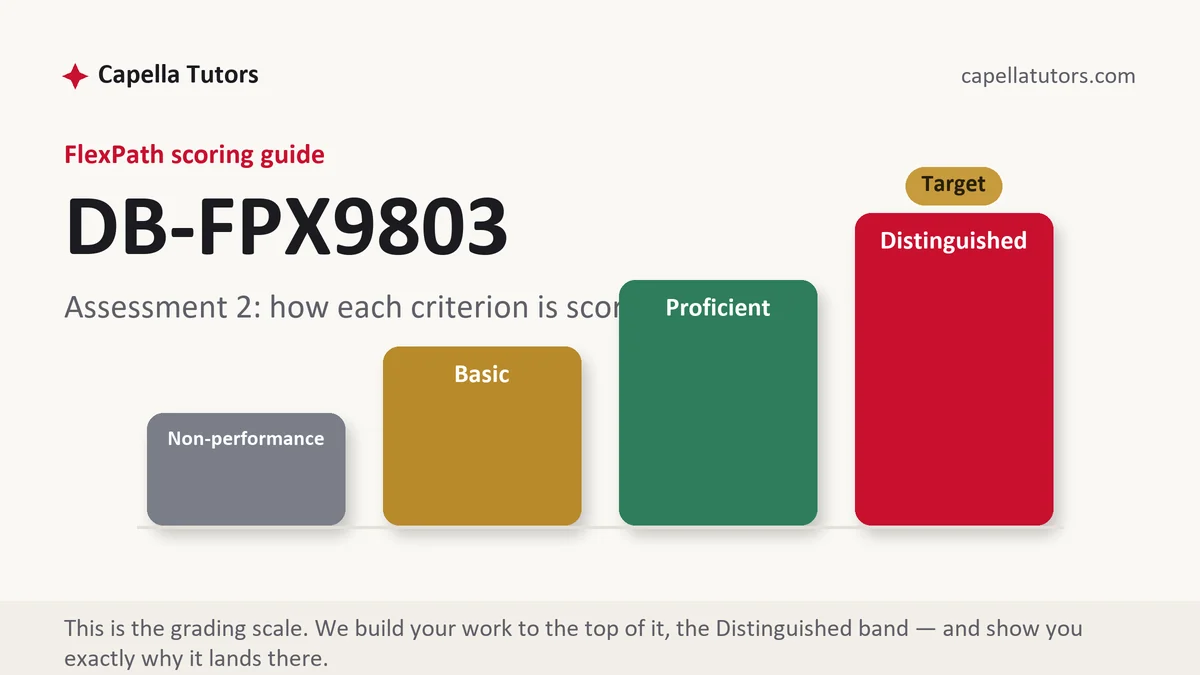
How DB FPX 9803 Assessment 2 is scored
There are no letter grades in FlexPath. Each criterion on the scoring guide lands on one of four levels, and the level language is the writing brief:
| Level | What it means on a findings submission |
|---|---|
| Distinguished | Each question is answered in one quotable sentence carried by a fully reported test, and the practical meaning is stated in figures somebody could act on. The extra move is saying plainly which reading the design cannot support. |
| Proficient | Every question is answered and every test is reported correctly. Solid, and still leaving the reader to work out what the number is worth. |
| Basic | Findings reported as p values with adjectives attached, in the order the software produced them rather than the order the questions were asked. |
| Non-performance | A required element is missing, most often a question left unanswered, or a finding with no test behind it in any table. |
Statistical significance belongs to the sample and practical significance belongs to the business, and a doctoral results chapter holds both without confusing them, which means a difference that is real and worth almost nothing gets described as both, in that order. The reporting decisions taken here also set up the closing stage: a finding sentence already carrying magnitude, precision and boundary lifts into the discussion and the abstract unchanged, while one carrying only a p value has to be rebuilt twice, and the abstract version will drift from the table. Write each sentence as though it is being copied forward, because it is.
The DB FPX 9803 Assessment 2 method, step by step
-
Answer in the order the questions were asked
One subsection per research question, numbered as the proposal numbered them, whatever order the analysis actually ran in. A chapter organized by output tells a reviewer it was assembled rather than written, and alignment is the criterion that notices.
-
Report the whole test every time
Statistic, degrees of freedom, exact p value, effect size and, where the analysis supports one, a confidence interval. A p value on its own says something is unlikely to be noise without saying how much of anything is there, which is the question a committee asks next.
-
Write the finding sentence under the table
One sentence a reader could quote, stating what happened and nothing about why. If the sentence needs a second clause beginning with because, that clause belongs in the discussion and the criterion will find it here.
-
Translate once, into volume or money
Convert the magnitude into the unit the organization already tracks: accounts, days, separations, dollars. Show the arithmetic in one line and name the assumption it rests on, because an untested assumption stated is defensible and an untested assumption hidden is not.
-
Report the result that refused to appear
A non-significant estimate still carries information, so give it with its interval and read the width. An effect of 0.03 bounded between minus 0.09 and 0.15 says the relationship is small; the same estimate bounded between minus 0.58 and 0.64 says the study could not see anything.
-
Police the verbs, then check the census
Associated with, higher among and differed by are verbs a cross-sectional design can keep, while drove and improved are not. Finish by confirming that every figure in the prose appears in a table with the same digits, since that is the check the closing course runs first.
A structure that maps to the criteria
Word counts below are our tutors' planning targets for a findings submission at doctoral level, not Capella requirements; expand wherever your scoring guide asks for more.
| Section | What it must do | Guide |
|---|---|---|
| Orientation to the findings | Which question is answered where, and the analysis used for each, in one short passage. | ~200 words |
| Findings by question | One subsection per question, each with its analysis, its full statistical report and one finding sentence. | ~900 words |
| Tables and figures | One table per question, titled and noted so it can be read away from the prose. | as needed |
| Practical translation | What the magnitude is worth in volume, days or money, with the assumptions of the conversion stated. | ~300 words |
| Null and unexpected results | Estimates that missed significance, reported with intervals and read for precision rather than skipped. | ~250 words |
| Boundary statement | What the design supports and what it does not, placed before the discussion asks for it. | ~200 words |
Annotated sample excerpt
An original model excerpt from our team, written on a payments scenario, showing one finding reported and then translated once. Study the order, then apply it to your own tests.
Across the 1,940 small-business accounts eligible for renewal in the study window, each additional point on the onboarding contact index was associated with 1.62 times the odds of renewal, 95 percent CI [1.21, 2.17], p = .001, in a model classifying 71 percent of cases correctly.1 Stated as a finding: accounts whose first ninety days carried more structured contact renewed at higher rates than accounts that did not, and the interval places the smallest credible effect well above zero.2 Moving the observed renewal rate of 78.4 percent to 82 percent across this portfolio retains roughly 70 accounts a year, which at an average annual revenue of $2,280 is about $159,600 the business keeps, on the assumption that contact can be added without displacing the work it competes with.3
- 1The whole test in one sentence, with the denominator, the interval and the model's own performance, so magnitude and precision can be judged together.
- 2The finding sentence a committee can quote, stated without inference and without a verb the design cannot support.
- 3One translation into volume and money, with the assumption the arithmetic rests on named rather than buried in it.
The full premium sample for your exact assessment, written fresh to your scoring guide and setting, is free to request. Study it, revise it into your own voice, and submit work you understand.
The five mistakes that cost Distinguished
- A p value with nothing beside it. Significance with no effect size hides how small the difference might actually be.
- Percentages with no denominator. Seventy-one percent of what, across which weeks, is the first question a reader asks.
- Causal verbs laid over correlational evidence. Drove, improved and increased are promises a cross-sectional design cannot keep.
- Findings ordered by software. Answering question three first tells a reviewer the chapter was assembled from output rather than written.
- The inconvenient result left out. A reviewer who finds it in your tables and not in your text stops trusting the tables as well.
Pre-submission checklist
- One subsection per research question, in the order the questions were asked
- Every test reported with statistic, degrees of freedom, exact p value, effect size and interval
- A single quotable finding sentence under each table, carrying no inference
- One practical translation into volume, days or money, with its assumption stated
- Estimates that missed significance reported with intervals and read for precision
- Verbs checked against the design, and every figure in the prose present in a table with the same digits
Findings written and the magnitude missing?
Send the output or the file, the questions and the guide. A premium original sample returns inside 24 to 48 hours with one subsection per question, each test reported in full, the finding sentence sitting under its table, and the practical translation costed with its assumption named. Where the data will not support the planned test we say so in the text and name the alternative rather than substituting quietly. Revision continues at no charge until every criterion clears.