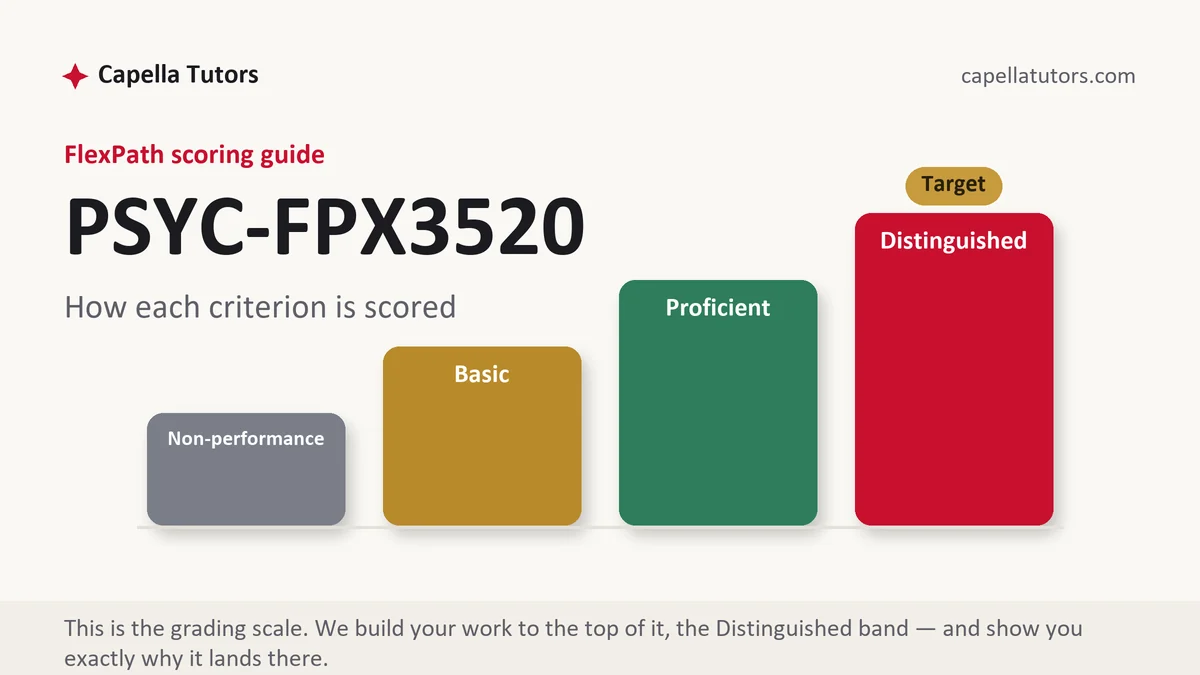
Send the prompt, the scoring guide, and the situation your assessment asks you to explain, and an original premium sample comes back within 24 to 48 hours, built to the Distinguished descriptors, read by a second person, and revised free until the criteria are satisfied. The course is listed as PSYC FPX 3520, Introduction to Social Psychology, in Capella's PSYC-FPX catalog. Its point value is not something we can confirm, and it was not on the General Psychology requirement list we verified, so check your own degree audit and catalog year before registering. Where a program does list it, a 3000-level number sits inside the band the BS in Psychology fills with at least 27 of its 90 points. In Capella's catalog the course code is written PSYC-FPX3520.
What PSYC FPX 3520 actually grades
Social psychology's central finding is that observers reliably underestimate how much the situation is doing. People watching a behavior reach for character, and people performing the same behavior point to circumstances, and that asymmetry is not a difference of opinion but a documented bias with a name. Every deliverable in this course tests whether you can resist it, which means the criteria reward an account that specifies what about the setting produced the behavior: who else was present, what the norm in that room appeared to be, what the person believed was expected, and what it would have cost them to act otherwise. A paper that explains a decision by calling the decider weak has answered a different question than the one the guide asked.
The second thing being graded is vocabulary that undergraduate papers routinely blur. Conformity is a change toward a group with no request made, compliance is a change following a direct request, and obedience is a change following an instruction from someone with authority, and the three run on different mechanisms. Conformity divides again, since going along because the group probably knows something you do not is a different process from going along because you do not want to be the odd one out, and naming which one your case involves is often a criterion by itself. Attitudes have their own machinery, with the discomfort of having acted against your own view being the standard route to changing that view, and the change requiring that the person feel the choice was theirs.
The third strand is groups, where this course becomes immediately useful. A group of like-minded people discussing a position typically ends up more extreme than its members started, teams under pressure with a directive leader and no channel for dissent make predictably worse decisions than their members would alone, and individual effort falls when contributions cannot be identified. Each of those has a countermeasure that a paper can recommend: collect independent judgments before discussion, assign someone to argue the other side, and make contributions visible. Prompts here often ask for exactly that turn from description to design.
How we help in this course
Our 3520 samples name processes rather than traits, and they report the evidence at its current strength rather than at the strength a textbook implies. Where a classic study is the right citation, the sample cites the original paper and says what later work did to the finding. Where the prompt supplies a scenario, the scenario's details carry the argument. Send us the assessment, the criteria, and the readings your section uses, and the draft will argue from your own material.
Commercially nothing here is special-cased. Each deliverable inside 24 to 48 hours, aimed at the Distinguished column, and routed through an eight-person pipeline before it reaches you, beginning with a research analyst on sources, then a psychology writer, then a reviewer who marks the draft against your scoring guide row by row, then an APA and originality pass, then an editor. Revisions stay free until the work meets the guide, and faculty feedback comes back into the same cycle at no charge.
The assessments, one by one
Assessment 1: Research Breakdown
Break down a social psychology study into its hypothesis, method, conclusions and application to everyday life. Read the full Assessment 1 manual.
Assessment 2: Self-Regulation
Analyze a case study through the concept of self-regulation, the research that supports it, its application, and the ethical reasoning involved. Read the full Assessment 2 manual.
Assessment 3: Thinking, Feeling, and Believing
Analyze a case through a social cognition concept such as confirmation bias, its research support, application, ethical reasoning and critical thinking. Read the full Assessment 3 manual.
How to actually write PSYC FPX 3520: where to begin
Work from the scoring guide outward. Each criterion becomes a heading, the Distinguished wording sits underneath it, and nothing enters the document that does not belong under one of them. The criteria in this course usually cluster as follows: describe the situation without explaining it, name the social process at work, support that process with research, address the obvious competing explanation, apply the analysis to something someone could change, and handle the ethics the material raises.
The competing explanation step is where marks are sitting unclaimed. Take a new employee who signs off on a report they believe contains an error. A situational account names the authority who asked, the absence of anyone else objecting, the ambiguity about whether the error is real, and the cost of being the only dissenter in a probationary period. A dispositional account says the employee lacks integrity. The strong paper writes the situational account, then explicitly tests the alternative by asking what would have to be true for character to be the better explanation, and notes what changed behavior in the studies where a single other person objected first. Nothing in the paper is longer, and one criterion moves.
Then handle the classics honestly, because this is the field where popular retellings have drifted furthest from the record. The famous obedience work produced very different rates across its variations, which is the actual finding rather than the single percentage everyone quotes, and its methods would not pass an ethics board now. The often-repeated story about a murder witnessed by dozens of indifferent neighbours is inaccurate in its particulars, while the underlying effect that responsibility diffuses as the number of bystanders grows has held up in later work. Several widely taught effects from this discipline shrank or disappeared in large multi-laboratory replications, and others held. Saying which is which, with a citation, is upper-division writing.
| Section | What goes in it | What Distinguished looks like |
|---|---|---|
| The situation | Who was present, what was asked, what the apparent norm was, and what dissent would have cost. | Description free of character language, so the analysis is not decided in advance. |
| The process | The specific social process named, with conformity, compliance, and obedience kept distinct. | The subtype identified, informational or normative, and justified from the details. |
| Evidence | Studies cited to their original reports, with sample, method, and year. | Replication status stated, and effect strength characterized rather than implied. |
| The rival account | The dispositional or alternative situational explanation, and why it fits less well. | A stated test: what would have to be observed for the alternative to win. |
| Application | A change to the setting, the incentives, or the procedure that follows from the process named. | An intervention aimed at the mechanism, with its likely limits acknowledged. |
| Ethics and sources | Consent, deception, and harm where research conduct is at issue, in current APA. | Ethical judgment applied to the specific study rather than described in general. |
Developing the synthesis
This field spent the last fifteen years auditing itself, and a paper that knows it reads differently from one that does not. Large coordinated replication projects re-ran well-known experiments across many laboratories and found a mixed picture: some effects reproduced at close to their original size, some came back much smaller, and a few did not appear at all, with several once-standard demonstrations of unconscious influence among the casualties. The response reshaped the discipline's methods, bringing preregistered designs, far larger samples, and published replication reports into normal practice. The useful consequence for your writing is a habit rather than a mood, since the question to ask of any finding you cite is how many people it was based on, whether anyone has repeated it independently, and how large the effect was when they did. Weigh that, then take your position anyway. A paper that reports a shrunken effect and still argues its case is doing what the top column describes.
Citations that survive faculty review
Four source types earn their place here. Peer-reviewed social and personality psychology journals, retrieved through the Capella library and PsycINFO, support the mechanisms and the applications. Classic studies get cited to the paper that reported them, since a textbook's retelling is where the popular distortions enter, and the original is usually short and readable. Replication reports and meta-analyses are worth citing directly when your claim depends on how strong an effect is, because they answer a question no single study can. National survey programs supply population figures when your prompt involves attitudes or group relations in real numbers, cited to the specific release. One reading habit does most of the work: check the sample and the setting before the conclusion, because a result from undergraduates in a laboratory and a result from a national sample support different sentences about people in general. Then confirm citations and references match both ways in current APA.
The mistakes that land Basic instead of Distinguished
- Using conformity, compliance, and obedience as synonyms. They are three processes with three mechanisms, and the criterion is often about the difference.
- Repeating the popular version of a famous study. The retold details are frequently wrong, and the original paper is the fix.
- Explaining a situation with character. The whole discipline exists because observers do that automatically, and rubrics here watch for it.
- Citing a textbook for a landmark experiment. Secondary summaries cannot be checked, and this is the field where they have drifted most.
- Treating a demonstration as a law. Give the effect a size and a replication status, or write it as a hypothesis.
PSYC FPX 3520 questions students actually ask
Is this the same course as PSYC FPX 2520, and which one counts for me?
They overlap in subject and differ on the requirement list, so the answer has to come from your own audit rather than from a catalog search. PSYC FPX 2520 Social Psychology in Action appeared as a named general education requirement in the listing we verified, worth 1.5 points. PSYC FPX 3520 appears in the PSYC-FPX catalog, and we did not find it on that requirement list and cannot confirm its point value. The practical step is to open your degree audit, find the requirement you are trying to satisfy, and confirm with an enrollment counselor which code fills it in your catalog year. The upper-division number matters separately, since the degree wants a minimum of 27 points at the 3000 level or above and a 2000-level course does not contribute to that total.
Should I still write about the classic obedience and conformity experiments?
Yes, and write about them accurately, which is more interesting than the version most students arrive with. Cite the original reports, give the year, and say what the variations showed, because the range of rates across conditions is the real result and the single headline figure is a simplification. Then add the two sentences that lift the paragraph: what the ethics review of that era permitted and would not permit now, and what later work using acceptable methods found about the same process. Faculty in this course have read the textbook summary several hundred times and have rarely read a student who knew the study had conditions.
How do I explain someone's behavior without excusing it?
Keep explanation and evaluation in separate paragraphs and say that you are doing so. A situational account describes the forces acting on a person and what made a particular choice likely, which is a causal claim. Whether the choice was right is a moral claim, and the research does not settle it. Write the mechanism first, then, if the prompt invites it, evaluate the conduct in its own paragraph while noting that understanding the pressure does not remove the responsibility. That structure answers the criterion asking for analysis, avoids the reading that social psychology excuses everything, and is the sentence pattern faculty in this course quote back approvingly.
Social psychology paper due?
Send the prompt, the scoring guide, and the situation you were asked to explain. We will build the account and state where the evidence has held up. Start with a free premium sample.