How to write PSYC-FPX3520 Assessment 1

The short answer

This manual is for PSYC-FPX3520 Assessment 1, start to submission. The opening deliverable in a social psychology course is usually the read-it-and-explain-it one: the assessment tends to hand you a situation, an advertisement, or a persuasion campaign and ask which social process is operating, in the field's own vocabulary, with research behind every claim. One practical note before you register, since the course page covers it in full: confirm on your own degree audit which social psychology code fills your requirement in your catalog year. Below is the method our tutors use for this deliverable, a structure that answers the criteria in order, and an annotated excerpt from an original model critique. Prefer to hand it over? A premium original sample built on your own case and scoring guide comes back in 24 to 48 hours, revised free until the criteria are met. Your courseroom may print this as PSYC FPX 3520 Assessment 1 or PSYC3520 Assessment 1; it is the same deliverable, and PSYC-FPX3520 Assessment 1 is what this manual walks through.

One honesty note before the manual: Capella revises courses and scoring guides over time, so always write to the exact scoring guide attached to your assessment in the courseroom. The course identity above is verified on capella.edu; the method and structure below are our tutors' approach to it, not Capella's official rubric text.
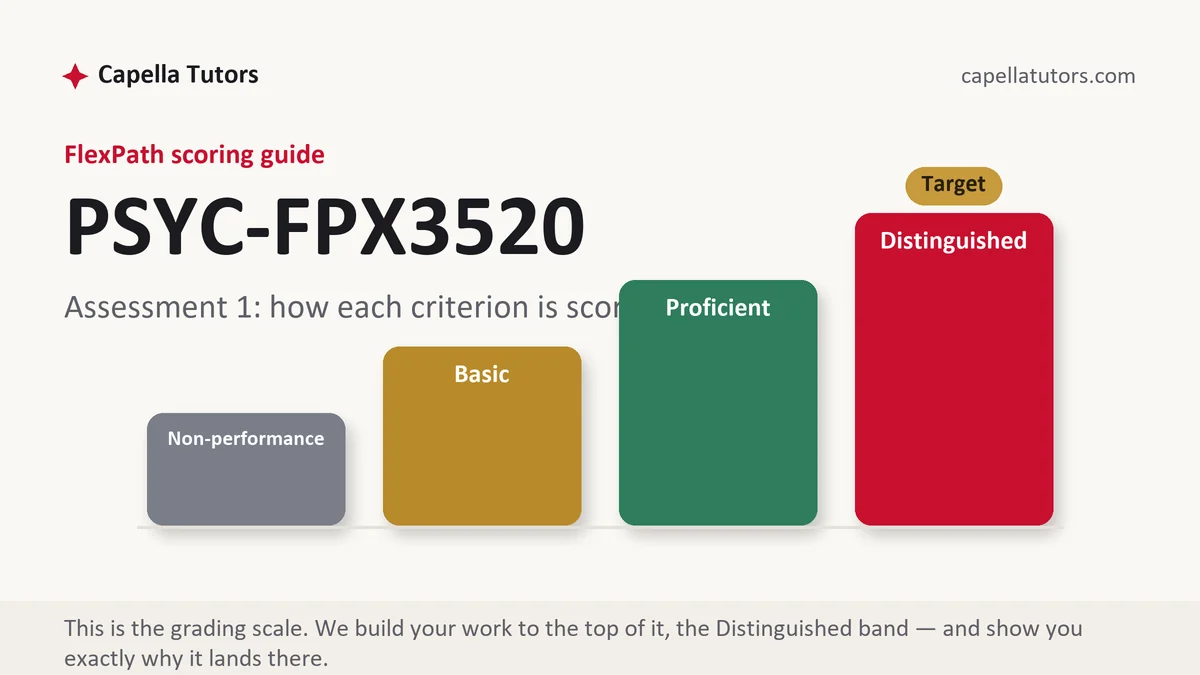
PSYC-FPX3520 Assessment 1 grading scale at Capella FlexPath, the criterion levels this assessment is scored on, from Capella Tutors
How Capella FlexPath grades PSYC-FPX3520 Assessment 1, visualized by Capella Tutors.

How PSYC-FPX3520 Assessment 1 is scored

Nothing here is graded as a percentage. Each criterion on your scoring guide is placed at one of four levels, and the level descriptions are the closest thing you will get to a model answer:

LevelWhat it means on an influence critique
DistinguishedEach technique is named as the research names it, the evidence behind it is reported at its actual strength, and the critique says which part of the campaign would stop working if that technique were removed. That last comparison is usually the criterion's own extra clause.
ProficientThe techniques are identified correctly and supported by sources. What is absent is the strength of the evidence, or a competing reading of the same material.
BasicThe campaign described accurately with psychology attached as vocabulary, roughly one term per paragraph and no mechanism connecting them.
Non-performanceA required element is missing, most often the research support or the ethical judgment the prompt asked for by name.

Write at the level of an upper-division undergraduate paper, which is more demanding than it sounds. It means the terms are used precisely rather than loosely, the sources are journal articles rather than summaries of journal articles, and nothing appears in the paper because it sounded like psychology.

The PSYC-FPX3520 Assessment 1 method, step by step

  1. Let the criteria write your headings

    Before you look at your case again, list the criteria down a page as headings and copy the Distinguished description under each one. The document you now have is the assignment. Every paragraph you write should be answerable to the heading it sits under, and any paragraph that is not belongs to a different assignment.

  2. Separate the technique from the message

    What a campaign says and how it is delivered are two different objects, and the criteria are almost always about the second. A donation appeal and a recruitment email can carry opposite content and run on the same mechanism, so start by listing the delivery devices: what arrives unasked, what is requested first, what other people are said to be doing, what deadline appears.

  3. Name the process, then name its subtype

    Conformity happens with nobody asking, compliance follows a direct request, and obedience follows an instruction from someone with standing to give it. Whichever you have, go one level finer: going along because the group probably knows something you do not is a different process from going along to avoid standing out, and the criterion often turns on which one you argue for.

  4. Cite the original report, never the retelling

    This is the field where popular versions have drifted furthest from what was actually published. Find the paper that first reported the effect you are using, give its year, and describe what its participants did. Textbook and website summaries cannot be checked by your evaluator, and in this discipline they are frequently wrong in the details that matter.

  5. Give every effect a size and a replication history

    Say how many people a finding rests on, whether an independent laboratory has reproduced it, and roughly how large it was when they did. Several once-standard demonstrations in this area came back much smaller in large coordinated replications and a few did not come back at all. Reporting that and still taking your position is the move the top column rewards.

  6. Keep the ethics separate, then self-score

    Explaining why a technique works and judging whether using it is defensible are two claims, and merging them costs the analysis criterion. Put the mechanism in one paragraph and the judgment in the next, say that you are doing so, and mark your own draft against each criterion before it leaves your desk.

A structure that maps to the criteria

These lengths are our own planning targets for a critique of this scale rather than anything Capella publishes; move words toward whichever criterion your guide spends the most sentences describing.

SectionWhat it must doGuide
The campaign, describedWhat arrives, in what order, addressed to whom, with the wording quoted where the wording is the technique.~200 words
The first techniqueOne device named in research vocabulary and traced to the behavior it is meant to produce.~250 words
The second techniqueA second device with a different mechanism, and why the two are not the same move twice.~250 words
Evidence and its strengthOriginal studies with their samples, plus replication status where the claim depends on the effect being large.~300 words
The competing readingAn account that explains the same response without your mechanism, and what would decide between them.~200 words
Ethics and referencesWhether the technique respects the person's ability to decide, then current APA matched both ways.~200 words

Annotated sample excerpt

A paragraph from an original model paper of ours, pitched where the guide's top column sits. Study the moves and then run them on your own case.

Sample excerpt: the two techniques Original model · Capella Tutors

The appeal arrives with a sheet of printed address labels the recipient never ordered, and the reply card asks for a first gift of five dollars rather than the monthly commitment the letter later describes.1 Those are two devices running on two mechanisms: an unrequested gift creates a sense of obligation that recipients rarely describe out loud and often deny when asked, while a deliberately small first request works because the second request then arrives at somebody who has already acted once.2 The distinction decides the critique, since the labels can be thrown away at no cost while the five dollars quietly changes how the donor would answer the question of whether they support this organization.3

  • 1Describes the physical mail before naming any theory, so the analysis has something specific to attach to rather than a general impression of the campaign.
  • 2Two techniques, two mechanisms, in one sentence each, and the note that people deny the first one is what shows the process was understood rather than looked up.
  • 3Compares the two devices instead of listing them. Comparison is what the analysis criterion is asking for and what most drafts leave out.

The full premium sample for your exact assessment, written fresh to your scoring guide and issue, is free to request. Study it, revise it into your own voice, and submit work you understand.

Get the full sample free

The five mistakes that cost Distinguished

  • Using conformity, compliance, and obedience as one word. They are three processes, and the criterion is often about the difference between them.
  • Citing a textbook for a landmark study. Secondary retellings cannot be verified, and this is the discipline where they have drifted most.
  • Treating a demonstration as a law. Attach a size and a replication history, or write the claim as a hypothesis and say so.
  • Explaining the audience by their character. Gullible, weak, and lazy are dispositional words, and the whole field exists because observers reach for them automatically.
  • Ethics as a closing sentence. If the prompt names ethics, it is a criterion, and one gesture at the end will be scored as one gesture.

Pre-submission checklist

  • Every criterion has its own heading, and nothing sits outside them
  • The campaign is described in concrete detail before any theory arrives
  • Two techniques named in research vocabulary, with distinct mechanisms
  • Each landmark study cited to its original report, with its year
  • Effect strength or replication status stated wherever the argument depends on it
  • Explanation and ethical judgment in separate paragraphs, current APA both ways

Need this critique finished?

Send the prompt, the scoring guide, and the campaign or case you were given. We will name the techniques, pull the original studies rather than the summaries, and write the ethics section as a criterion instead of a courtesy. First premium sample free.

Keep going

Online now