How to write PSYC-FPX3520 Assessment 3

The short answer

This manual is for PSYC-FPX3520 Assessment 3, start to submission. The closing deliverable in a course like this one is usually the one that asks for integration: two accounts of the same behavior, a reason for preferring one, and an application that follows from the preference. Attitude change is the topic most prompts choose for it, because the field has two long-standing explanations for why acting a certain way alters what a person believes, and choosing between them with evidence is exactly what a top criterion level describes. Below is the method, the structure, an annotated model excerpt, and the checklist we run before delivery. Want it drafted for you? A premium original sample written to your prompt and guide lands in 24 to 48 hours, revised at no cost until the criteria are satisfied. Your courseroom may print this as PSYC FPX 3520 Assessment 3 or PSYC3520 Assessment 3; it is the same deliverable, and PSYC-FPX3520 Assessment 3 is what this manual walks through.

One honesty note before the manual: Capella revises courses and scoring guides over time, so always write to the exact scoring guide attached to your assessment in the courseroom. The course identity above is verified on capella.edu; the method and structure below are our tutors' approach to it, not Capella's official rubric text.
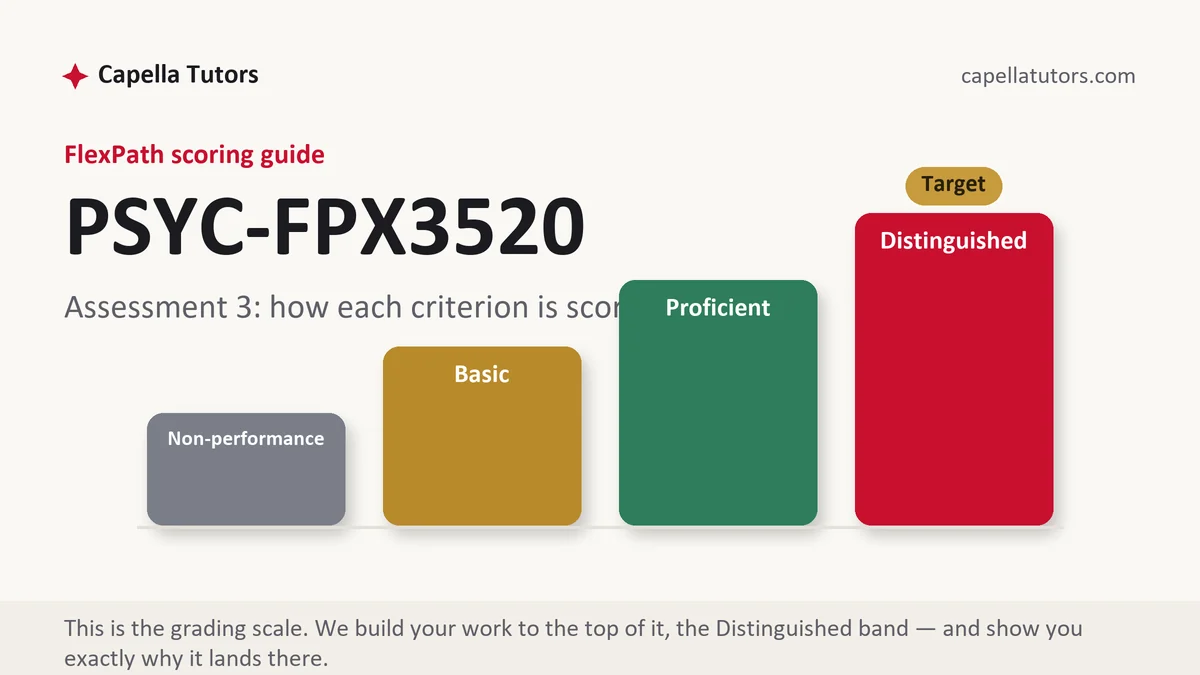
PSYC-FPX3520 Assessment 3 grading scale at Capella FlexPath, the criterion levels this assessment is scored on, from Capella Tutors
How Capella FlexPath grades PSYC-FPX3520 Assessment 3, visualized by Capella Tutors.

How PSYC-FPX3520 Assessment 3 is scored

Criterion by criterion, four levels each, and the level language is the specification you are writing against:

LevelWhat it means on an integrative paper
DistinguishedTwo theoretical accounts are stated fairly, a piece of evidence that distinguishes them is named, a choice is made on that basis, and the application follows from the choice rather than sitting beside it.
ProficientBoth accounts described correctly and one preferred. What is missing is the evidence that separates them, so the preference reads as a taste.
BasicTwo theories summarized in sequence, then an application that either theory would have produced. Accurate and unintegrated.
Non-performanceOnly one account appears, or the application contradicts the account chosen. A contradiction is graded as an absence here.

Integration is something a paragraph does, not a section you label. The evaluator is looking for a sentence in which both accounts appear and a piece of evidence decides between them, and that sentence usually sits about halfway through the paper.

The PSYC-FPX3520 Assessment 3 method, step by step

  1. Convert each criterion into a question you can answer

    Rewrite every criterion as a direct question and put it above the section that answers it. If you cannot phrase the question, you have not understood the criterion, and that is worth ten minutes of rereading before it becomes a resubmission.

  2. Start from the behavior, not from the theory

    Open with what somebody did and what changed afterward, in a described setting with a number in it. Theory earns its place by explaining that, which means it belongs on page two. Papers that open with definitions spend their strongest paragraph on material the criteria do not pay for.

  3. State both accounts in their own terms

    One account holds that acting against your own view produces discomfort, and that the cheapest way out of the discomfort is to revise the view. The other holds that people read their own attitudes off their own behavior the way an observer would, with no discomfort required. Write each one so its supporters would recognize it.

  4. Find the evidence that separates them

    The conditions matter and they are what the research turns on. Attitude change of the first kind depends on the person feeling the behavior was freely chosen and poorly justified, and studies that manipulate choice or measure discomfort speak directly to it. Behavior consistent with an existing view, produced without any pressure, is where the second account fits better. Name one study and what it found.

  5. Build the application on the account you chose

    If freely chosen effortful action is what shifts a view, the program you design creates opportunities to act with a genuine option to decline, and it stops paying people for the behavior it wants believed. Write that as a sequence with owners and dates, and note explicitly what your chosen account predicts would happen if the choice were removed.

  6. Handle the induced-compliance ethics, then self-score

    Arranging for people to argue against their own views in order to change them is a manipulation, and the criteria in this course notice when a paper does not say so. Address consent, the power relationship, and the difference between persuading and engineering. Then grade every criterion yourself before submitting.

A structure that maps to the criteria

Planning lengths from our own drafts rather than published requirements; the two middle rows are the ones to expand if your guide gives the comparison its own criterion.

SectionWhat it must doGuide
The behavior and the changeThe setting, the action, what shifted afterward, and the figure that shows the shift.~200 words
Account oneThe discomfort-based explanation with its conditions, cited to the work that proposed it.~250 words
Account twoThe self-observation explanation, stated at full strength rather than as a foil.~250 words
What decides between themEvidence that fits one and not the other, and the choice made out loud on that basis.~300 words
The applicationA program that follows from the chosen account, with owners, dates, and one indicator.~250 words
Ethics and referencesConsent, power, the manipulation named as one, and current APA matched both ways.~200 words

Annotated sample excerpt

One paragraph from an original model paper of ours, showing the sentence an integration criterion is actually hunting for.

Sample excerpt: what decides between the accounts Original model · Capella Tutors

Of the eleven staff at the cooperative cafe, the six who volunteered to explain the reduced-menu change to customers for two weeks later rated the change more favorably than the five who kept their usual stations, although all eleven had opposed it at the staff meeting in March.1 Both standing accounts predict that pattern, and they separate on one detail: the discomfort explanation requires that the six felt the extra duty was genuinely optional and thinly compensated, while the self-observation explanation needs neither condition and would predict the same shift in staff who were simply assigned.2 The volunteers here chose the duty, received nothing for it, and two described the first days as uncomfortable, which is the pattern the discomfort account was built on and the reason this paper argues from it.3

  • 1The behavior, the counts, and the change stated before any theory arrives, with the earlier opposition established so the shift is real rather than assumed.
  • 2Both accounts in one sentence with the point of separation named. This is the integration criterion being met rather than announced.
  • 3Checks the distinguishing conditions against the case and commits. Choosing out loud, with reasons, is what lifts this off the middle of the guide.

The full premium sample for your exact assessment, written fresh to your scoring guide and issue, is free to request. Study it, revise it into your own voice, and submit work you understand.

Get the full sample free

The five mistakes that cost Distinguished

  • Two summaries and a bridge sentence. If both accounts never appear in the same sentence, the integration criterion has not been attempted.
  • A preference with no evidence. Saying one theory explains it better, without the finding that shows so, reads as a preference for the theory you understood first.
  • Ignoring the conditions. The discomfort account holds under choice and weak justification, and a paper that drops those conditions has cited the wrong version of it.
  • An application either theory would produce. If your program survives switching accounts, the comparison you just wrote did no work.
  • Silence about manipulation. Designing behavior in order to change beliefs raises a consent question, and the guide expects you to raise it first.

Pre-submission checklist

  • Every criterion rewritten as a question and answered under its own heading
  • The behavior, the setting, and the change appear with numbers in the opening
  • Both accounts stated as their own supporters would state them
  • One sentence holds both accounts and names what separates them
  • The application follows from the chosen account and would change if the choice changed
  • Consent and power addressed, current APA both ways, and a self-score before submitting

Last deliverable of the course?

Send the prompt, the scoring guide, and the case you plan to argue from. We will state both accounts fairly, find the evidence that separates them, and build the application on whichever one wins. Start with a free premium sample.

Keep going

Online now