Any deliverable in this course can come off our desk as a premium original sample with a walkthrough, back in 24 to 48 hours. The identity, for the record: NURS FPX 6400, Nursing Informatics Fundamentals, 2 program points, the entry course of the Nursing Informatics specialization inside Capella's 27-point FlexPath MSN. This is where you stop writing as the nurse who uses the system and start writing as the nurse accountable for it. In Capella's catalog the course code is written NURS-FPX6400.
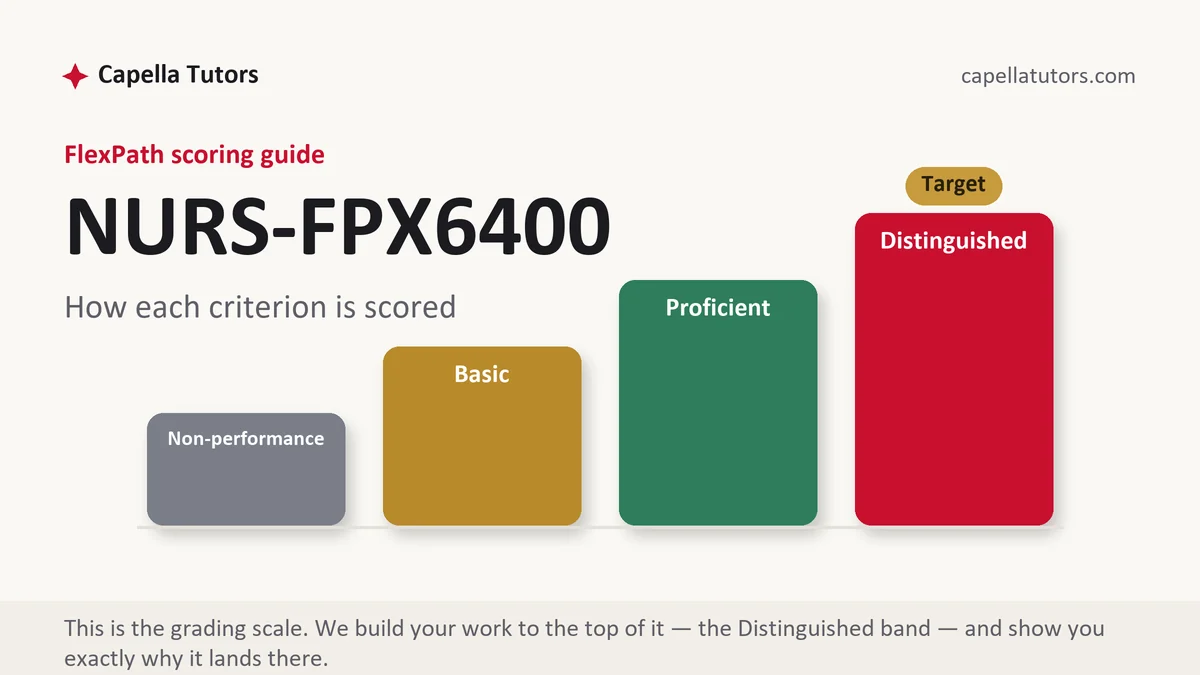
What NURS FPX 6400 actually grades
The course grades a change of position more than a change of topic. Undergraduate informatics work asks you to describe a technology you use on shift; 6400 asks you to speak for the data itself, across a program, to people who will act on what you say. Its criteria push on four things: the movement from data to information to knowledge treated as a working tool rather than a diagram, standards and terminologies named accurately, the informatics nurse's role stated as a set of accountable responsibilities on a project team, and privacy and security argued at the level of organizational controls instead of personal discretion.
The grading consequence is blunt. A warm account of an electronic record that helps your unit is Basic writing at master's level, no matter how well it reads. Distinguished writing in 6400 is writing a nurse executive could forward to an information technology director without translating it, because the terms are the terms both sides use and every claim has an owner attached.
How we help in this course
Send the scoring guide and one sentence about where you work, and the reply comes back with the criteria decoded and a delivery window. Our informatics writers hold graduate nursing credentials and have built these arguments before, so the draft arrives already speaking in program terms: a named setting, a named data element, the terminology standard that governs it, the committee that owns the access rule.
The machinery behind each order is the same one every course on this site gets. A research analyst reads your scoring guide and builds the source table before drafting starts. A subject-matched writer drafts to the Distinguished column, criterion by criterion. Two quality passes follow, one against the scoring guide and one for APA and originality. Delivery lands inside 24 to 48 hours, and revisions stay free until the work meets target.
From data to knowledge, written as a chain someone can audit
The four-level model is the most quoted and least applied idea in the course. Faculty have read the definitions hundreds of times; what they rarely see is one element carried the whole distance. Take a fall risk score keyed into a flowsheet at 0300. The score by itself is data. The score joined to unit, shift, and staffing level is information. The pattern showing that night-shift scores are recorded four hours after admission on one unit and at admission on another is knowledge. Deciding to move the documentation prompt, and knowing when a score should not override a nurse's read of the patient, is the judgment layer.
Written that way, each level has a location in a real system and each transition has a mechanism you can name. That is the difference between a paragraph the evaluator skims and a paragraph that earns the analysis credit.
The informatics nurse's role, with boundaries
Assessments in this course keep circling the role itself, and the reliable move is to describe it as a job with deliverables and limits. The informatics nurse elicits requirements from clinicians, reviews the build against how care is actually given, writes the test scenarios that mirror real shifts, trains and supports users, and escalates what the configuration cannot fix. The role recommends where clinical judgment is the evidence, and defers where security architecture or vendor code is the constraint.
The American Nurses Association's informatics scope and standards material is the right anchor for this section, and it beats a generic claim that informatics nurses bridge clinical and technical worlds. Say which artifact the role owns at each project stage, and the boundary question answers itself.
The assessments, one by one
Assessment 1
Send the scoring guide and this deliverable comes back as a premium original sample inside 24 to 48 hours, revised free until it meets the guide. Read the full Assessment 1 manual.
Assessment 2
This one can come off our desk as a premium original sample with a walkthrough, back inside 24 to 48 hours. Read the full Assessment 2 manual.
Assessment 3
Hand this one off and a premium original sample lands inside 24 to 48 hours, written to your scoring guide and revised free until it meets it. Read the full Assessment 3 manual.
Assessment 4
A premium original sample for this deliverable comes back inside 24 to 48 hours and stays in revision until it meets your guide. Read the full Assessment 4 manual.
How to actually write NURS FPX 6400: where to begin
Begin in the scoring guide, not the assignment prose. Copy each criterion into an empty document as its own heading, paste the Distinguished description underneath it, and write only into those sections. The criterion verbs at this level are analyze, evaluate, and recommend, so any section that merely describes has already capped itself at Basic before a word of it is wrong.
Then fix your ground and keep it. Choose one organization, one system or module, and one data element or process, and use them across the whole course rather than starting fresh each time. The assessments in this course tend to reward continuity, because an argument about governance gets sharper the second time you write about the same committee. Before drafting, write down four facts: what system holds the data, which terminology or code set the field uses, who approves access to it, and where the data goes when it leaves your unit.
Name the standards layer precisely, since this is the section where general writing is most obvious. Clinical findings and problems live in SNOMED CT, laboratory and observation names in LOINC, coded diagnoses in ICD-10-CM, nursing plans in an ANA-recognized nursing terminology, and the messages that move between systems in HL7 formats. On the privacy side, treat the HIPAA Security Rule as a rule with parts: administrative, physical, and technical safeguards, role-based access built to minimum necessary, audit logging with a stated review cadence. Precision here reads as competence faster than any other paragraph in the paper.
| Section | What goes in it | What Distinguished looks like |
|---|---|---|
| Introduction and setting | The organization, the system, and the informatics problem you are speaking to. | A problem stated as a measurable gap in data use, not a claim that informatics matters. |
| Data to knowledge | One element traced through the levels, with the system location at each step. | Every transition names the mechanism that performs it and the person who acts on the result. |
| Standards and terminologies | The code sets and exchange standards that govern the data you chose. | The right terminology matched to the right field, with the local deviation named and its cost stated. |
| The informatics nurse's role | Responsibilities across the project, with deliverables per stage. | Boundaries drawn: what the role decides, what it recommends, what it hands off. |
| Privacy and security | Safeguard categories, access model, audit practice, and breach response. | Each control has an owner, a review interval, and a named failure mode. |
| Conclusion and references | The recommendation restated, one limitation, current APA sources. | The limitation is specific to your setting, such as a data element no one owns. |
Developing the analysis
Graduate analysis in informatics means visible tradeoffs. Put two defensible options side by side and choose between them in the open: a discrete coded field against free text in a nursing note, a local pick list against a mapped standard terminology, wide access with strong auditing against narrow access with slower care. State what the winning option costs, because an option with no cost is a recommendation nobody has tested. Then close the loop with a measure. If you argue for mapping a field to a standard terminology, say what you would count six months later to know it worked, and how you would tell a real improvement from a documentation change. Naming what your evidence cannot settle belongs here too; the Distinguished column pays for that sentence far more often than students expect.
Citations that survive faculty review
Build the source list in two layers. The peer-reviewed spine comes through the Capella library, CINAHL, and PubMed, and holds the claims about outcomes, adoption, and clinician behavior. The standards layer comes from bodies that publish the rules themselves: the American Nurses Association's informatics scope and standards, position papers and reports from AMIA, HIMSS resources on competency and governance, and federal material on healthit.gov from the Office of the National Coordinator. Hold the peer-reviewed sources to roughly the last five years, cite standards and government documents as reports in APA 7 form, and give every source a named job for a named criterion. One rule worth keeping: a vendor page is acceptable evidence of what a product claims and never evidence of what it achieves.
The mistakes that land Basic instead of Distinguished
- Definitions instead of application. Three paragraphs defining the data levels, no element ever traced through them.
- Terminology name-dropping. SNOMED CT and LOINC listed in one sentence with neither attached to a field in your system.
- The role as a metaphor. Bridge, liaison, and champion language with no deliverable behind it.
- Privacy as sentiment. A promise that patient data is protected, with no control, owner, or audit interval named.
- Bedside altitude. Writing at the level of one nurse and one shift when the criteria are asking about a program.
NURS FPX 6400 questions students actually ask
Which standardized terminology should I name?
Match the terminology to the data element instead of listing all of them. Clinical findings and problems map to SNOMED CT, laboratory and observation names to LOINC, coded diagnoses for billing to ICD-10-CM, and nursing plans to an ANA-recognized nursing terminology such as NANDA-I, NIC, NOC, the Omaha System, or the Clinical Care Classification. Then say which one your organization actually uses in the field you are writing about, and what breaks when a unit keeps a local pick list instead.
How do I write the data to knowledge chain without sounding like a textbook?
Run one real data element through all four levels rather than defining the levels in the abstract. Take a fall risk score keyed at 0300: the number itself is data, the number joined to unit and shift is information, the pattern across a quarter is knowledge, and the decision about when that score should and should not drive the care plan is wisdom. One element carried the whole distance beats four textbook definitions, because the criteria are measuring whether you can apply the model, not recite it.
How much privacy and security detail does a master's paper need?
Enough to name controls and their owners. At this level a sentence about protecting patient privacy scores Basic. Write instead about the HIPAA Security Rule's administrative, physical, and technical safeguard categories, role-based access built to minimum necessary, audit log review on a stated cadence, and the person or committee accountable for each. One control described with its owner, its review interval, and its failure mode is worth a paragraph of general caution.
In NURS FPX 6400 right now?
Send the assessment you are on and the scoring guide from your courseroom. The first premium sample is free and lands within 24 to 48 hours.