This manual is for NURS FPX 6400 Assessment 1, start to submission. Send the scoring guide and this deliverable comes back as a premium original sample inside 24 to 48 hours, revised free until it meets the guide. Assessment 1 of NURS FPX 6400 is the course's opening working document: you arrange a scheduled conversation with the people who will supervise and host your informatics work, then produce the written record of it. Your scoring guide decides the exact fields, and the assessment usually asks for a scheduling artifact plus notes that fix scope, objectives, data access, and dates. It looks clerical. It is the document that decides how easy or impossible the next three deliverables will be. Capella's catalog lists the course as NURS-FPX6400, and some courserooms print NURS6400; both point to this same Assessment 1.
One honesty note before the manual: Capella revises courses and scoring guides over time, so always write to the exact scoring guide attached to your assessment in the courseroom. The course identity above is verified on capella.edu; the method and structure below are our tutors' approach to it, not Capella's official rubric text.
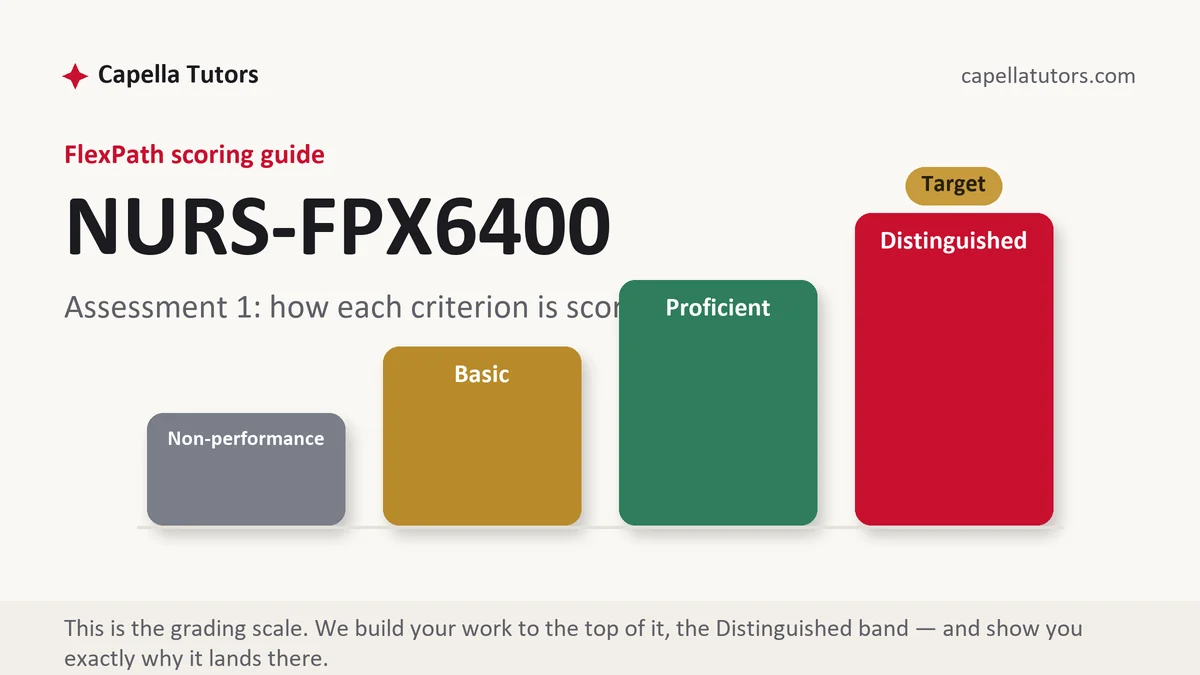
How NURS FPX 6400 Assessment 1 is scored
No criterion in FlexPath produces a letter grade. Each one lands on one of four levels instead, and the level language is the writing brief for a record like this one:
| Level | What it means on a documented planning conversation |
|---|---|
| Distinguished | The record reads like minutes an operations leader could act on: a scoped informatics problem, a named data source with a named access owner, a measurement window, decision gates carrying dates, and the point the group did not agree on. |
| Proficient | Every required field is filled and the conversation is summarized accurately. Complete, and still one move short, because a summary carries no accountability. |
| Basic | A pleasant narrative of who attended and what was discussed. The most common landing spot, since a description of a meeting is not a scope agreement. |
| Non-performance | A required element is absent, usually the objectives or the confirmed date and attendee list. Absent, rather than thin, is what puts a criterion on the floor. |
Read this record as the contract governing the rest of the course. Faculty assess your later work against the objectives written here, so a loose objective costs twice: once in this criterion, and again when a graded deliverable cannot be traced back to anything you committed to.
The NURS FPX 6400 Assessment 1 method, step by step
-
Draft the objectives before you book the call
Open a document and finish three sentences: by the end of this course I will have measured ___, using data from ___, to inform a decision made by ___. Objectives written first turn the conversation into a review rather than a brainstorm, and a reviewed objective is far more specific than an invented one. Bring them in writing so attendees edit words instead of generating them.
-
Fix the denominator before you fix the problem
Nurses arrive at informatics work carrying a numerator: the number of late entries, the number of unsigned orders, the count of alerts overridden. A count without a denominator cannot be compared to anything. Decide in this conversation what the denominator is, whether patient-days, encounters, orders placed, or eligible shifts, and write the measurement window beside it. Getting this on paper early is the single highest-value line in the record.
-
Bring an agenda made of decisions, not topics
An agenda item phrased as a topic produces discussion; an item phrased as a decision produces a record. Replace data access with who approves the report extract and by what date, and replace project scope with which two units are in and which are out. Every line on your agenda should be answerable yes, no, or a name.
-
Take the notes in the shape of the scoring guide
Set your note headings to the criteria before the call starts, then capture into them live. This is a documentation habit worth carrying past the course: a record organized by the assessment structure needs no reconstruction afterward, and reconstruction is where detail goes missing. Confirm spelling of names and exact titles in the moment rather than guessing later.
-
Write down what the group disagreed about
Records that report smooth consensus read as records nobody kept honestly. Name the point of contention, whose judgment sits on each side, and the gate that settles it: a date, a test, and who decides. The American Nurses Association's informatics scope and standards material describes the informatics nurse as accountable for exactly this kind of transparency, and the Distinguished column tends to pay for it.
-
Close the loop in writing within a day
Send the notes to every attendee with the agreements restated and a one-line request for correction, then log the date you sent them. That timestamp turns your document from a personal file into a shared reference, and it is the detail that lets you write in a later assessment that access was approved on a given date by a named person rather than that access was obtained.
A structure that maps to the criteria
Word counts are planning targets our tutors use for a record of this kind, not Capella rules; expand any section your scoring guide asks more of.
| Section | What it must do | Guide |
|---|---|---|
| Purpose and setting | The organization, the units or service lines in scope, and the informatics problem the conversation exists to bound. | ~120 words |
| Attendees and roles | Each participant named with the authority they hold, whether over the build, the data extract, the workflow, or the budget. | ~120 words |
| Objectives | Two or three objectives written as measurable commitments, each tied to a decision someone will make with the result. | ~200 words |
| Data, access, and measures | The source system, the fields, the denominator, the measurement window, and the person who approves the extract. | ~250 words |
| Agreements, disagreements, and gates | What was settled, what was not, and the dated gate with a named decider for each open item. | ~250 words |
| Follow-up and sources | Next dates, distribution of the notes, and any standards or policy documents the group agreed to work from, in current APA. | ~150 words |
Annotated sample excerpt
An original model excerpt from our team, written at the register these criteria reward. Study the moves in it, then build your own record around your own conversation.
Purpose: to bound a nursing documentation burden audit on two medical-surgical units before any data is extracted. Attending: the directors of 4 West and 5 East, the clinical informatics analyst who owns flowsheet build, and the health information management supervisor who approves reporting access.1 Agreed measures: flowsheet rows filed per patient-day, and recorded minutes inside the electronic record per twelve-hour shift, across the eight weeks from March 2 to April 26, with patient-days as the denominator and no unit-to-unit comparison drawn until the audit log extract has been screened for duplicate device sessions.2 Unresolved: the analyst holds that row counts overstate burden because template defaults file rows without nurse action, so the group set a gate for April 6, when 40 sampled shifts will be hand-reviewed and the measure kept, replaced, or split.3
- 1Identifies people by the authority they hold rather than by courtesy title. An access owner recorded here means no later deliverable stalls on a permission nobody actually granted.
- 2States the denominator and the measurement window before a single number appears, then withholds the comparison until a data-quality screen clears. That refusal to compare early is what marks graduate informatics work.
- 3Writes the disagreement down and attaches a date, a method, and a decision to it. Distinguished records show governance operating, rather than consensus performed for the reader.
The full premium sample for your exact assessment, written fresh to your scoring guide and issue, is free to request. Study it, revise it into your own voice, and submit work you understand.
The five mistakes that cost Distinguished
- Minutes as narrative. A chronological account of who said what, with no agreement extractable from it, reads as Basic no matter how carefully it was typed.
- Objectives with no measure. Improve documentation efficiency cannot be assessed later; reduce flowsheet rows filed per patient-day by a stated amount over a stated window can.
- Unowned data. Naming a source system without naming who approves access leaves the most predictable failure of the whole course sitting unaddressed in your own record.
- Manufactured consensus. A record in which everyone agreed is a record that hid the interesting part, and evaluators at master's level read that absence accurately.
- Unsourced footing. Even an administrative deliverable is graded on scholarly support, so anchor the informatics role in the ANA scope and standards material and cite policy documents as reports in APA 7 form.
Pre-submission checklist
- Every scoring-guide criterion appears as its own labeled section in the record
- Attendees listed with the decision authority each one holds, spelling confirmed
- Two or three objectives, each with a measure, a window, and a decision it feeds
- Denominator and measurement window recorded before any count or rate is named
- Each open item carries a dated gate and a named decider
- Notes distributed to attendees, distribution date logged, references in current APA
Want the record built with you?
Send the scoring guide and one line about the setting you are writing from. A team of eight, including a research analyst and two quality reviewers, returns a premium original sample written to the Distinguished column in 24 to 48 hours, with free revisions until it lands there. This is the deliverable every later assessment in the course leans on, so it is worth getting right on the first pass.