This manual is for NURS FPX 6400 Assessment 4, start to submission. A premium original sample for this deliverable comes back inside 24 to 48 hours and stays in revision until it meets your guide. Assessment 4 of NURS FPX 6400 is the course's regulatory deliverable. Your scoring guide decides the shape, and the assessment usually asks you to analyze the rules governing a specific piece of health data in your setting, then say what those rules require you to change: privacy and security regulation, exchange and information-blocking obligations, the standards that make data mean the same thing in two systems, and the ethical questions the rules leave open. Capella's catalog lists the course as NURS-FPX6400, and some courserooms print NURS6400; both point to this same Assessment 4. In current courserooms this assessment typically appears as "Exploration of Regulations and Implications for Practice".
One honesty note before the manual: Capella revises courses and scoring guides over time, so always write to the exact scoring guide attached to your assessment in the courseroom. The course identity above is verified on capella.edu; the method and structure below are our tutors' approach to it, not Capella's official rubric text.
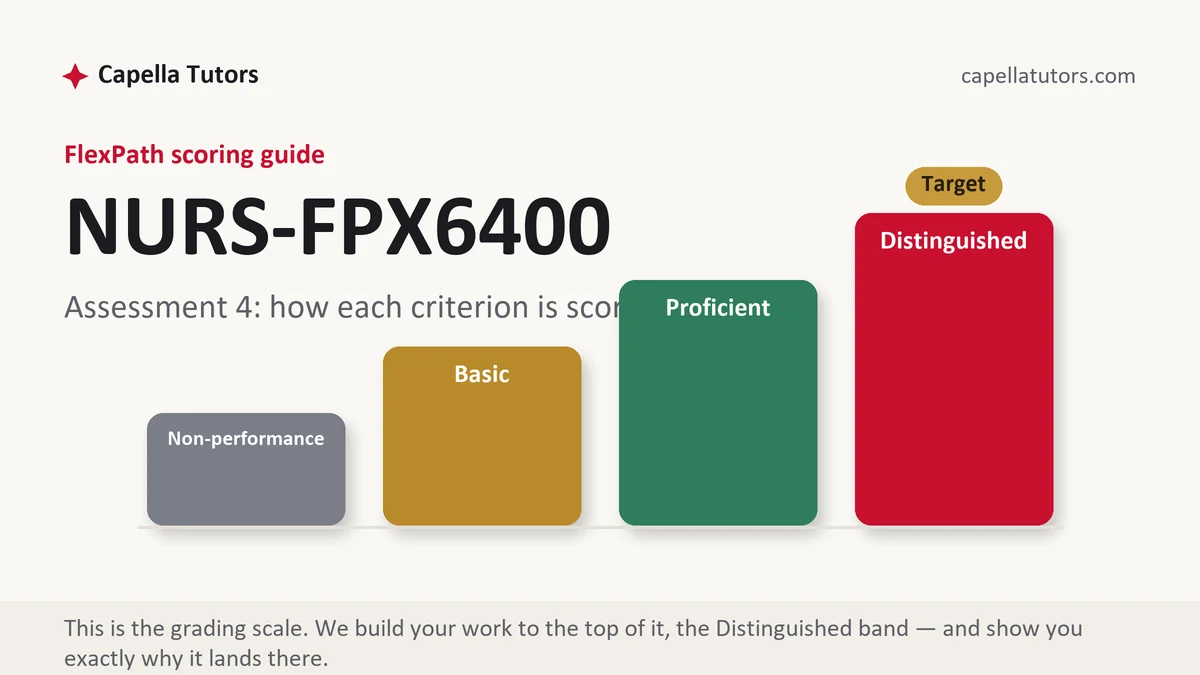
How NURS FPX 6400 Assessment 4 is scored
Each criterion resolves to one of four levels. On a regulatory analysis the levels sort almost entirely by specificity:
| Level | What it means on a regulation and standards analysis |
|---|---|
| Distinguished | Each rule is traced to a control, the control to an owner, and the owner to a review interval, with the ethical question the regulation does not answer stated plainly and taken seriously. |
| Proficient | The regulations are described correctly and applied to the setting. Accurate work that stops at compliance and never reaches accountability. |
| Basic | A summary of what the law says, arranged by statute, with the writer's own organization mentioned but never implicated. Correct, and capped. |
| Non-performance | A required criterion is unaddressed, commonly the ethical analysis or the implications for nursing practice. An unwritten section scores nothing. |
The trap in this deliverable is that regulation is easy to summarize and hard to apply. A paragraph restating the safeguard categories reads as coursework; a paragraph naming which safeguard your unit fails, who owns the fix, and when it is next reviewed reads as informatics practice.
The NURS FPX 6400 Assessment 4 method, step by step
-
Anchor the paper to one data flow
Choose a specific movement of data across an organizational boundary and keep it. A flow crossing a boundary is where regulation actually bites, because two entities, two systems, and two sets of obligations meet at that line. Describe the flow in four sentences before you cite anything.
-
Read the rule at the level of its parts
Regulation cited as a statute name is regulation not yet applied. Work at the level of the components: the administrative, physical, and technical safeguard families under the HIPAA Security Rule, the minimum necessary standard, breach notification timing, the information-blocking exceptions under the 21st Century Cures Act, and the certification and interoperability material published on healthit.gov. Name the part, then the field in your flow that it governs.
-
Attach every control to an owner and an interval
For each obligation, write a row: the requirement, the control that satisfies it, the person or committee accountable, the review interval, and the failure mode. A control with no owner is an aspiration, and an unowned control is the single most common real finding in any informatics review. Governance written this way also gives your later coursework a structure it can reuse.
-
Make the standards argument concrete
Interoperability obligations only mean something once you say what the receiving system does with the field. Match the element to its terminology, LOINC for laboratory and observation names, SNOMED CT for findings, and describe the mapping step: who maintains the map, how often, and what happens to a result that arrives with a local code and no mapping. Vagueness here is the most detectable weakness in the paper.
-
Separate the legal question from the ethical one
Compliance and ethics are not the same analysis, and the criteria usually want both. A disclosure can be permitted and still corrode trust; a restriction can be lawful and still delay care. State the tension, name the interests on each side, and say which way you would decide and why. Refusing to reduce ethics to a compliance checklist is a graduate-level move.
-
Build the source list in two layers
The regulatory layer comes from primary and federal material: the rule text itself, ONC and healthit.gov resources including the SAFER guides, and professional standards such as the ANA informatics scope and standards. The scholarly layer comes from peer-reviewed informatics journals and AMIA or HIMSS publications, and it carries the claims about what the rules do in practice. Cite regulations and agency documents as reports in APA 7, and hold the empirical sources to roughly five years.
A structure that maps to the criteria
The word targets below are our tutors' planning proportions for a regulatory analysis, not Capella requirements; your scoring guide governs the final shape.
| Section | What it must do | Guide |
|---|---|---|
| The data flow in scope | The two entities, the elements moving between them, and why this flow is the one worth analyzing. | ~200 words |
| Privacy and security obligations | The safeguard families and access standards mapped to the specific fields and systems in your flow. | ~300 words |
| Exchange and interoperability rules | The obligations to share, their exceptions, and the terminology mapping that makes the shared data usable. | ~300 words |
| Controls, owners, intervals | A row per obligation: control, accountable owner, review cadence, and the failure mode it guards against. | ~250 words |
| The ethical question | The tension the rules leave unresolved, the interests in conflict, and your reasoned position on it. | ~250 words |
| Implications and references | What nursing practice changes as a result, one limit of your analysis, and current APA sources. | ~200 words |
Annotated sample excerpt
An original model excerpt from our team, showing regulation applied rather than recited. Take the pattern and rebuild it around the flow you know.
Results from the regional reference laboratory arrive over an HL7 interface, and 9 of the 34 assay names in the current feed carry the laboratory's local codes with no LOINC mapping, so those results land as text in the miscellaneous results section rather than as discrete values a trend view can read.1 The obligation is not only technical: under the information-blocking provisions of the 21st Century Cures Act, practices that make electronic health information harder to access or use require an applicable exception, and interface convenience is not one of them.2 The control we recommend is a quarterly mapping review owned jointly by the laboratory's interface analyst and our own terminology steward, with unmapped assays reported to the health information governance committee and a named failure mode: an unmapped result reaching a clinician without the flag that tells them the value is not trendable.3
- 1Quantifies the gap inside the flow, 9 of 34, and says exactly what the receiving system does with the unmapped results. The regulatory argument now has something to attach to.
- 2Applies the rule at the level of its exceptions rather than naming the statute and moving on, and rejects the convenience defense explicitly. Precision like this is what the criterion is scanning for.
- 3Gives the control a review interval, two named owners, an escalation path, and a stated failure mode. Governance described this way could be adopted as written.
The full premium sample for your exact assessment, written fresh to your scoring guide and issue, is free to request. Study it, revise it into your own voice, and submit work you understand.
The five mistakes that cost Distinguished
- The statute tour. A paragraph each on the major rules, none of them touching a field, a system, or a person in your organization.
- Privacy as sentiment. An assurance that patient data is protected, with no safeguard family, owner, or audit interval anywhere in the section.
- Ethics collapsed into compliance. Answering the ethical criterion with a restatement of what the law permits is the fastest way to leave that criterion unearned.
- Interoperability without mapping. Arguing for data exchange while skipping who maintains the code map, and how often, leaves the analysis one layer above where the work happens.
- Aging regulatory citations. Rules are amended and guidance is reissued, so a five-year-old summary of a federal requirement is a factual risk as much as a sourcing one.
Pre-submission checklist
- One data flow named early and analyzed throughout, crossing an organizational boundary
- Regulations applied at the level of their parts and exceptions, not their titles
- Every obligation paired with a control, a named owner, a review interval, and a failure mode
- Terminology mapping described, including who maintains it and on what cadence
- An ethical tension stated and reasoned, distinct from the compliance analysis
- Primary regulatory and federal sources cited as reports in APA 7, empirical sources current
Want the regulatory analysis handled?
Send the scoring guide and the data flow you have in mind, or ask us to pick one that fits your setting. A research analyst assembles the regulatory and peer-reviewed layers before drafting starts, and the finished sample arrives inside 24 to 48 hours with revisions free until it meets the guide.